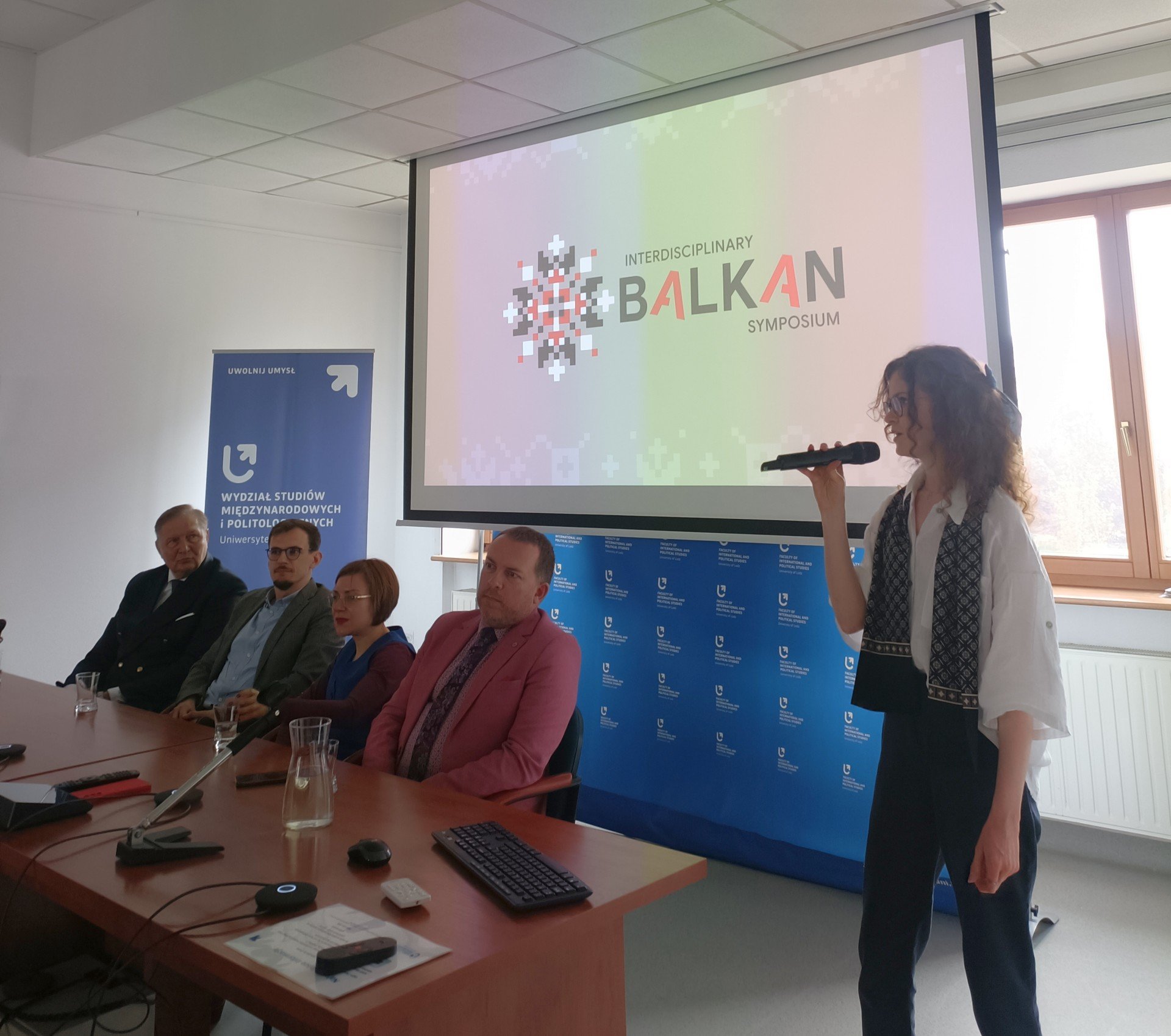
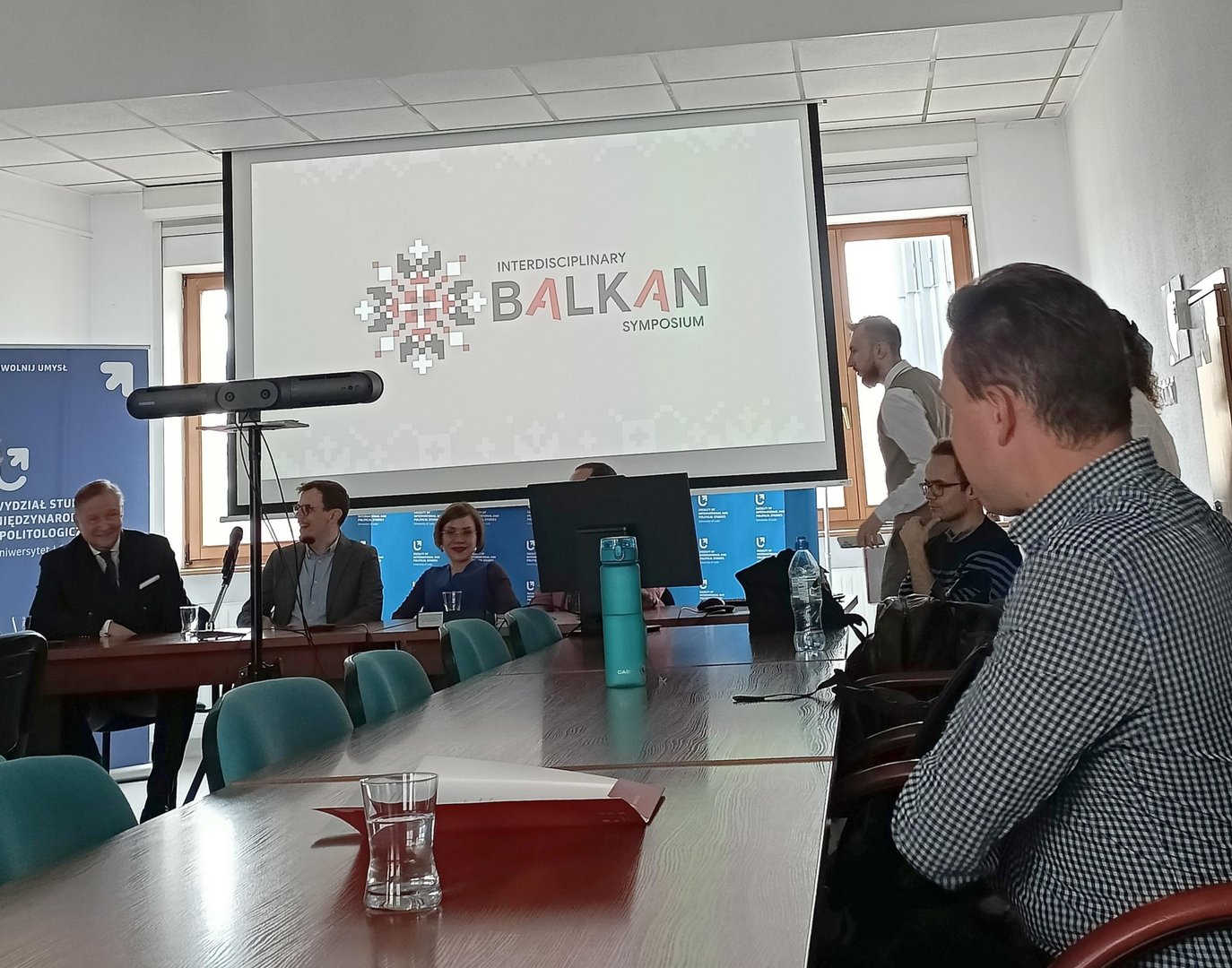
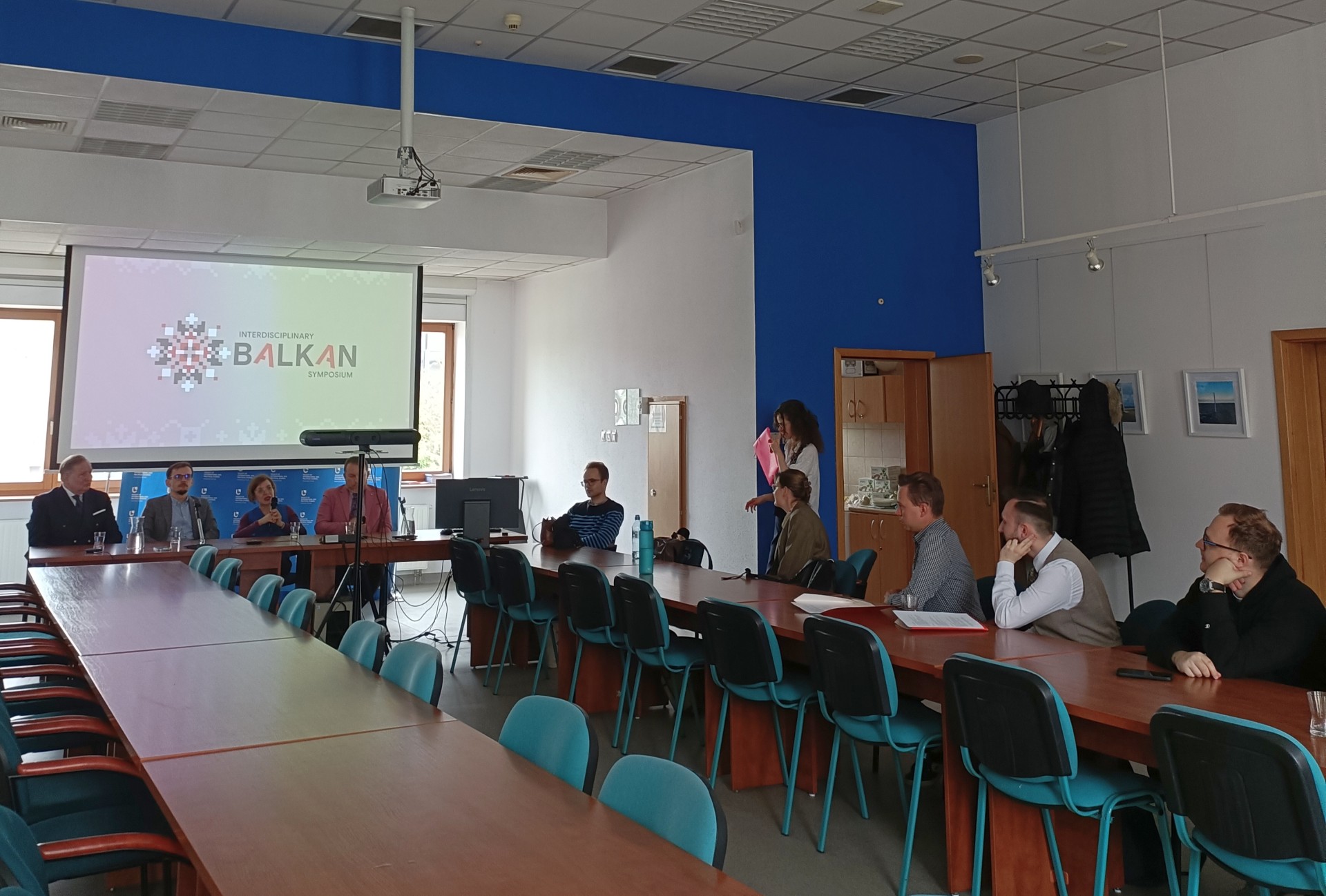
On 7 May 2026, a press conference was held in the Council Chamber of the Faculty of International and Political Studies, University of Lodz, organised by students of the International Relations study programme in cooperation with the University of Lodz Science and Research Centre “The Balkans at the Turn of the 20th/21st Century”. The event was attended by:
- dr hab. Magdalena Rekść, Associate Professor at the University of Lodz – a political scientist, Head of the Centre, a specialist in political myths and collective memory (Faculty of International and Political Studies);
- Dr Paweł Piotr Michalak – Honorary Consul of the Republic of Albania;
- Dr Piotr Kręzel – a Slavist and historian, Secretary of the Centre, researcher of migration and language policies (Faculty of Philology);
- Dr Sławomir Lucjan Szczesio – a historian, Secretary of the Centre, researcher of diplomacy and contemporary Balkan history (Faculty of Philosophy and History).
Challenges facing the Balkan states
During the discussion, participants analysed the consequences of the breakup of the Socialist Federal Republic of Yugoslavia (SFRY), emphasising that the memory of those events continues to influence current Balkan politics. A wide range of issues relating to the past, present and future challenges of the Balkan states was addressed. Experts discussed, among other topics, collective memory 35 years after the dissolution of Yugoslavia. Prof. Rekść pointed out that in Serbia, for instance, the past had not been fully reckoned with, which was exploited by President Aleksandar Vučić in constructing a narrative portraying Serbs as victims. She noted that although younger generations were striving for democracy, they were disillusioned with the European Union and often expressed pro-Russian views. Participants stressed that although full reconciliation was still lacking at the political level, cooperation in the region was flourishing, particularly in areas such as the economy and culture.
The role of the international community and the impact of organisations such as NATO and the European Union on regional security and stability was also an important theme. Dr Szczesio recalled that the breakup of Yugoslavia was a test for Euro-Atlantic structures. He emphasised that despite failures of UN missions (e.g. in Srebrenica), international organisations had played and continued to play a key stabilising role, in which Polish troops had been actively involved for years (including the KFOR mission in Kosovo).
The conference also addressed a number of important issues concerning Bulgaria, focusing on its internal political instability, relations with Russia and Western structures, and its entry into the eurozone. Dr Kręzel noted that in recent years Bulgaria had faced a difficult internal situation marked by short-lived governments. A turning point came with the resignation of Rumen Radev from the presidency in January 2026, enabling him to enter active domestic politics and win the most recent parliamentary elections, which in turn made it possible to form a single-party government of “Progresywna Bułgaria”.
Bulgaria stands out for its strong and historically rooted pro-Russian sentiment, stemming from gratitude for Russian support in gaining independence in the 19th century. Prof. Rekść emphasised that the belief that no one has ever helped as much as the Russians was widespread in Bulgaria and was reflected in its politics of memory and numerous monuments. Dr Szczesio added that Radev, a former military pilot and commander of the Bulgarian Air Force, had resigned in the past in protest against plans to secure Bulgarian airspace with NATO aircraft. For this reason, many politicians and experts across Europe are observing the decisions of Bulgaria’s new authorities with concern. As Dr Kręzel observed, Radev’s government represents both an “opportunity and a threat” for the EU and NATO – on the one hand bringing an end to internal chaos, and on the other posing a risk of increased assertiveness and efforts to normalise relations with Russia.
A separate part of the debate focused on Albania, including remarks by Dr Michalak, who presented the country as a pillar of regional development. The Consul emphasised that under Prime Minister Edi Rama (in office since 2013), Albania was currently experiencing the most prosperous period in its history, becoming “one large construction site” of modern infrastructure and luxury resorts. Tourism has become a key sector of the economy, attracting millions of visitors, including large numbers of Polish tourists. He also noted that a new study programme dedicated to Albania and the Balkans was planned to be launched at the University of Lodz, with the aim of strengthening academic and cultural exchange.
Announcement of the Interdisciplinary Balkan Symposium 2026
The conference concluded with an announcement of the international Interdisciplinary Balkan Symposium, which will be held on 22–23 June 2026 in Lodz. Held under the patronage of the Minister of National Defence, the symposium will bring together around 80 researchers from across the world – from the Balkans to Japan. The event will be interdisciplinary in nature, combining political science, history, sociology, philology, and economics. It is a joint initiative of scholars from several institutions: the University of Lodz Science and Research Centre “The Balkans at the Turn of the 20th/21st Century”, the Jagiellonian University, Kazimierz Wielki University in Bydgoszcz, the University of Warsaw, as well as the Polish Academy of Arts and Sciences (PAU).
It is yet another invitation from the Lodz academic centre, which for years, by organising conferences on key anniversaries, such as the 15th anniversary of the Dayton Agreement or the 20th anniversary of the breakup of the federation, has been bringing together the academic community.
We encourage you to watch the entire press conference online:
The role of the Centre from Łódź
Lodz has repeatedly hosted researchers specialising in Balkan studies. For example, in 2010 the conference “Bosnia and Herzegovina 15 Years after Dayton: Past, Present, Future” was organised. The December 2010 meeting at the University of Lodz was the first large-scale interdisciplinary conference in Poland devoted to the problems of Bosnia and Herzegovina and the wider Balkan region, contributing significantly to the integration of the academic community.
In June 2011, the University of Lodz Science and Research Centre “The Balkans at the Turn of the 20th/21st Century” was established, founded and first headed by Prof. Paweł Chmielewski. The Centre subsequently organised further conferences bringing together historians, political scientists, Slavists, lawyers, and leading experts from academic and research institutions in Poland and abroad, including: “The Western Balkans – between the past and the future (on the 20th anniversary of the breakup of Yugoslavia)” (2011); “The Western Balkans in the Euro-Atlantic security system” (2013); “Serbia – from the breakup of Yugoslavia to the European Union?” (2016).
The combination of theory and practice has been a distinctive strength of the Lodz meetings. Debates included direct witnesses of history, such as prominent journalists and members of the diplomatic corps. These discussions resulted not only in scholarly exchange but also in concrete initiatives – for example, the formal appeal issued by participants in 2011 calling for the continued integration of Balkan states with the European Union. The conferences were also accompanied by exhibitions and cultural events.
A lasting outcome of the Centre’s work, in cooperation with Lodz University Press, is a series of several books entitled “Bałkany XX/XXI” [The Balkans at the Turn of the 20th/21st Century].
Another result of this collaboration was the organisation in 2025 in Kraków of the international conference “Political Order in the Balkans – Stabilising and Destabilising Factors” by the Department of International Relations and Foreign Policy at the Institute of Political Science and International Relations of the Jagiellonian University, the Central European Commission of the Polish Academy of Arts and Sciences (PAU), the Commission on the Recent History of the Slavs, the University of Lodz Science and Research Centre “The Balkans at the Turn of the 20th/21st Century”, the Department of Contemporary History and International Relations at the Kazimierz Wielki University in Bydgoszcz, and the Faculty of Political Science and International Relations at the University of Warsaw.
Source: CNB Bałkany