Call for applications
Personal documents were identified as a distinct research category over 70 years ago by the Dutch historian and Holocaust survivor Jacques Presser. As a researcher documenting the fate of Dutch Jews during the war, he encountered the stories of both survivors and perpetrators. In his pioneering research on the wartime experiences of Jews in the Netherlands, published in the monumental work Ondergang (Ashes in the Wind), he relied heavily on personal accounts, recognizing a unique testimony to the human dimension of the tragedy. Even then, he drew attention to the immense value of such sources, which were often dismissed by researchers as too subjective and literary compared to traditional official documentation. The term quickly garnered interest among researchers and gradually entered the mainstream of scholarship, including the history of the Holocaust.
Contemporary research on egodocuments in the context of the Holocaust and World War II is undergoing dynamic development, part of a broader “biographical turn” and interest in history from below. Egodocuments allow us to understand how individuals constructed their identities in relation to a world engulfed in crisis and how they coped with the trauma of wartime experiences.
During the workshop, we would like, among other things, to analyze and discuss the following issues:
I.
Methodology and hermeneutics: How can we interpret subjective personal accounts while maintaining scholarly integrity? How can we study “silence” and what remains unexpressed in wartime narratives?
II.
Typology and form: Are traditional categories (diary, letter, memoir) sufficient? How can we incorporate less obvious forms into our research, such as almanacs, marginal notes, or visual documents?
III.
Collection and processing: What ethical and practical challenges are associated with working in Holocaust archives? What archival practices should be used to restore a voice to marginalized communities?
IV.
Personal documents in the age of digital humanities: What possibilities do geographic information systems (GIS) and “deep mapping” offer for visualizing wartime trajectories? How does Linked Open Data (LOD) allow us to connect personal stories with a broader historical context?
The
European Holocaust Research Infrastructure (EHRI-PL) workshop: Holocaust Egodocuments: Research and Challenges
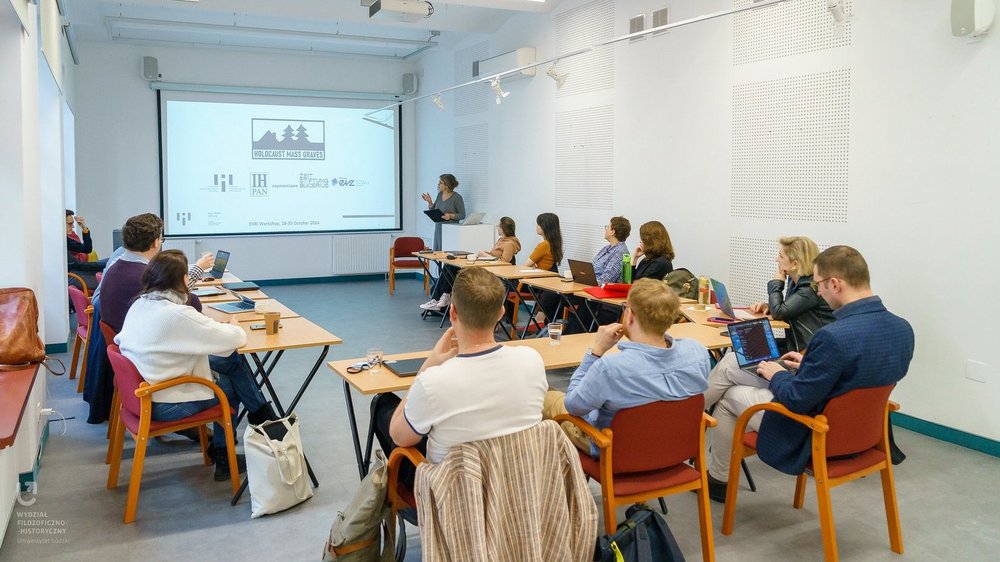
classroom

excoursion
Published: Michael Green
UNIVERSITY OF LODZ
Narutowicza 68, 90-136 LODZ
fax: 00 48 42/665 57 71, 00 48 42/635 40 43
NIP: 724 000 32 43


Projekt Multiportalu UŁ współfinansowany z funduszy Unii Europejskiej w ramach konkursu NCBR