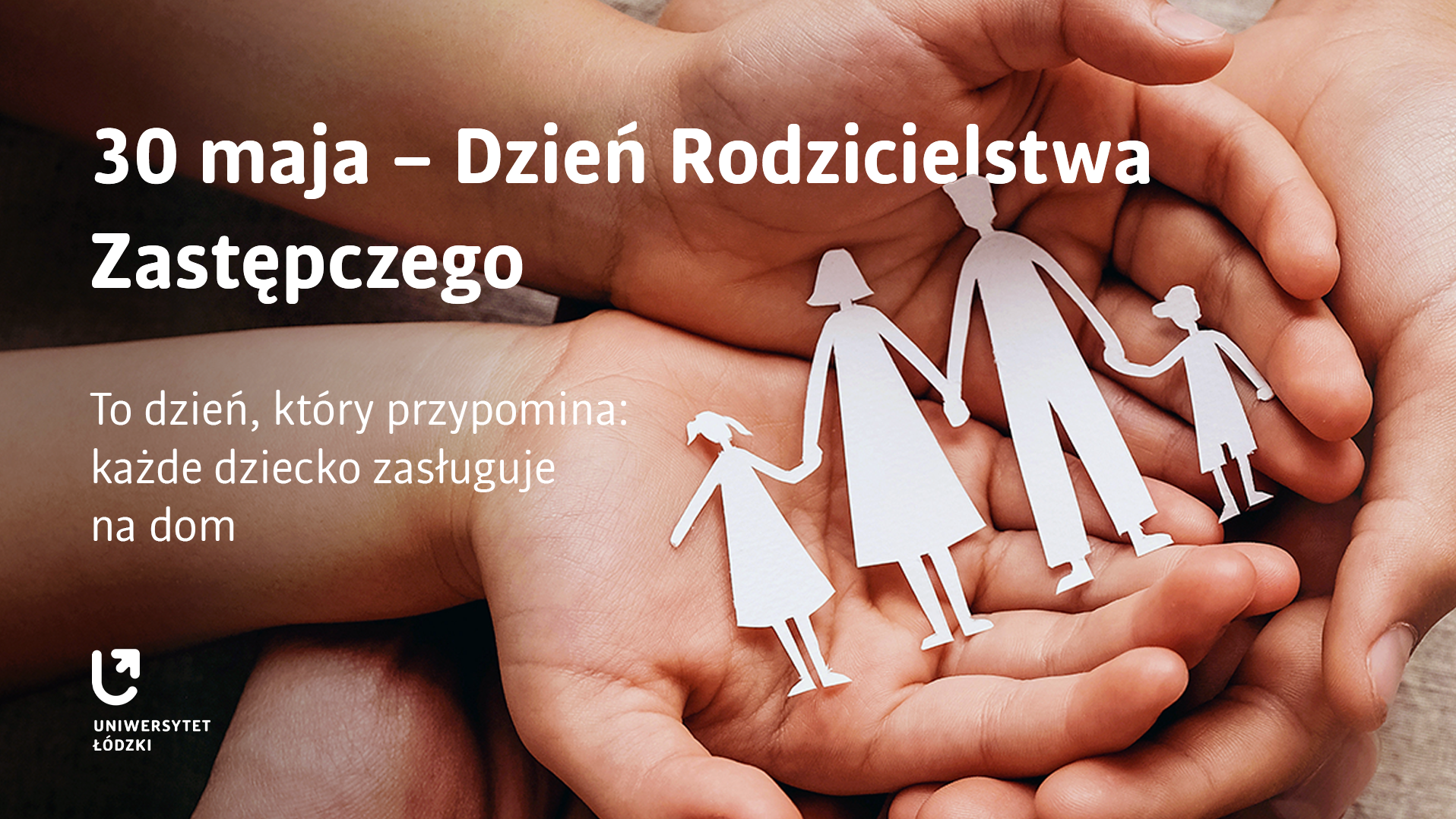
What is foster care?
In the Polish system, foster care operates in two basic forms: family-based (there are several types of foster families) and institutional, commonly referred to as a children’s home. Dr Paulina Bunio-Mroczek from the Department of Applied Sociology and Social Work at the University of Lodz explains:
Foster care is extremely important in terms of safeguarding the well-being and ensuring the best possible developmental conditions for children whose original (biological) family is unable to fulfil its caregiving and upbringing functions. Children whose biological parents or other relatives cannot or are unable to provide proper care are placed (or should be placed) in foster care. In principle, it is a form of protecting children from harm and a way of securing their life, health and opportunities for proper development.
Family – the best environment for development
The direction of change in the foster care system is towards deinstitutionalisation. This means moving away from large institutions in favour of family-based forms. It is assumed that the most appropriate and best environment for a child’s development is a family – if not a biological one, then a foster family. As emphasised by Dr Magdalena Błaszczyk from the Department of Applied Sociology and Social Work at the University of Lodz:
Young children (up to the age of 10), according to the law, should not be placed in institutions such as children’s homes. Researchers have shown that children raised in institutions achieve poorer outcomes in all areas of development compared to their peers brought up in families. As a result, we can be certain that a safe family constitutes the best upbringing environment for a child. For this reason, the foster care reform implemented since 2012 has placed particular emphasis not only on reducing the size of care and educational institutions (to a maximum of 14 children per home) but also on the development of foster parenting.
These are systemic solutions whose meaning is realised in everyday life: shared meals, doing homework together, evening conversations – in everything that makes up an ordinary, peaceful childhood.
The plan failed. Regulations versus reality
However, there is a clear gap between assumptions and reality.
The legislator intended that as the number of foster families increased, care and educational institutions would shrink and eventually be phased out. Unfortunately, this plan has failed – comments Dr Magdalena Błaszczyk, adding:
Many children still remain in institutional foster care, there are still too few foster families and family children’s homes, and those running foster families report a number of challenges in fulfilling their responsibilities, including – very importantly – a lack of sufficient support from the system.
This shows that the issue of foster care is not a matter of individual cases but has a systemic nature.
System under pressure
The situation has caused concern among academic and social communities for years. Dr Izabela Kamińska-Jatczak from the Department of Social Pedagogy and Resocialization points out:
Statistical data from Statistics Poland leave no doubt – the number of children placed in foster care is steadily increasing. At the end of 2023, there were 75.3 thousand children in foster care; in 2024 – 77.3 thousand; and in 2025 already 78.3 thousand. At the same time, contrary to general European guidelines on the deinstitutionalisation of care, the number of professional foster families is not increasing, as there is a lack of new candidates willing to take on this role. This constitutes one of the key barriers to the development of family-based foster care. Terms such as “a crisis in the foster care system” or even “a system on the brink of capacity” appear increasingly often in government and media reports.
At the same time – as the researcher emphasises – the development of family-based forms of care is also economically rational: the cost of maintaining a child in a foster family is significantly lower than in an institution.
Change is possible – but not only through regulations
Planned reforms aim to strengthen the system by increasing remuneration, developing professional foster parenting and expanding family-based care. However, change will not occur solely at the legislative level. Building public awareness is equally important. As practice shows, foster care remains a topic rarely present in public debate, and when it is addressed, it is usually only through the prism of individual, dramatic stories. Meanwhile, it is a system that can – and should – function effectively if it receives social support.
The University’s social responsibility
In this context, the cooperation between the University of Lodz and the Happy Foundation, which has been creating family children’s homes for many years, becomes particularly significant. One form of support is student volunteering, which in practice is primarily based on building relationships and being present in a child’s everyday life.
A volunteer – a student at the University of Lodz – says that there are no rigidly defined tasks. It often involves just a few hours of ordinary presence: playing, talking, simply being there. As she points out, this form of involvement can be demanding, as it means long-term relationships rather than one-off visits, but at the same time it brings a personal sense of meaning and the mutual value of this bond.
You can read more about the cooperation between the University of Lodz and the Happy Kids Foundation on the University’s website:
- student volunteering at the Happy Kids Foundation,
- the University of Lodz and Happy Kids Foundation strengthen cooperation,
-
Flowers? – No, thank you – in the Shop of the University of Lodz, you can purchase greeting cards and the proceeds from their sale go to foundations supporting children
Source: Dr Paulina Bunio-Mroczek, Dr Magdalena Błaszczyk, Dr Izabela Kamińska-Jatczak, Agata Dawidowicz
Edit: Agata Dawidowicz, Centre for External Relations and Social Responsibility of the University of Lodz