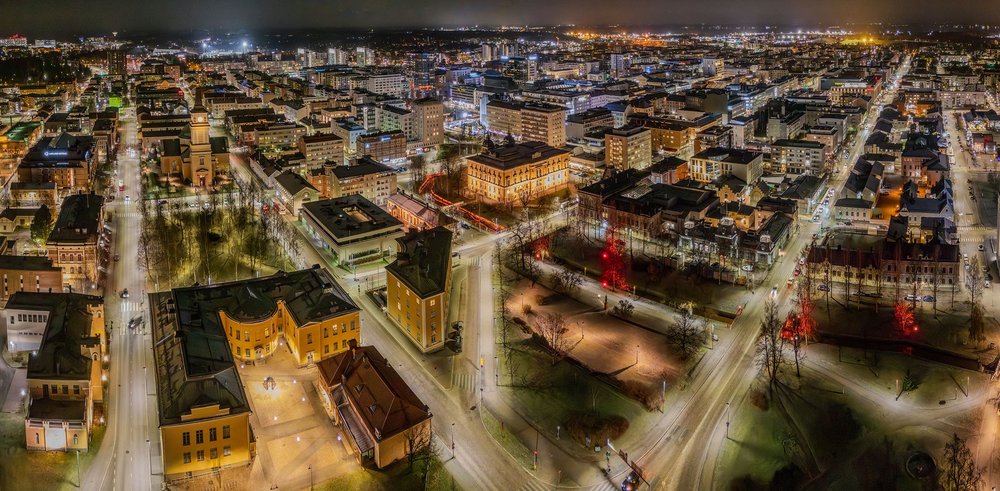
How can art help us understand and transform cities? How can artistic research methods support the sustainable and inclusive revitalisation of post-industrial areas? Participants in an the international programme organised by the University of Oulu as part of UNIC will seek answers to these questions. This alliance of 10 universities located in post-industrial cities creates opportunities to participate in international projects without spending months abroad. Be curious about the world!
Online seminars and onsite classes
The programme, organised as an Erasmus+ Blended Intensive Programme (BIP), combines online seminars (21 – 22 May) with five-day workshops in Finland (25 – 29 May 2026). The workshops will take place in locations including the Meri-Toppila district, a former industrial area that housed a factory designed by Alvar Aalto. Today, it's a dynamic, multicultural part of the city, providing an ideal laboratory for urban transformation.
Goals and assumptions of the programme
The programme participants will work in interdisciplinary teams, combining perspectives from art, architecture, urban planning and social sciences. The programme assumes:
- developing collaboration between various fields of research and practice,
- using artistic methods to analyse and interpret urban space,
- designing artistic interventions in public spaces,
- working with the local community and its vision for the future,
- reflecting on the ethical aspects of artistic activities in the urban context.
The project will culminate in a festival at AaltoSiilo featuring live music and artistic presentations. The event is part of the programme for the European Capital of Culture Oulu 2026.
For whom?
The programme is open to:
- doctoral students,
- MA students.
English language proficiency at least at a B2 level is required. Knowledge of urban studies or art history is an advantage.
Programme completion and ECTS credits
The programme concludes with a group presentation of the artistic intervention concept. The programme completion is based on a pass/fail system, and participants receive 5 ECTS credits.
Funding and organisation
Students who qualify for participation can apply for funding for their Erasmus+ mobility through their home university. The University of Oulu does not cover travel or accommodation costs. Participation requires attendance at both the online and in-person sessions.
Admissions
Admission process is open until 15 March. Space is limited – 10–30 participants are planned, with 3–5 applicants from each partner university.
Where to apply?
Interested individuals should first contact the Erasmus+ programme coordinators at their respective faculties (go to the list of faculty coordinators).
NOTE: Students from the Faculty of Philosophy and History should contact Dr Alicja Piotrowska (alicja.piotrowska@uni.lodz.pl) and Prof. Aneta Pawłowska (aneta.pawlowska@uni.lodz.pl) no later than 11 March. The faculty admissions meeting will be held on 12 March at 10:00 a.m. at the office of the Institute of History of Art, University of Lodz (Narutowicza 65).