From Childhood Fascination to Scientific Research on Thunderstorms
Thunderstorms fascinated Natalia Rosińska from an early age, but it was only during her studies at the Faculty of Geographical Sciences of the University of Lodz that she began to view them from a scientific perspective. She completed a degree in geomonitoring and then studied geography with a specialisation in Climatology and Atmospheric Protection.
I wanted to be right at the centre of the action. I have been involved with the Łowcy Burz Łódzkie group for four years, and for the past two years I have also been a member of the Polish Storm Chasers Association
– she says.
Thunderstorms also became the subject of her research. In her BA thesis, she analysed atmospheric conditions on thunderstorm days in central Poland, while her MA thesis focused on one of the most dangerous weather phenomena: supercell thunderstorms occurring in the Łódź Voivodeship.
Storm chasing, however, is about much more than spectacular expeditions with a camera.
It is primarily painstaking work in front of a computer: analysing numerical models, monitoring radar data and issuing warnings – Natalia Rosińska underlines.
– Natalia underlines.
Storm chasers also conduct what is known as nowcasting, providing real-time updates via social media on the location of storms, their intensity and the direction in which they are moving.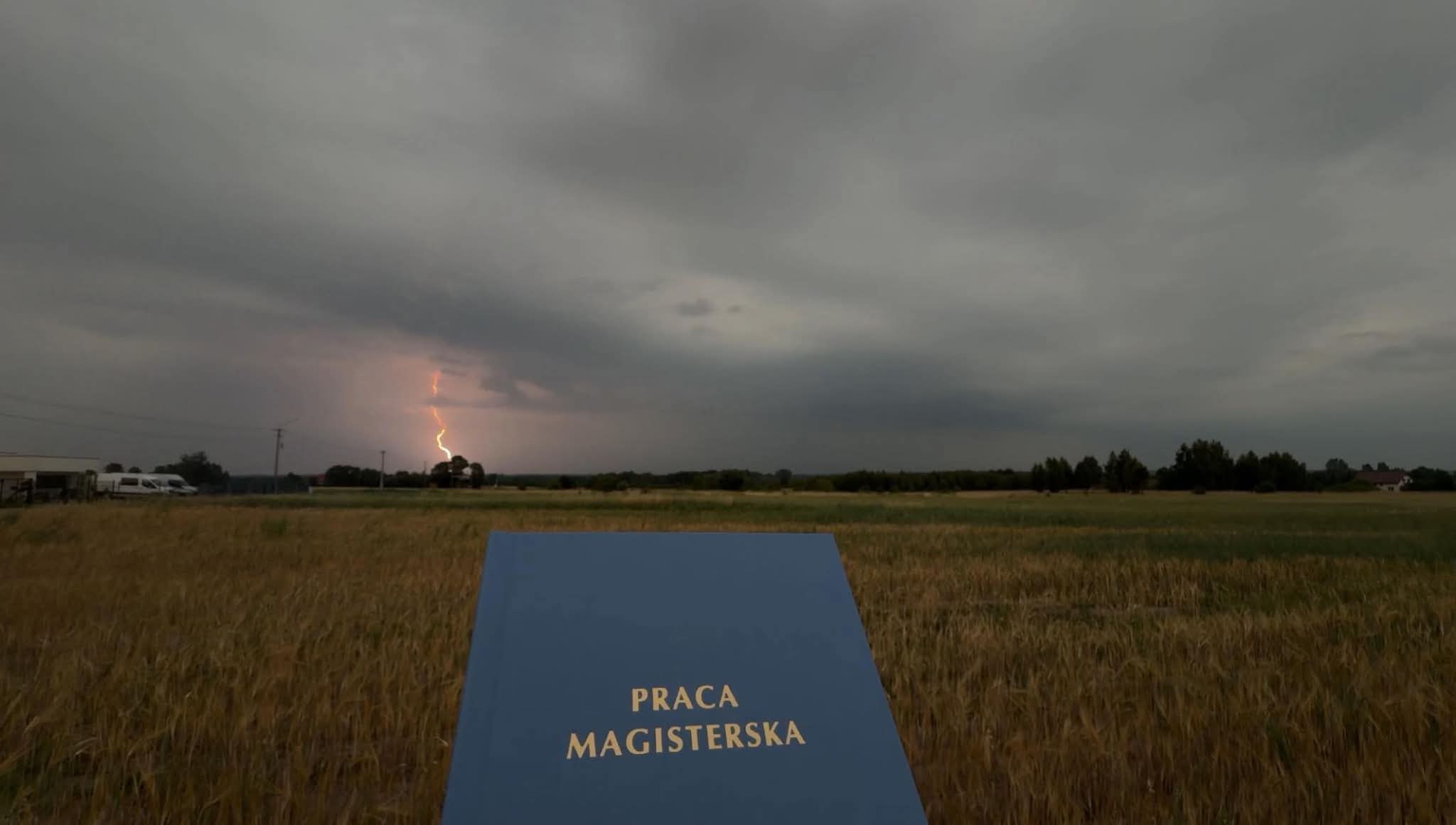
How Does a Thunderstorm Form?
Three key ingredients are needed for a thunderstorm to develop: sufficient moisture, an unstable atmosphere and a mechanism capable of lifting warm air upwards. This may be, for example, intense surface heating or the passage of a weather front.
Warm, moist air begins to rise rapidly, cools, and the water vapour it contains condenses. Increasingly large thunderstorm clouds form, sometimes reaching altitudes of several kilometres. Within these clouds, electrical charges become separated, resulting in lightning discharges.
What fascinates me most about thunderstorms is their immense power combined with absolute beauty. I am captivated by the speed at which a small, innocent cloud can grow into a monster stretching for several kilometres within just a few dozen minutes
– says Natalia Rosińska.
The Sky Can Warn Us
An approaching thunderstorm can sometimes be spotted before the first clap of thunder. Particular attention should be paid to rapidly developing clouds that resemble enormous cauliflowers or towers.
The sky is our best natural radar. If, on a hot day, we see white clouds growing rapidly, it is a sign that the atmosphere is ‘cooking’ and that a thunderstorm may break out later in the day
– the expert explains.
An even clearer signal is the characteristic anvil shape that appears at the top of a fully developed thunderstorm cloud. Sudden gusts of wind, oppressive air and a noticeably darkening sky can also serve as warning signs.
Lightning, Thunder and... Mathematics
The distance of a thunderstorm can be estimated without any specialist equipment. All that is required is counting the seconds between seeing a lightning flash and hearing the thunder.
Light reaches us virtually instantaneously, whereas sound travels much more slowly, at a speed of approximately 340 metres per second.
When you see a flash of lightning, start counting the seconds. When you hear the thunder, divide that number by three. The result gives an approximate distance to the lightning strike in kilometres
– Natalia explains.
If three seconds pass between the flash and the thunder, the lightning strike occurred roughly one kilometre away. The shorter the interval, the closer the storm is.
What Should You Do During a Thunderstorm?
The safest place during a thunderstorm is inside a closed building. At home, windows should be shut and items left on balconies or terraces secured. Thunderstorms may be accompanied by very strong wind gusts capable of damaging buildings or carrying away lightweight objects.
It is also advisable to unplug sensitive electronic devices, such as computers and televisions. A lightning strike does not need to hit a building directly for damage to occur; power surges can also travel through the electrical system.
Safety comes first. Closing windows is not a myth. It is absolutely essential
– Natalia Rosińska stresses.
During a severe thunderstorm, it is also wise to avoid unnecessary contact with water systems, for example by postponing showers or washing dishes until later.
The most important rule, however, is simple: if you can hear thunder, the storm is close enough to be treated seriously and it is time to seek proper shelter.
Because although towering storm clouds and lightning are among nature’s most fascinating spectacles for storm chasers, observing them safely requires above all knowledge and respect.
Storm chasing teaches great humility. Every storm is different and every one is a unique and extraordinary spectacle – Natalia concludes.
– Natalia concludes.
Source: mgr Natalia Rosińska
Edit: Kacper Szczepaniak, Centre for Brand Communications, University of Lodz