Six Centuries and Dozens of Unexpected Stories
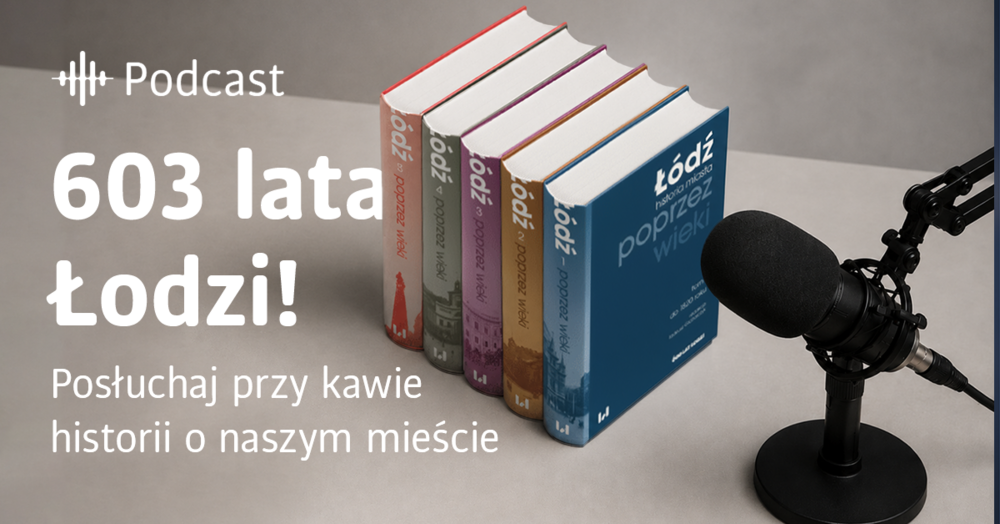
On 29 July 1423, Władysław Jagiełło granted municipal rights to Łódź. The University of Lodz was established 522 years later, but today it is inseparably linked to the city, including through research into and popularisation of its history. One result of these efforts is the five-volume monograph "Łódź poprzez wieki. Historia miasta” [Łódź Through the Centuries. History of the City], prepared by more than 100 specialists to mark the 600th anniversary of Łódź.
The books also have their audio counterpart. In the podcast “Łódź poprzez wieki. Rozmowy jak przy kawie” [Łódź Through the Centuries. Conversations Over Coffee], licensed city guide Justyna Tomaszewska meets with the authors of the monograph as well as individuals engaged in preserving Łódź’s heritage. Rather than lectures, listeners are treated to questions, anecdotes and conversations driven by a genuine curiosity about the city.
A Lion in the Coat of Arms, Rivers Beneath the Streets and the First “Skyscraper”
The podcast reveals, among other things, that the royal charter granted in 1423 has not survived to the present day. Listeners can also discover Łódź’s oldest official symbol, a small boat with an oar visible on sixteenth-century seals, as well as the period when a lion appeared in the city’s coat of arms.
Other episodes take audiences beneath the city’s surface. Although Łódź is not usually associated with water, it developed thanks to rivers that powered its early industry. Today, many of these waterways flow through underground channels beneath the streets, and heavy rainfall still serves as a reminder of their existence, particularly in the areas around Manufaktura Shopping Centre and Zdrowie Park.
Architecture enthusiasts will hear how, more than 200 years ago, a three-kilometre-long street was laid out in anticipation of the city’s future growth. They will also learn that the Savoy Hotel, built in 1911, was the tallest non-religious building in Łódź and a sign of the city’s ambition to grow upwards.
Industrial Łódź Remains Listeners’ Favourite Topic
The most popular episode of the series on YouTube remains “O Łodzi opowiada Mistrz” [A Master Tells the Story of Łódź]. In the episode, Ryszard Bonisławski discusses lesser-known factory owners and entrepreneurs who arrived in Łódź not only from Germany and France, but also from Sweden. During a visit to the city, Karol Scheibler’s great-great-grandson reportedly found it hard to believe that a business accounting for nearly 15 per cent of Łódź at the time could have been managed without computers or telephones.
Another episode that attracted a large audience is “Miasto gotowe na sukces” [A City Ready for Success], a conversation with Prof. Piotr Gryglewski about the visionary urban planning behind the “Polish Manchester”.
“Łódzka niepodległość” [Łódź Independence] is also among the most popular episodes. In this episode, Prof. Przemysław Waingertner reminds listeners that on 11 November 1918 the struggle for the city took place, among other locations, around present-day Wolności Square and at Łódź’s railway stations.
And that is only the beginning. All episodes are available free of charge on YouTube and Spotify, while all five volumes of the monograph can be purchased from the Lodz University Press Bookshop.
Edit: Michał Gruda (Centre for External Relations, University of Lodz)