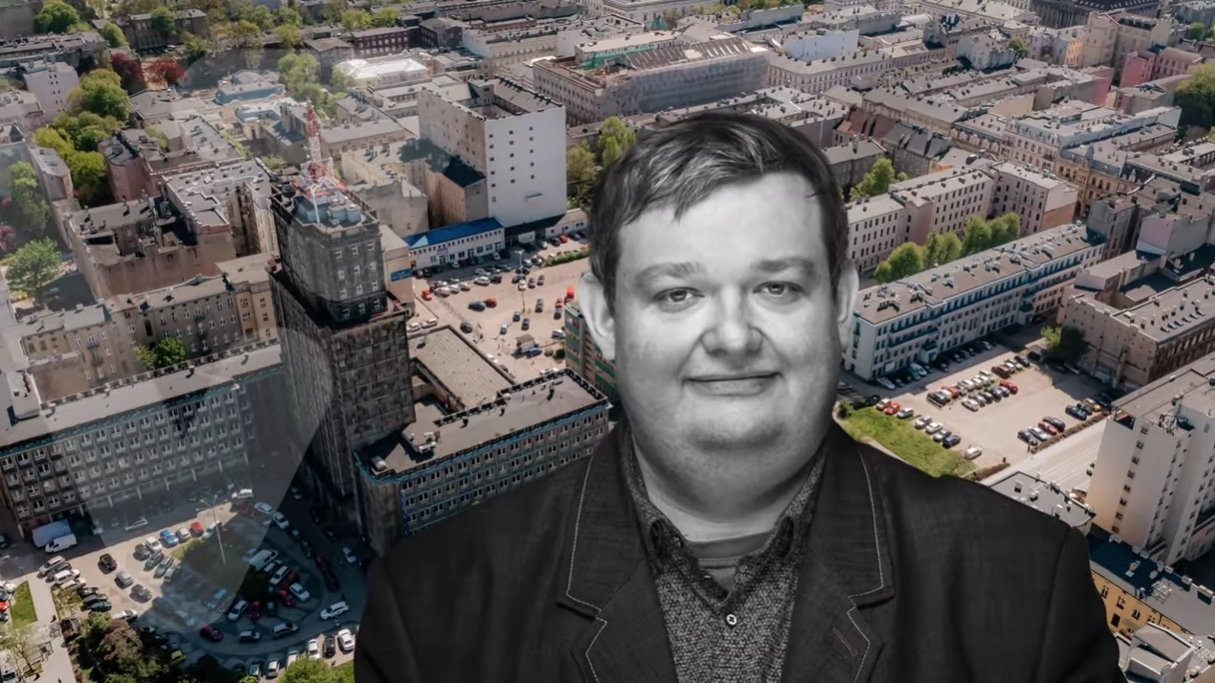
The University of Lodz Interdisciplinary Centre for Urban Studies, headed by dr hab. Kamil Śmiechowski, Associate Professor at the University of Lodz, is a research unit continuing the tradition of inter-faculty cooperation initiated in 2015. The unit conducts interdisciplinary research on the phenomenon of urbanity, urban culture, urban economics, social actors and mechanisms of urban space management.
In the conversation, Prof. Śmiechowski introduces the term "niedomieść" ("suburban"), describing suburban areas that are formally villages but operate like the outskirts of large cities. Such a town is formally a village, but people who live there feel no connection to their rural surroundings. They are simply residents of large cities who have bought homes outside their borders – explains Prof. Śmiechowski, adding – Their development, while profitable in the short term for the suburbs of Krakow or Poznań, is detrimental in the long run to the entire organisms that urban agglomerations are becoming today.
Although suburbs often offer a higher standard of living than city centres, their development can lead to a weakening of the urban agglomeration. Residents' outflow from the centre reduces its attractiveness to investors, while the lack of coherent spatial and transportation management deepens communication problems.
Urbanity in Poland – still under construction?
Prof. Śmiechowski points out that although Poland has been a highly urbanised country for decades, our urban character is "still under construction." Only recently has an urban culture, which has existed in the West for generations, begun to develop in Poland. Large cities continue to be pitted against the rest of the country, leading to social and political tensions. The interview also touches on cities that aren't metropolitan. In Poland, as many as 139 cities are losing their socio-economic functions. The largest of these, such as Grudziądz and Konin, have over 80,000 residents but are struggling with development prospects. The situation is even more difficult for the smallest towns, which struggle with transportation exclusion and a limited labour market. As Prof. Śmiechowski notes, urban status loses its significance when residents are deprived of basic services – for example, access to the regional capital.
As many as 31 towns regained their municipal rights in 2024, mainly in central Poland. This shows that urbanity, even symbolic, still has social and cultural significance. This shows that urbanity in itself continues to be desirable, even if in practice nothing concrete results from obtaining municipal rights, comments Prof. Śmiechowski. Urbanity in Poland is neither obvious nor unambiguous. It balances between history and modernity, between the centre and the periphery, between aspiration and reality. In a conversation with Prof. Kamil Śmiechowski, not only is there an analysis of space, but above all, the question of who we are as a society.
We encourage you to read the full interview: link to the article (in Polish)
Source: Sławomir Szymański, Gazeta Wyborcza
edit: Agata Dawidowicz, Centre for External Relations and Social Responsibility of the University, University of Lodz
Photo: University of Lodz