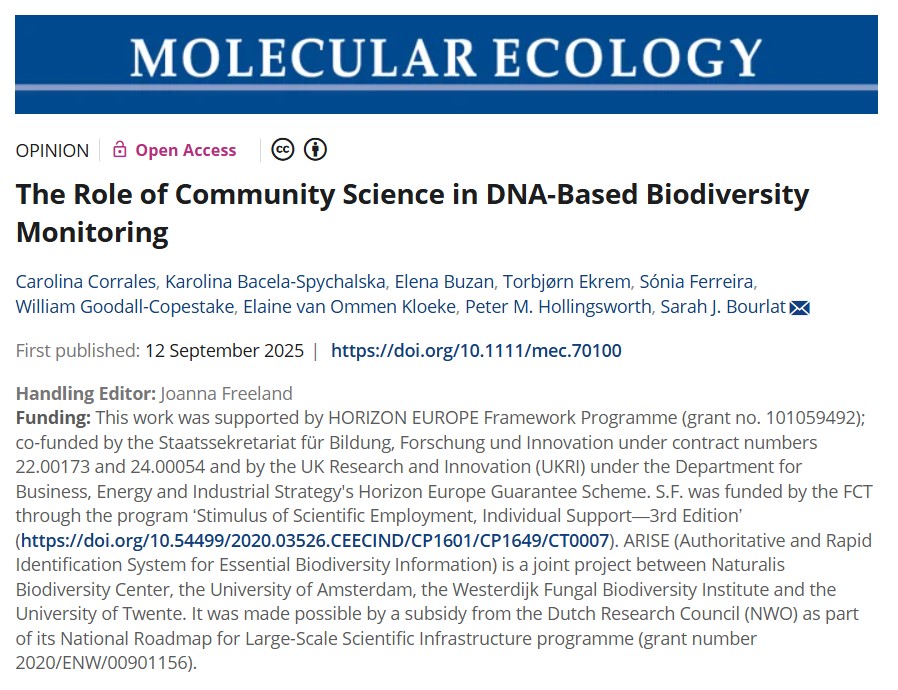
An article co-authored by our colleague Karolina Bącela-Spychalska has been published in the journal Molecular Ecology. The article examines the role of citizen science in monitoring biodiversity using DNA methods.
The authors point out that combining community-based activities with DNA biomonitoring brings tangible benefits. Collaboration between scientists, volunteers, and amateur taxonomists allows for research to encompass a much broader geographic and temporal scope than would be possible within research teams alone. Hobbyists also play a crucial role in creating and supplementing reference libraries, essential for species identification based on DNA fragments. This enables mutual support, knowledge exchange, and co-creation, which increases the chances of implementing conservation programs.
The article also emphasizes that participation in citizen science projects fosters learning, competence development, and integration with the local community. The authors highlight key conditions for successful collaboration: appropriate training, clear procedures, recognition of participant contributions, and ensuring high-quality data.
Community involvement in DNA biomonitoring can deepen our understanding not only of the distribution, population structure, and genetic diversity of many taxa, but also of their abundance and life cycles.
Congratulations!