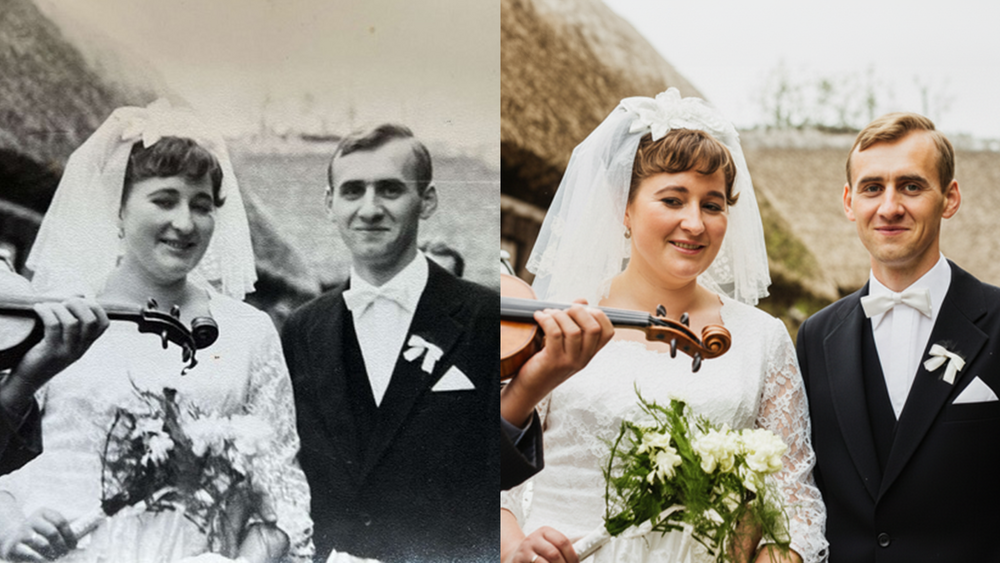
The Deep Nostalgia tool was launched in 2021. It allows you to create a short video from an old photo, in which the image of the person in the photo moves. In the first month, users generated 26 million animations. This demonstrates the scale of how important it is for us as humans to remember those who have passed away. A few years later, in 2025, additional tools appeared on the market, such as Google's Nano Banana graphic model and the Kling video generation model. These tools achieve surprisingly good results. Social media is filled with videos of people showing their grandparents animations made decades earlier. Tears of emotion can often be seen in the eyes of older people…
What can you do at home these days besides colouring and animating photos? Advanced virtual reality headsets (e.g., Apple Vision Pro) can transform a two-dimensional photo into a three-dimensional one. This makes us almost feel as if these people were with us. Avatars and "griefbots" are also emerging, enabling conversations with a digital version of a loved one, trained on their voice, texts and recordings.
The market for “digital immortality” exists and needs rules. A team from the University of Cambridge proposes principles for the responsible design of digital likenesses of the deceased and points out the risk of "digital haunting," which can occur if the bot is not under family control or does not have a "switch-off" mode. Some people working in marketing have come up with the idea of using images of the deceased to recommend products. So, one could imagine a digital Napoleon selling in France, and in Poland... there would be many candidates. At the same time, if the phenomenon reached a sufficient scale, the product could be recommended by... our own grandmother. It sounds bizarre and outrageous, but technically possible. To protect us from abuse, the Cambridge team recommends clear labeling of avatars created by artificial intelligence, age restrictions for users of such services and "digital farewells" for shutting down such services.
The psychological effects of conversations with digital images of the deceased are currently ambiguous. Some people report relief, while others fear disruptions to the grieving process. Researchers describe cases of positive support, but also the risk of perpetuating the illusion of presence. Understandably, long-term clinical studies are lacking, prompting caution. The visual form enhances the impression of "authenticity."
In Poland, there is an obligation to label content generated or modified by AI. According to the EU AI Act, content generated or significantly modified by AI (images, audio, video, including deepfakes) must be clearly marked. Some regulations have already been in force since 2 February 2025, and the entirety will become law 24 months after the act comes into force. For families and companies creating "souvenirs," this means the need for clear labels. Social media platforms are currently strengthening the labelling of materials created using AI. "Made with AI" labels are being introduced for modified content. At the same time, some privacy regulations apply only to living individuals. Recent legal work calls for clear rules for managing data and models after the death of the "data donor," which in practice means the need for a "digital will."
Memory technologies are changing the ways we commemorate our deceased loved ones. From now on, we're not just "going to the cemetery" but also building digital rituals: short films with great-grandparents, three-dimensional stories, sometimes conversations with avatars. This gives us a sense of agency and offers new forms of intergenerational learning. The condition is that we act responsibly. In accordance with the law, respecting the will of the deceased and the boundaries of the living, with clear labelling of AI content and a "switch-off" plan. Then technology becomes a tool of memory, not a caricature of it.
To see for myself what impact such materials can create, I have decided to animate a photo of my grandparents from their wedding, which took place in the 1960s. Then I created a 3D photo using virtual reality glasses. The impression was incredible. My grandmother passed away 24 years ago. When I showed these materials to my grandfather, he was moved and smiled. It was worth it
– said Dr Dominik Skowroński.
Faculty of Management, University of Lodz
Dr Dominik Skowroński is an expert in the practical use of artificial intelligence in business and education. He runs the YouTube channel Dominik Skowroński – Napędź biznes z AI [Dominik Skowroński – Drive Your Business with AI]. He conducts training courses and workshops on this topic. Here's a video recording of his TEDx talk: “What we miss in the AI era?”
Edit: Press Office, University of Lodz