A conversation about dog welfare. What topics did we cover?
- What is the purpose of dog breeding, breeds and exhibitions?
- How important is early socialisation for a dog's development?
- How can we prevent shelters from becoming overcrowded?
- What should we consider when deciding to adopt a dog?
- What has changed in the last two decades in the attitudes of dog owners and caregivers?
Who spoke up on behalf of dogs?
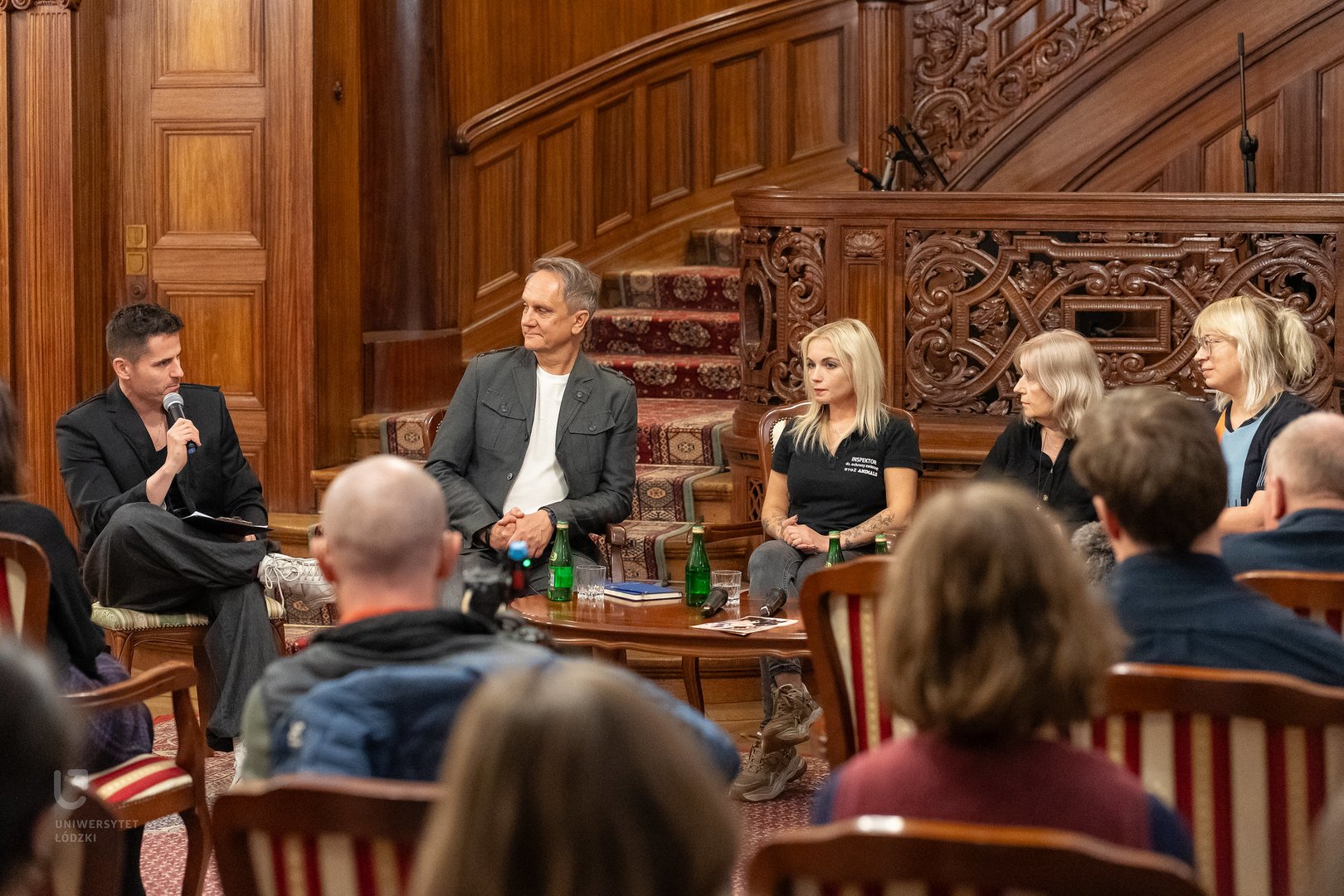
The discussion was attended by special guests and visitors – people for whom the fate of animals is truly important, both in their professional and private lives:
- Dr Katarzyna Majecka – a scientist from the Faculty of Biology and Environmental Protection of the University of Lodz, whose interests focus on the welfare of animals in zoos and animal shelters.
- Albert Kurkowski – director of the Animal Shelter in Łódź – a facility that was described as exemplary during recent inspections related to the scandalous conditions in which animals were kept at the shelter in Sobolewo.
- Elizabet Araj – Animal Protection Inspector at OTOZ Animals Łódź.
- Maria Apoleika – an artist, illustrator and an author of "Psie Sucharki".
The discussion was moderated by Dr Bartosz Kałużny from the University of Lodz Centre for External Relations and Social Responsibility of the University, a photographer, communications specialist, curator of the PIESPEKTYWA project, and a dog lover.
A full photo gallery of the event is available on the university's Flickr (go to the album).
Learn more about the PIESPEKTYWA [DOGSPECTIVE] project
The event was part of the PIESPEKTYWA project. The curatorial text for the exhibition states:
The shift in attitudes toward dogs over the past two decades is readily apparent – chained kennels are slowly disappearing from the Polish landscape, awareness is growing that prong collars are not a substitute for a collar, and more and more people are training their four-legged friends without the use of aversives. Importantly, they do this not for their own convenience, but for mutual understanding and successful cooperation. We are also less likely to thoughtlessly feed our canine friends leftovers from dinner, and Polish law now includes a fine for clipping a dog's ears or tail without a health-related reason.
Yet, animal shelters in Poland are still overcrowded, which demonstrates that as a society, we have work to do. We are far from achieving a collective consensus that dogs are not toys, cannot be unexpected gifts, that they have their own olfactory needs that cannot be satisfied by going out to pee in the square outside their apartment building several times a day. And that they don't understand what we say to them in our language until we teach them.
You can read more about PIESPEKTYWA on the project website – PL (go to the website).
Support your canine friends
Information on how to support the association and the shelter can be found on the websites:
- Animal Shelters in Łódź (go to the website)
- Otoz Animals (go to the website) and Otoz Animals Łódź (go to the website)