Knowledge in the Past and Today
Austronesian sailors, pioneers of long-distance maritime communication, discovered that underground aquifers emerged along the coastline where land met the sea, creating freshwater springs. These natural springs, sometimes transformed into freshwater wells, not only allowed them to survive on islands without surface water but also played a crucial role in mobility and trade in the Indo-Pacific region. Their journeys were not one-off – they took place in stages over thousands of years, and the reasons for these journeys still remain a mystery. Navigating the ocean in canoes required not only knowledge of the stars and sea currents but also the ability to locate freshwater sources. Hydrological knowledge, passed down from generation to generation, enabled the survival not only of the sailors but also of their descendants and non-Austronesian-speaking communities.
Although it sounds like ancient history, today this ancient knowledge is regaining its importance. In times of global climate change, the topic is resurfacing with renewed vigour. In an era of rising sea levels and depleting global water resources, the skills of ancient sailors can inspire the development of more sustainable water policies and better resource management.
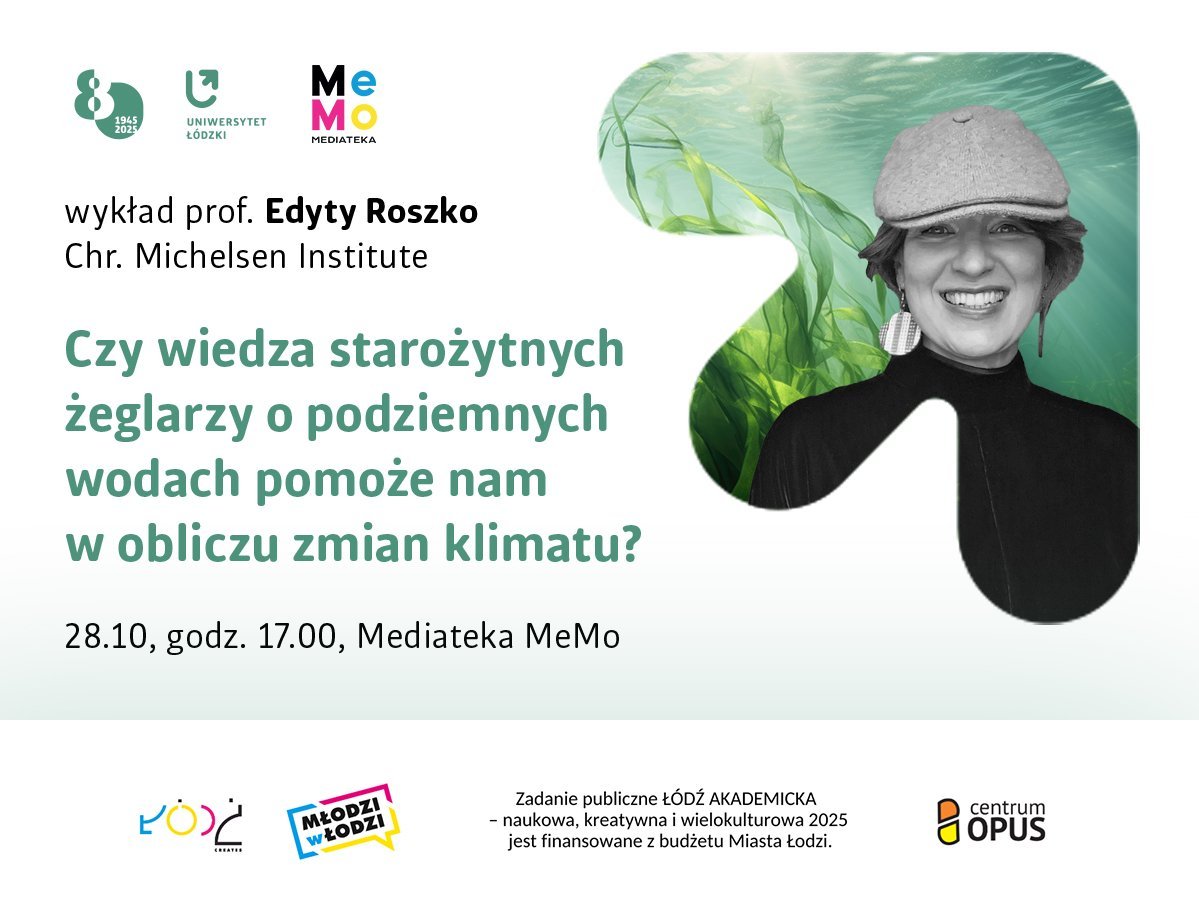
During the lecture, Prof. Edyta Roszko will refer to the results and assumptions of her research project carried out under the prestigious ERC Consolidator Grant – Global Hydroconnectivities beyond Oceans, Seas, and Rivers.
Meet the Speaker
Edyta Roszko is a Research Professor and a social anthropologist at the Christian Michelsen Institute in Bergen. She earned her PhD degree in Social Anthropology jointly from the Max Planck Institute for Social Anthropology and Martin Luther University, Halle Wittenberg, Germany in 2011.Edyta is a Visiting Professor at the Department of Anthropology of the University of Copenhagen and a Fellow of the Young Academy of Europe, a pan-European initiative of outstanding young scientists for networking, advocacy, scientific exchange, and science policy.
Her expertise is grounded in East and Southeast Asia but with a global reach and theoretical ambition to advance our understanding of how societies process globalised economic and climate precarity. Edyta’s achievements include the book "Fishers, Monks and Cadres: Navigating State, Religion and the South China Sea in Central Vietnam", published jointly by NIAS and the University of Hawai’i Press (available in Open Access).
In January 2025 Edyta completed her European Research Council (ERC) Starting Grant project Transoceanic Fishers: Multiple Mobilities in and out of the South China Sea (TransOcean) at Chr. Michelsen Institute. She has now launched a new project funded by an ERC Consolidator Grant: "Global Hydroconnectivities beyond Oceans, Seas, and Rivers." It combines anthropology, archaeology, and geohydrology to better understand the impacts of climate change.
The event is open in nature – feel free to join us!
This is a unique opportunity to hear an inspiring story about how knowledge from thousands of years ago can help us understand the modern world and the challenges we face. Let's meet on 23 October 2025, at 5:00 p.m. at the MeMo Media Library (Moniuszki 5, Łódż) and together we'll seek answers to questions that connect history and the future.
Participation in the event is free of charge, we encourage to register first using the REGISTRATION FORM
The event is made possible thanks to funding obtained by the University of Lodz Foundation through the OPUS Center competition. The public task "Academic Lodz 2025 – Scientific, Creative and Multicultural 2025" is financed from the City of Lodz budget.
Edit: Magdalena Paszko, Centre for External Relations and Social Responsibility of the University, University of Lodz
Graphics: Michał Strzelec, Centre for Brand Communications, University of Lodz