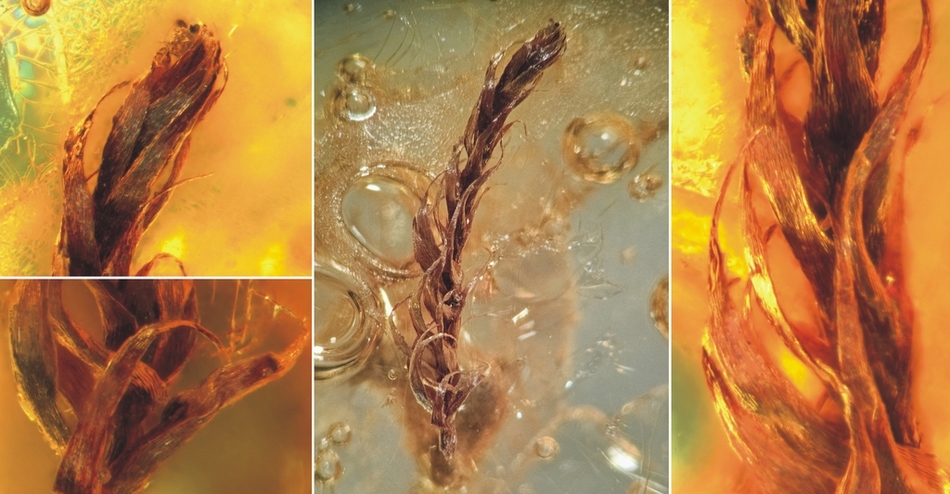
 Sematophyllites lodziensis – mosses examined by Dr Grzegorz Wolski.
A fragment of the past from 40 million years ago fell into the scientist’s hands – moss embedded in Baltic amber…
A gift that has influenced a scientific path
The story of this discovery began... with a birthday gift. Professor Wolski, who has been studying bryophytes – small, often overlooked plants – for 20 years, received a lump of amber with a microscopic specimen embedded within it. At first glance, it appeared to be just a tiny fragment of the plant, but when examined under a microscope, it proved to be a true treasure – a testament to a previously unrecorded chapter of Earth's history.
– Detailed analysis of this material revealed that it belongs to an extinct genus – explains Dr hab. Grzegorz Wolski from the Faculty of Biology and Environmental Protection, University of Lodz. He has named the newly discovered species Sematophyllites lodziensis, in honour of the University of Lodz (celebrating its 80th anniversary) and the city of Lodz (recently celebrating its 600th anniversary).
The specimen is all the more valuable because only six species of the genus Sematophyllites have been described so far. This makes the find absolutely unique.
Why is this so important?
Baltic amber was formed around 40 million years ago, when northern Europe was covered in forests of a completely different character than today – hot, tropical, full of resin-bearing trees. Their sticky resin trapped plant fragments and insects, which we can now admire, encased in "frozen time."
However, as Professor Wolski points out, insects or pieces of wood in amber aren't that rare. Moss, on the other hand, is a very rare and valuable find!
The discovery shows that completely different ecosystems existed in the past. Thanks to such research, we can almost literally recreate the world of 40 million years ago. We can understand the plants that made up ancient forests and what ancient ecosystems looked like. Interestingly, not all bryophytes found in amber are extinct species. Some have survived to this day, following climate change and migrating to warmer regions of the world – East Asia or the tropics.
Jurassic Park? More like a Hollywood fantasy...
Could such moss be "brought to life" like the dinosaurs in Hollywood's "Jurassic Park"? A scientist dispels these illusions.
Plants preserved in amber contain no DNA. Their cells are too microscopic and delicate for genetic material to survive for millions of years. They cannot be "cloned," like the much-talked-about mammoths preserved in ice. Nevertheless, each such specimen is a true treasure for scientists. Thanks to them, we learn not only about ancient flora but also about climate change and plant adaptation mechanisms
– explains dr hab. Grzegorz Wolski.
What does such a test look like?
Taxonomic research is a painstaking process requiring extraordinary precision. A key element is the so-called nomenclature type – the standard, the first specimen from which a new species is described. Such a specimen must be preserved for future generations.
– Types, typical specimens, cannot be damaged because they would lose their scientific value.
In the case of amber, the situation is even more complicated. The moss is literally "suspended" within it. It's impossible to cut the amber without destroying the inclusions. Furthermore, amber itself isn't a clean environment. It contains air bubbles, fragments of other plants and animals, and impurities. Sometimes, the moss is buried deep within and is almost completely obscured.
Many specimens will never be thoroughly examined, described and named because their features will remain invisible, obscured by pollution and other remnants of the ancient world – says Dr Wolski.
– says dr hab. Wolski.
The mission of the only scientist
 Dr hab. Grzegorz J. Wolski.
Dr hab. Grzegorz Wolski doesn't hide the fact that he views his research as a mission. He is the only scientist in Europe specialising in mosses embedded in amber. There are only a few such researchers in the world.
– For me, every new piece of amber is another opportunity for discovery – says Dr Wolski. Unfortunately, most amber with inclusions is in private collections. This means that access to them (and their secrets) can be limited.
The scientist, however, has no intention of abandoning his work. He has just described another species – a moss that has survived for 40 million years and is now found only in Japan and China.
Discovering the world from millions of years ago
Thanks to such research – as Dr Wolski underlines – we can gradually reconstruct the landscape of ecosystems from millions of years ago. We can learn what plants existed, what forests looked like and what the climate was like. Every fragment of moss, every tiny nugget of amber is another page in the great, previously unknown history of life on Earth.
Source: Kacper Szczepaniak, Press Office, University of Lodz
Photos: Archive of dr. hab. Grzegorz J. Wolski