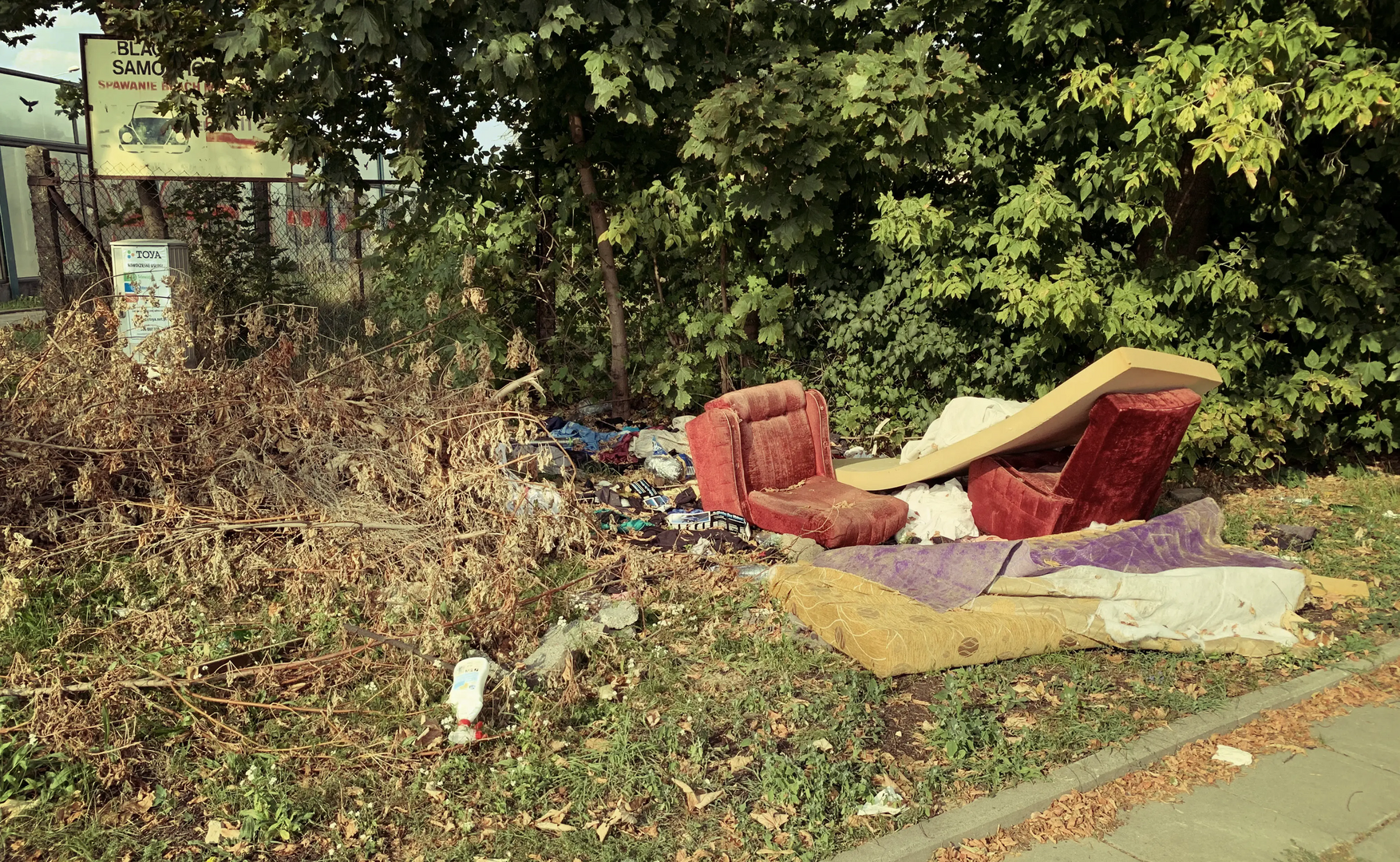
Ruderal spaces are areas that appear to belong to no one – neglected, overgrown with spontaneous vegetation, often located along service roads, embankments, abandoned plots or on the outskirts of built‑up areas. They are easily accessible, yet at the same time give the impression of being deserted and lacking social control.
Dr Maciej Adamiak from the Faculty of Geographical Sciences, University of Lodz, together with a research team led by Prof. Anna Kacperczyk from the Faculty of Economics and Sociology, University of Lodz, has proposed a new analytical category: urban marginal ruderal area.
These are areas situated near tertiary access roads, surrounded by buildings of mixed functions, covered with ruderal vegetation indicating advanced plant succession, and perceived socially as chaotic and neglected spaces. According to the researchers, such locations most often become targets for illegal waste dumping.
How were illegal dumping sites studied?
The research was conducted in Łódź using modern geospatial methods combined with field observations. The researchers drew on field data, Volunteered Geographic Information (VGI), drone imagery (UAV), OpenStreetMap (OSM) data, as well as spatial analyses of the distribution of dumping sites in relation to urban infrastructure and vegetation.
Based on the collected data, a predictive model and a map of the city’s susceptibility to illegal dumping were developed. The results showed that potentially at‑risk areas are present almost throughout the entire city of Łódź.
Waste is not only an aesthetic problem
The authors emphasise that waste is not merely a visual issue. Discarded materials undergo biochemical processes and interact with the environment in uncontrolled ways. Illegal dumping sites may contaminate soil and groundwater, emit toxic chemical compounds, affect the local microclimate, pose sanitary risks and contribute to the degradation of plant and animal habitats.
Spatial analyses revealed a clear relationship between the presence of ruderal vegetation and the location of dumping sites. Places perceived as “wild”, disordered and abandoned are often treated as spaces where unwanted waste can be deposited safely and anonymously.
Paradoxically, these areas are also of considerable ecological value. Ruderal sites increase biodiversity, create enclaves of urban wildlife, function as ecological corridors, enhance cities’ resilience to climate change and help mitigate the urban heat island effect. In many cases, their value stems precisely from the lack of intensive human intervention.
The city and wild nature. A new perspective
Contemporary geography of nature conservation increasingly treats cities not as the opposite of nature, but as parts of complex ecological systems. Urban wild nature is beginning to be seen as an integral element of urbanisation. Concepts such as green infrastructure, ecological networks and ecological corridors are becoming essential for designing modern cities resilient to climate crisis and biodiversity loss.
Researchers highlight an important dilemma: any attempt to “organise” ruderal areas may lead to the loss of their most valuable features. Transforming such spaces into investment areas, highly controlled parks, commercial zones or technical infrastructure often results in the elimination of their spontaneous, wild nature.
This raises an important question – should cities control such spaces, or rather leave them at least partly “wild”?
As Dr Adamiak notes:
Our model shows that changes in land use alter the susceptibility of a given location to illegal dumping. The study is particularly meaningful for spaces where no dumping site exists yet but where the risk is high. It seems that it is enough to take care of areas where ruderal vegetation develops.
Questions about the future of cities
The authors emphasise that the issue of illegal dumping goes far beyond waste management. It concerns the way we think about the city and nature, as well as the relationships between various social actors, waste and the environment.
The research raises a number of important questions: Are we ready to accept the presence of wild nature in the city? Can we protect ruderal areas without fully subjecting them to human control? How can we reconcile the protection of urban wildness with preventing environmental degradation? Will cities of the future be spaces of coexistence between nature and urbanisation, or fully controlled environments?
Illegal dumping sites are not only a problem of waste left in urban space, but also a phenomenon that reveals broader social mechanisms related to responsibility for shared space, everyday practices of residents and the ways urban order is organised. Those interested in this topic, the research findings and activities undertaken in Łódź can find more information at www.dzikiewysypiska.uni.lodz.pl, where the project is presented in a broader social and research context.
The research is funded by the National Science Centre as part of the OPUS26 call: “Dzikie wysypiska - wytwarzanie ładu i nieładu społecznego w przestrzeni miejskiej” [Wild dumping sites – the production of social order and disorder in urban space] (2023/51/B/HS6/02545).
Source: Adamiak M., Brzeziński K., Bulski P., Kacperczyk A., Kossowski M., Statucki P., Żulicki., 2026. Urban marginal ruderal areas as hotspots for illegal waste dumping. Acta Geographica Lodziensia 119; 23-44.