Important dates, registration and fees
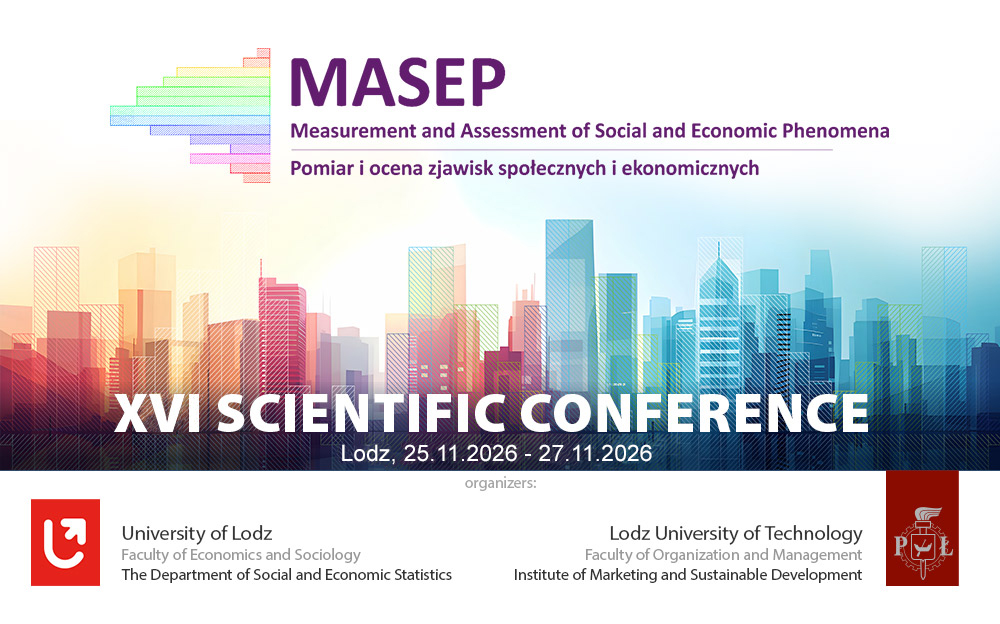
The 16th MASEP Conference 2026 is scheduled for November 25–27, 2026.
The opening ceremony will be held on November 25th.
Debates, plenary, thematic, guest, and poster sessions are planned for November 25th and 26th, followed by training workshops on November 27th.
| Registration Type | Early Bird (until 30 April) | Standard Fee |
|---|---|---|
| Academic / Business Participants | ||
| Conference only | PLN 1,600.00 | PLN 1,900.00 |
| Conference + Workshop | PLN 2,000.00 | PLN 2,300.00 |
| Doctoral Students | ||
| Conference only | PLN 1,100.00 | PLN 1,400.00 |
| Conference + Workshop | PLN 1,500.00 | PLN 1,800.00 |
| Students (Research Group Members) | ||
| Conference only | PLN 900.00 | PLN 900.00 |
The conference fee should be paid by a bank transfer to the following account:
- Uniwersytet Łódzki, ul. Narutowicza 68, 90-136 Łódź
- Bank PEKAO SA
- BIC (SWIFT code) – PKOPPLPW
- IBAN – PL17 1240 3028 1111 0011 6066 7496
- Bank transfer title: “MASEP 2026 Conference, [full name of the participant]”
The fee covers: conference materials, participation in scientific sessions and scientific debate, meals during the conference, gala dinner, artistic/cultural programme, and costs to support the publishing process. For participants who have opted for the conference-plus-workshops package, the fee additionally includes the cost of the 8-hour workshop sessions and a meal on the workshop day.
The costs of publishing the article are paid by the Author(s) directly to the Editor of the journal.
Negative reviews of the submitted article do not constitute grounds for applying for a refund of the conference fee paid.
Detailed information on publishing costs is available on the conference website
To register for MASEP 2026, please complete the registration form
Patronage
About the Conference
The 16th Scientific Conference on the Measurement and Assessment of Social and Economic Phenomena (MASEP 2026) will be held from November 25th to 27th, 2026.
The conference serves as a premier forum for exchanging insights and experiences regarding the application of quantitative methods to contemporary economic and social issues. Now in its sixteenth year, this event continues a long-standing tradition of bringing together scholars and practitioners to discuss the methodological aspects of global challenges—ranging from sectoral performance and economic activity to the overall quality of life.
Call for Guest Sessions
A key highlight of the event will be our Guest Sessions, and we warmly invite proposals for their organization. Hosting a thematic guest session offers a unique opportunity to actively shape the scientific discourse and define the key research directions of MASEP 2026. Proposals for guest sessions can be submitted via the online form (please note that you can toggle the form's display language to English using the selector in the top right corner).
This year's conference focuses on the following issues:
- European countries in the face of the economic and social crisis;
- Sustainable development;
- Innovativeness and competitiveness;
- Artificial Intelligence (AI);
- Labour market and working conditions;
- Population ageing;
- Food economy;
- The tourism sector in the face of environmental and geopolitical challenges.
The full conference programme is scheduled for release in early November.
Training Workshops
The organizers of MASEP 2026, in collaboration with Predictive Solutions Sp. z o.o. and the Statistical Office in Lodz, are pleased to invite you to a series of training workshops held on November 27th, 2026.
These workshops are offered as an optional addition for conference participants. All attendees will receive a certificate confirming the skills acquired during the sessions.
Please note that seating is limited and will be allocated on a first-come, first-served basis.
- Workshop 1: From Data to Knowledge: First Steps in Data Science for Education Using PS CLEMENTINE PRO (conducted in Polish)
- Workshop 2: The Public Services Monitoring System and the Statistical Geoportal (conducted in Polish)
- Workshop 3: Artificial Intelligence in Academic Research (conducted in Polish)
The MASEP 2026 conference sessions (November 25–26) will be held at the Academic Sports and Didactic Center of the Lodz University of Technology – "Zatoka Sportu", located at 10 Politechniki Ave., Lodz.
The training workshops (November 27) – available only to pre-registered participants – will take place in the computer labs of the Lodz University of Technology campus, in the immediate vicinity of Zatoka Sportu.
For your convenience, please find directions to the main venue below:
- By Car
The Zatoka Sportu parking lot can be accessed via three entry points:- 10 Politechniki Ave. (access for those driving toward the City Center),
- Wróblewskiego St. (opposite the Łódź-Górna Tax Office),
- Wólczańska St. (near the intersection with Czerwona St.).
Please note: The parking lot is open to the public and is subject to a fee.
- By Public Transport
- Bus: Lines 72A, 72B, 55 (stop: Park Klepacza) and 57 (stop: Wólczańska/Czerwona).
- Tram: Lines 15 and 16 (stop: Targi Łódzkie, near the Sukcesja mall).
The MASEP 2026 organizers do not provide accommodation for conference participants. However, with your comfort in mind during your stay in Łódź, we have reached out to a trusted accommodation partner:
Holiday Inn Łódź ****
The Holiday Inn is located in the very city centre, at ul. Piotrkowska 229/231.
Website: https://hilodz.com/
Reservations: reservations@hilodz.com
By booking under the code "MASEP", you can take advantage of reduced rates for:
- Standard room (net / gross): PLN 361.11 / PLN 390.00
- Standard twin room (net / gross): PLN 379.63 / PLN 440.00
- Parking (net / gross, per day, per vehicle): PLN 48.78 / PLN 60.00
The offer includes accommodation, breakfast, Wi-Fi access, and use of the sauna and fitness centre.
The offer is valid until 30 September 2026 and is subject to hotel availability.
Guest thematic sessions
Tourism in Transition: Changing Demand, Resilient Destinations and New Research Perspectives
We are pleased to invite researchers to participate in a guest session devoted to the ongoing transformation of the tourism sector, organised as part of the 16th Scientific Conference “Measurement and Assessment of Social and Economic Phenomena” – MASEP 2026.
Tourism is particularly sensitive to changes in the social, economic, environmental and geopolitical environment. Demographic shifts and changing lifestyles, growing environmental awareness, digital transformation, new mobility patterns and evolving tourist preferences, as well as economic and geopolitical uncertainty, are reshaping both the scale and structure of tourism demand and the ways in which tourism businesses and destinations operate.
The session aims to provide a forum for presenting research findings and discussing the changing landscape of contemporary tourism, with particular emphasis on the measurement and determinants of these transformations and their implications for tourists, businesses, cities and regions.
We welcome contributions from researchers in economics, statistics, management, tourism studies, socio-economic geography and related disciplines. We particularly encourage empirical research employing quantitative methods, comparative and spatial analyses, survey data, econometric modelling and forecasting techniques.
Suggested areas for research and scientific discussion include, but are not limited to:
· changing patterns of tourism participation and tourist behaviour;
· socio-economic and demographic determinants of tourism demand and barriers to tourism participation;
· tourism accessibility for different social and demographic groups, including the implications of demographic change and population ageing;
· emerging forms of travel, including urban tourism and city breaks;
· sustainable tourism development and the environmental impacts of tourism;
· the capacity of the tourism sector and destinations to adapt to change and respond to economic, environmental and geopolitical crises;
· competitiveness and development pathways of tourism destinations;
· digitalisation, artificial intelligence and new technologies in tourism;
· spatial and seasonal patterns of tourist flows;
· measurement, modelling and forecasting of tourism demand and tourist flows;
· new data sources and quantitative methods in tourism research.
The session is open and interdisciplinary in scope. We welcome both presentations of completed empirical research and contributions addressing new methodological approaches and emerging research directions that respond to the dynamic transformation of contemporary tourism.
The organisation of the session forms part of the activities undertaken by the University of Lodz Foundation within the “Academy of Sustainable Tourism” project, funded by the Ministry of Science and Higher Education under the “Science for Society II” programme.
The European Union in the face of the multi-dimensional challenges of the 21st century
We warmly invite you to participate in a guest session dedicated to the policies of the European Union and its member states, created in response to changes in the global economy and issues of global development, organized as part of the 16th Scientific Conference “Measurement and Evaluation of Social and Economic Phenomena” – MASEP 2026.
Due to the combined economic significance of its member states, the European Union is both an actor shaping the global social, economic, environmental, and geopolitical environment, as well as an entity influenced by external factors. For this reason, it is important to study the interactions between internal EU processes and external changes, as well as EU policies and those of its member states that are created or modified in response to external events.
The goal of the session organizers is to create a space for presenting research results and discussing changes in European Union policies, designed both to influence global developments (regulating international trade and investment to protect economic openness while respecting environmental and civilizational standards) and to respond to phenomena relatively independent of European states (population processes).
We invite researchers representing economics, statistics, management, socio-economic geography, and other disciplines addressing the issues of global economic changes and the evolution of EU policies.
The proposed areas for analysis and academic discussion include, among others:
- Trade and investment flows between EU countries and other regions of the world;
- Negotiation of multilateral trade agreements and partnerships between the EU and selected countries around the world;
- Prospects for sustainable development on a global scale and within economically mature regions (countries of de-growth or post-growth);
- Population processes and policies on migration and temporary economic immigration;
- Protection of global public goods, including maritime transport and sea resources;
- Security of transregional transport of goods and people;
- Global technology transfers, innovation, and the dissemination of digital skills;
- The EU's impact on the global energy transition;
- Methodological challenges in research on global economic processes: new data sources and methods for modeling economic processes.
The session is open and interdisciplinary. We encourage both presenting completed research results and discussing new methodological approaches and research directions needed to adequately explain EU policy in the context of contemporary economic changes.
Session Organizer: Professor Joanna Garlińska-Bielawska, Head of the Department of European Studies and Economic Integration, Krakow University of Economics
The Creative Sector – Value Creation, Business Models and Development Challenges
The session aims to provide a forum for presenting research findings and discussing how creative professionals, enterprises and institutions generate cultural, social and economic value. Particular attention will be paid to differences in development across creative industries, ranging from rapid growth to stagnation and decline, and to the factors preventing them from realising their potential. Discussions will also address the long-term viability, organisation and funding of creative activities, alongside the psychosocial dimensions of creative work.
Suggested areas for research and academic discussion include:
· creative industries with strong growth potential and those experiencing stagnation or decline – comparative perspectives, underlying factors and prospects for change;
· business models, entrepreneurship and revenue streams in the creative sector;
· the role of creative skills, trust and collaborative networks in value creation;
· working conditions, barriers to development and the economic stability of creative activities;
· the experiences of highly sensitive individuals with creative talent, including coping with evaluative pressure, overload and external expectations;
· neurodiversity in the creative sector, including the experiences of creative professionals with ADHD, work organisation, talent development and support needs;
· the impact of digitalisation and artificial intelligence on creative processes and relationships with audiences and customers;
· the contribution of the creative sector to urban and regional development;
· methods for measuring and assessing changes in the sector and the economic, social and cultural outcomes of creative activities.
The session is open and interdisciplinary. We welcome researchers in management, economics, psychology, sociology, cultural studies, art studies and related disciplines. We encourage contributions drawing on quantitative, qualitative and mixed-methods research, including interview-based studies involving representatives of different creative industries.
Session Organizer: dr Katarzyna Caban-Piaskowska, Strzemiński Academy of Fine Arts Łódź.
Climate change and the transition towards a low-carbon economy are becoming increasingly important areas of economic, social and environmental research. Their impacts are multidimensional, evolve across space and time, and may propagate across countries, regions, sectors and markets. At the same time, the growing availability of data and rapid advances in statistical, econometric and artificial intelligence methods create new opportunities for studying these complex processes and interdependencies.
As part of the 16th Scientific Conference “Measurement and Assessment of Social and Economic Phenomena” – MASEP 2026, we invite researchers to participate in a guest session devoted to climate change, climate risk, the energy and low-carbon transition, and their socio-economic implications.
The session aims to bring together two complementary perspectives: research on climate-related processes and their impacts on economies and societies, and modern data-driven methods for analysing dynamic, spatial and networked phenomena. We particularly welcome studies that account for interdependencies among countries, regions, sectors, firms or financial institutions, as well as changes in these relationships over time.
We invite contributions from all researchers working on climate-related issues and the climate transition, regardless of the methodological approach adopted. The session is open to both classical empirical and econometric studies and research applying machine learning, artificial intelligence, network analysis, and spatial and spatio-temporal modelling.
Suggested areas for research and scientific discussion include, but are not limited to:
· economic and social consequences of climate change;
· physical and transition climate risk;
· extreme weather events and natural disasters and their economic impacts;
· energy transition and the transition towards a low-carbon economy;
· resilience and adaptive capacity of countries, regions, sectors and firms;
· climate-related impacts on financial markets, banking and insurance;
· spatial and temporal patterns of climate risk;
· transmission of climate-related risks and interdependencies across countries, regions and sectors;
· network analysis and dynamic networks in climate-related research;
· artificial intelligence, machine learning and deep learning for climate and socio-economic data;
· spatial, temporal and spatio-temporal neural networks, including Graph Neural Networks;
· forecasting climate risk and the consequences of the low-carbon transition;
· new data sources, integration of heterogeneous data, and methods for analysing large and complex datasets;
· new statistical, econometric and computational methods for climate-related research.
The session is open and interdisciplinary. We welcome both researchers for whom climate-related issues constitute the primary focus of their work and researchers developing or applying innovative data-analysis methods that can contribute to the study of climate change, energy transition and climate risk.
We aim to create a forum bringing together researchers from economics, finance, statistics, econometrics, data science, mathematics, computer science, geography and environmental sciences, and to encourage exchange between applied climate research and the development of new quantitative and computational methods.
Session Organizer: Professor Anna Denkowska, Department of Mathematics, Institute of Quantitative Methods in Social Sciences, Krakow University of Economics
For authors
Monograph / Conference Proceedings
The organizers plan to publish a peer- reviewed monograph with a Level II publisher according to the classification of the Ministry of Science and Higher Education - 75 pts.
ISSN: TBA
Publication Language: English
Author Guidelines: TBA
Bulletin of Geography: Socio-economic Series
Included in the Ministry of Science and Higher Education (MNiSW) list of ranked journals - 100 pts.
ISSN: 1732-4254
Publication Language: English
Author Guidelines: link
Central European Economic Journal
IIncluded in the Ministry of Science and Higher Education (MNiSW) list of ranked journals - 70 pts.
ISSN: 2543-6821
Publication Language: English
Author Guidelines: link
Comparative Economic Research. Central and Eastern Europe
Included in the Ministry of Science and Higher Education (MNiSW) list of ranked journals - 100 pts.
ISSN: 1508-2008
Publication Language: English
Author Guidelines: link
Economics and Business Review
Included in the Ministry of Science and Higher Education (MNiSW) list of ranked journals - 70 pts.
ISSN: 2392-1641
Publication Language:English
Author Guidelines: link
Ekonomia i Prawo. Economics and Law
Included in the Ministry of Science and Higher Education (MNiSW) list of ranked journals - 70 pts.
ISSN: 1898-2255
Publication Language: English
Author Guidelines: link
Ekonomia i Środowisko. Economics and Environment
Included in the Ministry of Science and Higher Education (MNiSW) list of ranked journals - 100 pts.
ISSN: 0867-8898
Publication Language: English
Author Guidelines: link
Statistics in Transition
Included in the Ministry of Science and Higher Education (MNiSW) list of ranked journals - 70 pts.
ISSN 1234-7655, e-ISSN 2450-0291
Publication Language: English
Author Guidelines: link
Humanities and Social Sciences
Included in the Ministry of Science and Higher Education (MNiSW) list of ranked journals - 70 pts.
ISSN: 2300-5327; e-ISSN 2300-9918
Publication Language: angielski
Author Guidelines: link
Acta Universitatis Lodziensis Folia Oeconomicca (FoE)
Included in the Ministry of Science and Higher Education (MNiSW) list of ranked journals - 40 pts.
ISSN: 0208-6018, eISSN: 2353-7663
Publication Language: English
Author Guidelines: link
Annales Universitatis Mariae Curie-Skłodowska, Sec. H Oeconomia
Included in the Ministry of Science and Higher Education (MNiSW) list of ranked journals - 70 pts.
ISSN: 0459-9586
Publication Language: English
Author Guidelines: link
Optimum. Economic Studies
Included in the Ministry of Science and Higher Education (MNiSW) list of ranked journals - 70 pts.
ISSN: 1506-7637
Publication Language: English, Polish
Author Guidelines: link
Zeszyty Naukowe SGGW, Polityki Europejskie, Finanse i Marketing
Included in the Ministry of Science and Higher Education (MNiSW) list of ranked journals - 40 pts.
ISSN: 2081-3430, eISSN: 254-0640
Publication Language: English
Author Guidelines: link
Econometrics. Ekonometria. Advances in Applied Data Analysis
Included in the Ministry of Science and Higher Education (MNiSW) list of ranked journals - 40 pts.
ISSN: 1507-3866, eISSN: 2449-9994
Publication Language: angielski
Author Guidelines: link
Abstracts of submitted papers must be uploaded to the abstract repository (link below).
Please note that submitting an abstract to the MASEP 2026 organizers is not equivalent to submitting it to the journal's editorial office. These two actions are independent of each other.
The abstract should be prepared in accordance with the guidelines provided in the abstract template.
Digital versions of posters to be presented in poster sessions should be sent to the organisers of MASEP 2026 by submitting them to the poster repository (link below).
Poster dimensions - 70x100 cm, vertical orientation. If possible, please print on a rigid material such as Styrofoam. This will make it easier for us to display the posters on an easel. However, if this is not possible, we will provide a solution on site.
We would like to inform you that you can have your poster printed in the immediate vicinity of the Sports Bay - Media Press Printing House, 19a Wróblewskiego St., tel. 042 682 60 25. The printing house is located about 800 m from the conference venue. Please note that printing and delivery to the venue is the responsibility of the poster author(s).
Feel free to use the conference logo in your materials.
Presentations should be submitted to the abstract repository (link below).
Feel free to use the conference logo in your materials.
Organisers
Chair of the Scientific Committee
dr hab. Maria M. Grzelak, prof. UŁ, Uniwersytet Łódzki
Vice-Chairs of the Scientific Committee
dr hab. Justyna Wiktorowicz, prof. UŁ, Uniwersytet Łódzki
dr hab. Małgorzata Koszewska, prof. PŁ, Politechnika Łódzka
Members of the Scientific Committee
doç.dr. Gultekin Altuntas, Istanbul University, Turcja
dr hab. Adam Balcerzak, prof. UWM, Uniwersytet Warmińsko-Mazurski w Olsztynie
dr hab. Teresa Bednarczyk, prof. UMCS, Uniwersytet Marii Curie-Skłodowskiej
dr inż. Katarzyna Boczkowska, Politechnika Łódzka
prof. Alessandro Bonadonna, University of Turin, Włochy
dr hab. inż. Elżbieta Broniewicz, prof. PB, Politechnika Białostocka
prof. dr hab. Sławomir Bukowski, Uniwersytet Technologiczno-Humanistyczny im. Kazimierza Pułaskiego w Radomiu
dr hab. Grażyna Dehnel, prof. UEP, Uniwersytet Ekonomiczny w Poznaniu
prof. dr hab. Józef Dziechciarz, Uniwersytet Ekonomiczny we Wrocławiu
dr hab. Joanna Garlińska-Bielawska, prof. UEK , Uniwersytet Ekonomiczny w Krakowie
dr hab. Małgorzata Grzywińska-Rąpca, prof. UWM, Uniwersytet Warmińsko-Mazurski w Olsztynie
dr hab. Arkadiusz Kijek, prof. UMCS, Uniwersytet Marii Curie-Skłodowskiej
dr hab. Tomasz Kijek, prof. UMCS, Uniwersytet Marii Curie-Skłodowskiej
prof. dr hab. Patrycja Klimas, Uniwersytet Ekonomiczny we Wrocławiu
prof. dr hab. Ewa Kmiecik, Akademia Górniczo-Hutnicza im. S. Staszica w Krakowie
dr hab. Jarosław Korpysa, prof. US, Uniwersytet Szczeciński
prof. Natalia Kryvinska, Comenius University in Bratislava, Słowacja
dr hab. Robert Kurek, prof. UEW, Uniwersytet Ekonomiczny we Wrocławiu
prof. dr hab. Eugeniusz Kwiatkowski, Politechnika Warszawska
prof. Ing. Lubor Lacina, Mendel University in Brno, Czechy
dr hab. Marzanna Lament, prof. UTH Rad., Uniwersytet Technologiczno-Humanistyczny im. Kazimierza Pułaskiego w Radomiu
dr hab Renata Lisowska, prof. UŁ, Uniwersytet Łódzki
dr hab. Marta Maciejasz, prof. UO, Uniwersytet Opolski
dr hab. Marek Matejun, prof. UŁ, wiceprezes Zarządu PTE Odział w Łodzi
dr hab. Iwona Markowicz, prof. US, Uniwersytet Szczeciński
dr Alena Mojsejova, Technical University of Košice, Słowacja
dr inż. Konrad Niziołek, Politechnika Łódzka
prof. dr hab. Ewa Okoń-Horodyńska, Uniwersytet Jagielloński
prof. dr hab. Tomasz Panek, Szkoła Główna Handlowa w Warszawie
dr hab. Jolanta Perek-Białas, prof. UJ, Uniwersytet Jagielloński
dr Paweł Piątkowski, Uniwersytet w Białymstoku
dr hab. Michał Pietrzak, prof. PG, Politechnika Gdańska
dr hab. Bogusław Plawgo, prof. UwB, Uniwersytet w Białymstoku
prof. dr hab. Stanisław Popek, Uniwersytet Ekonomiczny w Krakowie
prof. dr hab. Olha Prokopenko, Sumy State Makarenko Pedagogical University, Ukraina
dr Dragana Radicic, University of Lincoln, Wielka Brytania
dr hab. inż. Renata Salerno-Kochan, prof. UEK, Uniwersytet Ekonomiczny w Krakowie
dr hab. Agnieszka Stanimir, prof. UEW, Uniwersytet Ekonomiczny we Wrocławiu
dr Justyna Stecko, Politechnika Rzeszowska
dr. oec. Jelena Titko, The EKA University of Applied Sciences, Łotwa
prof. dr hab. Bogusława Urbaniak, Uniwersytet Łódzki
dr inż. Anna Walaszczyk, Politechnika Łódzka
dr hab. Stanisław Wanat, prof. UEK, Uniwersytet Ekonomiczny w Krakowie
dr hab. Rafał Wisła, prof. UJ, Uniwersytet Jagielloński
prof. Ildiko Virag Neumann, University of Pannonia, Węgry
dr Nataliya Voytovych, Ukraina
prof. dr hab. inż. Agnieszka Zakrzewska - Bielawska, Politechnika Łódzka
dr Marta Znajmiecka, Stowarzyszenie Rozwoju Kadr w Łodzi
dr hab. Katarzyna Żyminkowska, prof. UBB, Uniwersytet Bielsko-Bialski
The Department of Social and Economic Statistics is an independent unit conducting research, scientific and teaching activities within the framework of the Institute of Statistics and Demography at the Faculty of Economics and Sociology of the University of Lodz.
The Department's employees conduct teaching activities at the Faculty of Economics and Sociology, the Faculty of Law and Administration, the Faculty of Educational Sciences and the Faculty of Management in the fields of Computer Science and Econometrics, Economic Analysis, Social Analysis, Economics, European Studies, Finance and Accounting, Logistics, International Economic Relations, Social Work, Social Policy, and Sociology, as well as seminars for PhD students at the Faculty of Economics and Sociology and the Faculty of Management.
The Department's employees are involved in many international, national and regional research projects.
The Department has been the organiser of ten editions of biannual conference entitled “The Application of Statistics in Social and Economic Analysis in the Process of Integration with the European Union”.
Department of Social and Economic Statistics
Head of the Department: dr hab. Maria Magdalena Grzelak, prof. UL
phone: (0048) 42 / 635 48 31
The Institute of Marketing and Sustainable Development is one of two institutes operating within the Faculty of Organization and Management at the Lodz University of Technology. Within its structure, there are five departments: Marketing, Sustainable Production and Consumption, Quality and Technology Transfer, Ecotechnology, and Humanities. The Institute's scientific activities align with the priority research areas of the Faculty, such as organizational perspectives, management in the context of sustainable development, and technology in organizational management.
The Institute's staff members participate in various research projects. Currently, the Institute is involved in projects, including those within programs such as Horizon 2020: SAPIENS - "Sustainability and Procurement in International, European, and National Systems," Erasmus+: "Educate4green," and "Skills4Future."
Institute of Marketing and Sustainable Development
Director: dr hab. Małgorzata Koszewska, prof. PŁ
phone: (0048) 42 / 631 32 54
Chairperson: dr hab. Elżbieta Roszko-Wójtowicz, prof. UŁ
Secretary: dr Łukasz Ziarko (University of Lodz)
Secretary: mgr Patryk Stawicki (University of Lodz)
Contact
Correspondence regarding participation in the MASEP 2026 should be addressed to masep@uni.lodz.pl
Contact to members of the Organising Committee:
Chair: Elżbieta Roszko-Wójtowicz, e-mail: elzbieta.roszko@uni.lodz.pl
Secretary: Łukasz Ziarko, e-mail: lukasz.ziarko@uni.lodz.pl
Secretary: Patryk Stawiarski, e-mail: patryk.stawiarski@uni.lodz.pl