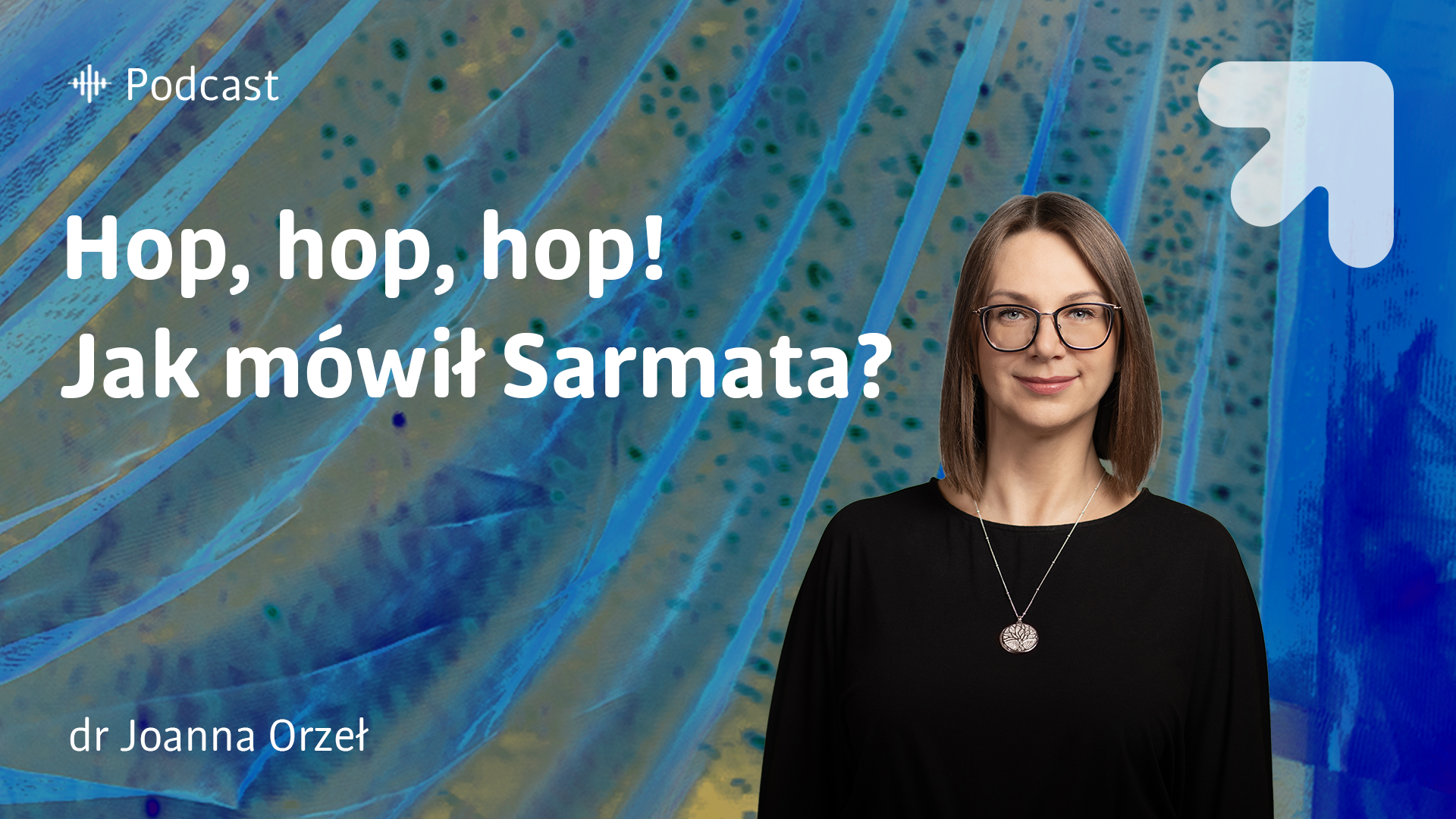
The podcast series “Aleja Badaczek” (Female Researchers' Alley), recorded in cooperation between the University of Lodz and Radio 357, presents female scientists who help to better understand the phenomena influencing social life – here, the popular science book by Dr Joanna Orzeł: "My, Sarmaci… Mity i rzeczywistość szlachty Rzeczypospolitej" [We, Sarmatians... Myths and reality of the nobility of the Polish-Lithuanian Commonwealth] is the starting point.
Should we popularise science?
The conversation begins with the work of scientists created in laboratories, libraries and archives – often in places isolated from society, hermetic. As Dr Joanna Orzeł underlines, the academic community still too rarely discusses its research in a language understandable to the general public:
Unfortunately, scientists still have a reluctance to reach out to the masses, to speak plainly about complex matters. This results in a proliferation of conspiracy theories and fantasies that are unsubstantiated by research and yet have a greater social impact than our scientific textbooks.
The Ministry of Science and Higher Education is only now recognising the need to popularise science and speak about it in plain language. However, the lack of systemic incentives remains a problem – popularising scientific research does not directly translate into promotions or employee evaluations.
The word "Sarmatian" didn't always mean the same thing
In the 16th century, this term referred to inhabitants of the Polish-Lithuanian Commonwealth; it wasn't until the 17th century that the term was appropriated by the nobility. Over time, its meaning began to change – during the Age of Enlightenment, "Sarmatian" was often synonymous with someone impulsive, uneducated or abusing alcohol, although at the same time, "enlightened Sarmatians" were also referred to as "Sarmatians" who were open to new ideas.
The source of the concept itself was the myth of the nobility's descent from the ancient Sarmatian people. As the researcher explains, the chronicler Jan Długosz played a crucial role in popularising it, interpreting ancient accounts to place Poland's history within the history of very ancient, advanced civilizations.
The myth was later developed by 16th-century chroniclers, and over time, it became a prestige-building element for the Jagiellonian state and its elites.
Troy, the Amazons and the Roman legions – the power of myth
Stories about the Sarmatians were often incredibly colourful. According to accounts, they existed as early as the Trojan War, maintained contacts with the Amazons, and, above all, were such a valiant people that they effectively held back the expansion of the Roman Empire in this part of Europe.
Such stories, though scientifically unsubstantiated, served an important function – building a sense of community and uniqueness.
It was a myth developed, as it were, 'to order' – the aim was to establish a founding myth and establish the dignity of a very old state and its ancient roots.
Loan translations that have survived to this day
Contemporary notions of nobility are largely based on established patterns – often drawn more from literature and cinema than from history.
To this day, most people know the meaning of terms or phrases such as:
- "Poland, the granary of Europe",
- "bulwark of Christianity",
- kontusz, żupan, coffin portrait or hussars.
As Dr Orzeł emphasises, even such a well-known term as the "granary of Europe" requires further clarification:
I agree that it was a granary, but of the Netherlands.
The supply of grain and timber from Gdańsk to Dutch ports was driven, in part, by a cooling climate and crop problems in northwestern Europe. However, this economic model was not sustainable – the emergence of new crops and competition changed the economic situation in the Polish-Lithuanian Commonwealth.
Honour and Identity
Not all elements of the Sarmatian heritage are merely myth, however. A strong sense of honour and duty to the state was indeed an important element of the noble ethos.
Titles of nobility were often earned on the battlefield, and the belief in the necessity of personal defense of the homeland was deeply rooted. Sources even include the belief that defensive walls were unnecessary, as the country could be defended more effectively "with one's own breasts."
Why do we keep returning to the Sarmatians?
The return to Sarmatian themes in contemporary culture is no accident. As the researcher notes, Poles are constantly searching for stories about their own roots and identity.
At the same time, historical knowledge can be fragmented – school curricula often present history selectively, omitting, for example, the multi-denominational nature of the former Polish-Lithuanian Commonwealth. This, in turn, fosters simplifications and stereotypes.
From "Europe's Granary" to "Hop, Hop, Hop" – how myth becomes memory
The conversation with Dr Joanna Orzeł shows that Sarmatism is not just a closed chapter in a history textbook. It's a living collection of ideas that we still operate on – often without reflection. On the one hand, we have the myth of ancient ancestors who, even during the Trojan War, were supposed to have existed as a valiant people and held back the Roman legions. On the other, we have modern simplifications, in which the Sarmatian can be either a rough adventurer or a romantic defender of the homeland.
Our collective memory still embodies slogans like "Poland, the granary of Europe," "the bulwark of Christianity," and "God, honour and fatherland." We rarely consider that the "granary" primarily meant an economic base for the Netherlands, and that the myth of the bulwark obscured the multi-faith nature of the former Polish-Lithuanian Commonwealth. Even less often do we ask where we actually know what we know – whether from historical research, or rather from literature, film and contemporary television series.
This is why we can argue passionately about the 17th and 18th centuries today, as if they were current affairs. Sarmatism, then, is not merely a thing of the past – it's an element of our identity, built on a blend of facts, political narratives, literary visions and later stereotypes.
The podcast conversation demonstrates that separating myth from reality doesn't mean stripping history of its vividness. Rather, it means restoring its proportions – so that we can see real historical processes between the kontusz and the chronicle, between the Amazons and the Roman legions.
Dr Joanna Orzeł is a historian and Polish philologist by training. She defended her doctoral dissertation in history at Nicolaus Copernicus University in Toruń in 2015. That same year, she began working at the Institute of History, University of Lodz. Her work focuses on two aspects: on the one hand, she conducts research on: the intellectual and cultural history of the 18th century, the history of noble culture in the Polish-Lithuanian Commonwealth and the education of the nobility, particularly educational travel. On the other hand, she teaches students, primarily in the areas of: the history of modern Poland, the history of travel and broadly defined cultural history (including history in fiction and the history of cinema). Dr Orzeł's main research interests include: the intellectual and cultural history of the 18th century, the noble culture of the Polish-Lithuanian Commonwealth, the editing of historical sources and contemporary editing. She is committed to popularising science, reaching diverse audiences.
She has received scholarships, among other things, from the French government and the Lanckoroński Foundation and has participated in numerous national and international research projects. She is currently involved in a project on the image of the Polish-Lithuanian Commonwealth in 18th-century European dictionaries and encyclopaedias.
You can find more great content about science on the “Science Inspires” series.
Edit: Honorata Ogieniewska, Centre for External Relations and Social Responsibility of the University, University of Lodz