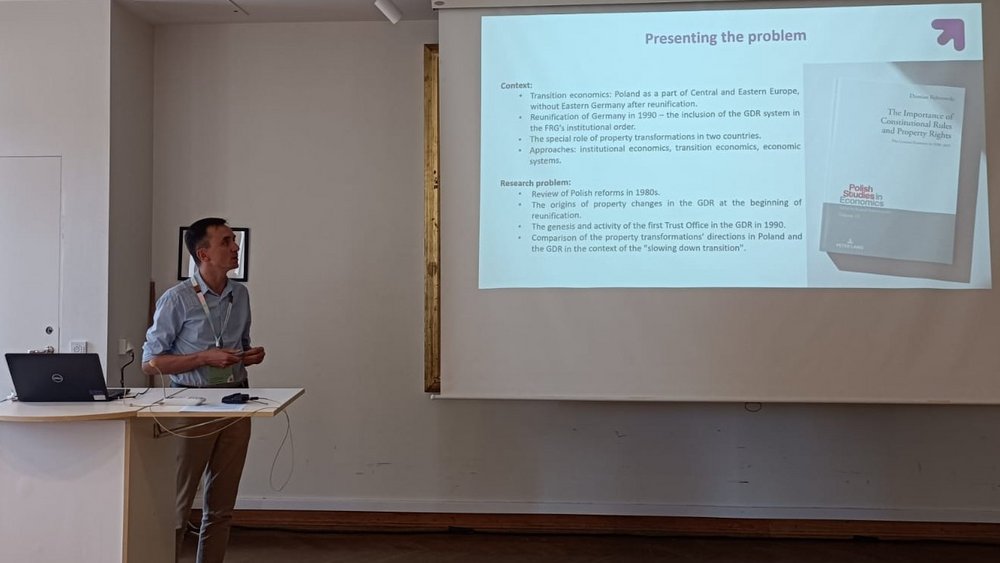
Dr Bębnowski's distinguished book was recognised for its contribution to the analysis of the role of key formal institutions during the quarter-century of post-reunification economic development in Germany. The author combines perspectives from institutional economics and economic history and employs methodological pluralism, encompassing both qualitative and quantitative approaches. He argues that a stable constitutional framework and consistent property rights were crucial for the implementation of the ordoliberal model of the social market economy in the new federal states and for the unification, integration and convergence of both parts of Germany. Despite the significant costs (not only financial), this complex process should be viewed positively. The work is based on a broad source base (legislative acts and statistical materials) as well as extensive literature on the subject.
The publication has already been honoured with the Individual Award of the Third Degree of the Rector of the University of Lodz (2023) and the Honourable Mention of the Polish Society of Economic History in the Competition for the Franciszek Bujak Award for the best book in the field of economic and social history (2024).
Dr Damian Bębnowski is a historian and an economist. He has served as a visiting scholar at the Harriman Institute, Columbia University in New York. His research interests focus on economic history, institutional economics and socioeconomic thought. He has received scholarships from, among other things, the Kościuszko Foundation. He has conducted research in the USA (Columbia, Harvard) and Germany (JLU Giessen, Humboldt, Regensburg, RUB Bochum). He is known to students for his courses on the history of economics, the history of economic thought, microeconomics, institutions in the economy, the contemporary German economy, the main trends in contemporary economics, economic powers throughout history (China, the USA, the USSR), economic systems, and historical and economic themes in Nobel-winning economic research. He cooperates with the Ratzingerianum Research Center, Nicolaus Copernicus University in Toruń.
We would like to offer our heartfelt congratulations and wish you continued scientific success!