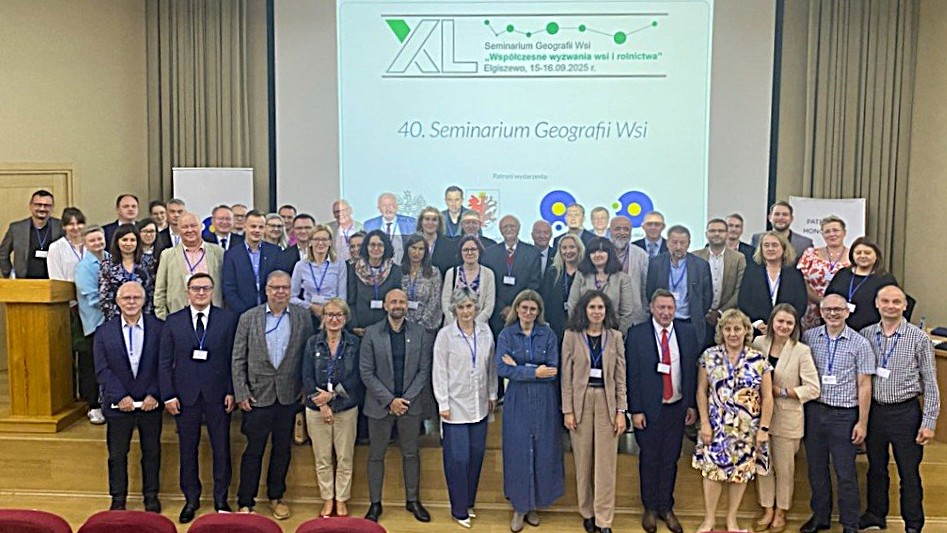
The University of Lodz had an exceptionally strong and visible presence at the Congress. Approximately 40 researchers associated with our university – staff, doctoral students and students – participated in the event. This was one of the largest delegations, clearly demonstrating the diverse and dynamic geography we are developing in Lodz.
The thematic scope of the presentations prepared by representatives of the University of Lodz covered almost all areas of contemporary geographical sciences. Our scholars addressed issues in physical geography and paleogeography, analysing, among other things, environmental changes, geomorphological processes and the evolution of lakes. Researchers representing socio-economic geography and spatial management discussed urban transformations, the European Union's cohesion policy and contemporary migration processes. Political and historical geography were also present, as part of which issues of borders, spatial memory, and the identity of places were discussed. There were also presentations devoted to the geography of tourism and education, addressing topics such as the future of geography teaching and the development of tourism research. Modern research trends – GIS, remote sensing and geoAI –including innovative methods of mapping, spatial data analysis and the application of artificial intelligence in geography – were also strongly emphasized.
Representatives of the University of Lodz took on various roles: as authors of papers and posters, organisers of thematic sessions, chairpersons of the sessions, and panellists on prestigious panels. The participation of dr hab. Marta Borowska-Stefańska, Associate Professor at the University of Lodz, in a panel devoted to the challenges facing geographical disciplines from the perspective of young researchers was a particular highlight. Our researcher's presence in such an important debate underlined the University of Lodz's role in shaping the future of geography in Poland and Europe.
The participation of such a large and diverse team from the University of Lodz made a significant contribution to the development of Polish geography – both scientifically and practically. The Congress demonstrated that Lodz is one of the most important geographical centres in the country, and our research is valued and recognised nationally.
The Congress was also accompanied by artistic events as part of the GeoArt Lublin Festival, which served as a reminder that geography is not limited to scientific research but also inspires culture, art and social awareness. Although the main sessions had concluded, participants attended field sessions, which allowed for a practical perspective on selected topics.
Source: dr hab. Marcin Wójcik, Associate Professor at the University of Lodz, Faculty of Geographical Sciences, University of Lodz
Edit: Press Office, University of Lodz