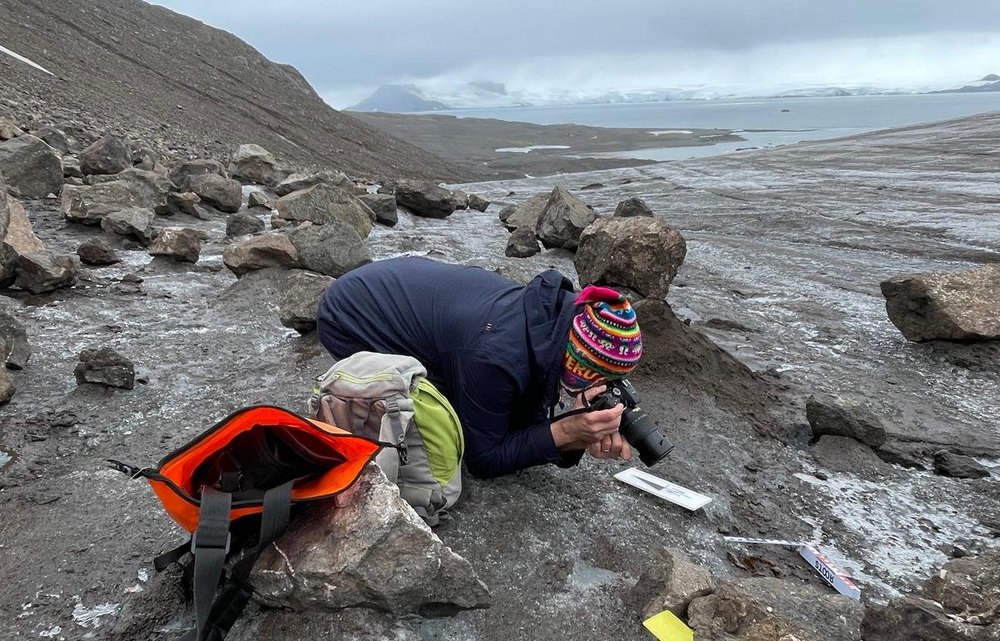
The research was conducted in cooperation with the Arctowski Polish Antarctic Station and the Institute of Biochemistry and Biophysics of the Polish Academy of Sciences, in difficult and dangerous glacial conditions.
The remains of the polar explorer were exposed by the melting glacier. They were found (along with everyday items: a wristwatch, a pipe and a radio) by Polish researchers from an expedition operating near the Arctowski Polish Antarctic Station. Some of the bones were found in loose ice and rocks embedded at the foot of a glacier on King George Island. The rest were found on the glacier's surface.
Scientists from the University of Lodz, Prof. Piotr Kittel, Dr Paulina Borówka and Dr Artur Ginter, meticulously archived and examined the remains. They discovered that they belonged to Dennis Ronald Bell, nicknamed "Tink," a meteorologist and a winter cook at Admiralty Bay Station, a husky enthusiast, and one of the pioneers of mapping King George Island. He tragically died after falling into a glacial crevasse.
You can read more about this extraordinary story in the BBC article.
Source: BBC, Faculty of Biology and Environmental Protection, Institute of Archaeology, University of Lodz
Edit: Press Office, University of Lodz