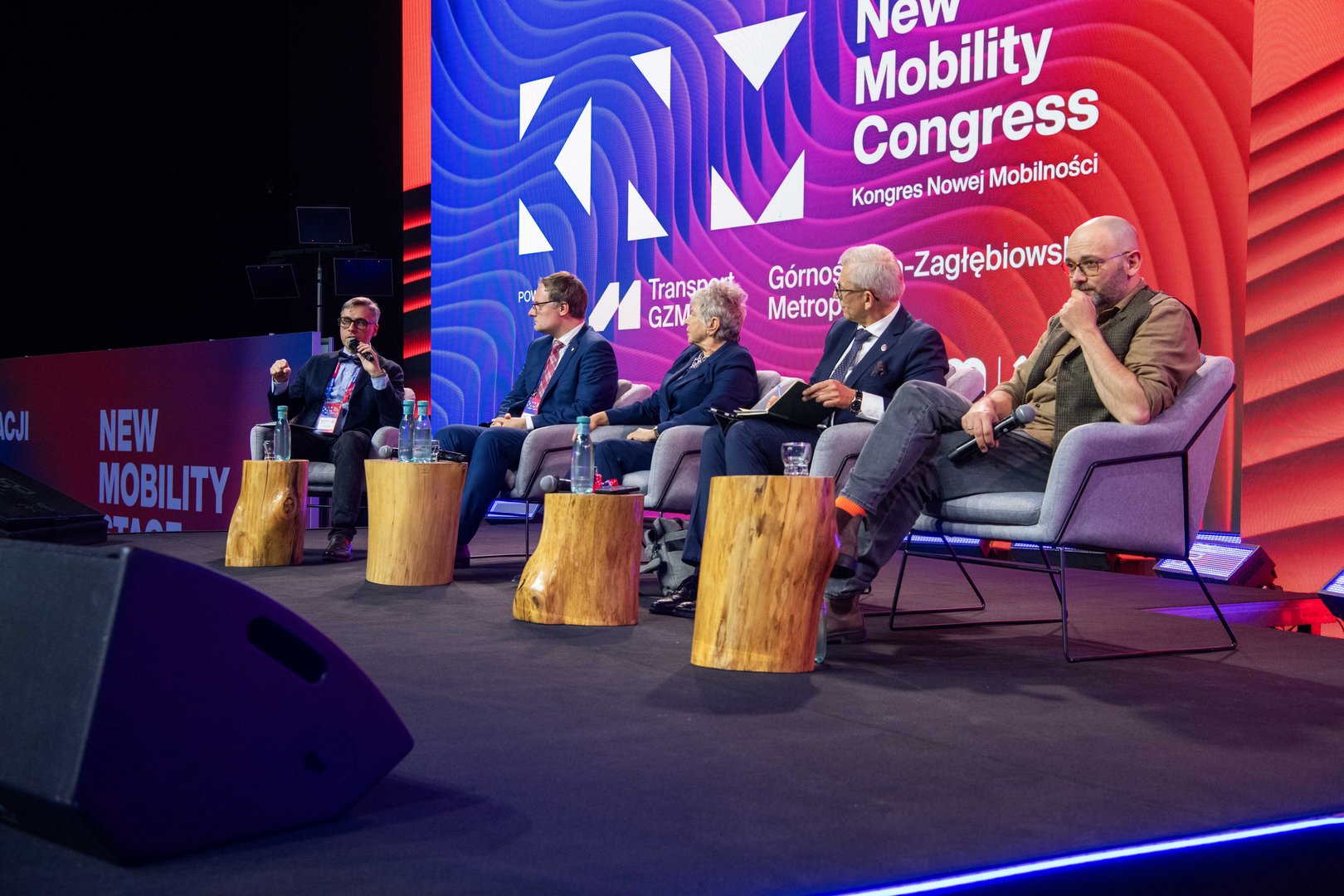
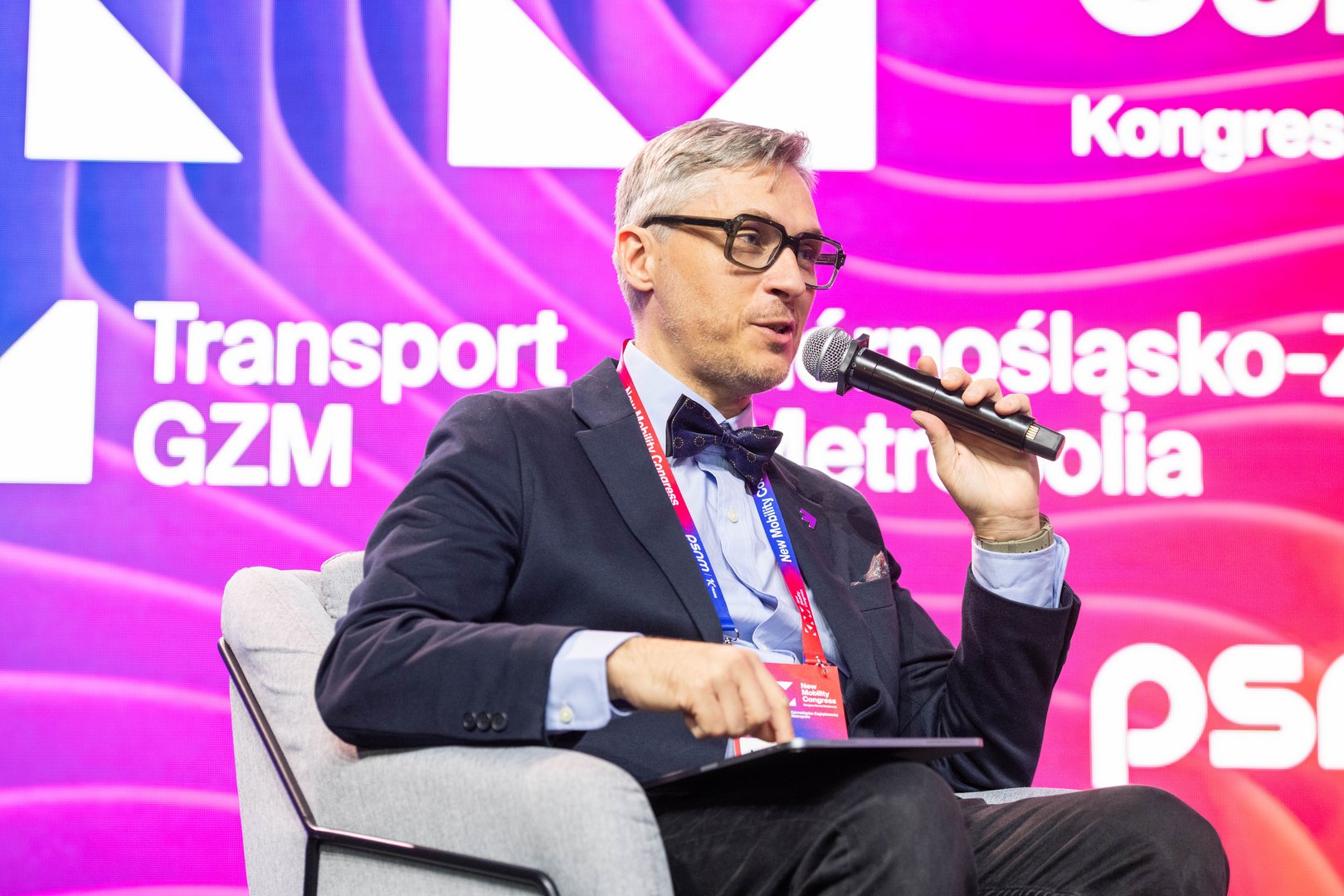

Alongside Prof. Mariusz Sokołowicz, the following panellists took part in the discussion:
- Kamil Żbikowski, Mayor of Zabrze,
- Krzysztof Kwiatkowski, Senator of the Republic of Poland,
- Joanna Sekuła, Senator of the Republic of Poland,
- Filip Springer, curator of the New Architecture & Construction track at the New Mobility Congress 2026.
“Future-Resilient Cities: How to Plan Development in an Era of Uncertainty?” Session
Contemporary cities operate in a context shaped by multiple overlapping changes and threats. Climate change, technological transformation, demographic processes, geopolitical tensions and threats to digital infrastructure all influence how urban development should be approached today.
Urban resilience therefore does not solely mean the ability to respond to crisis situations. It is also the ability to maintain a city’s essential functions, ensure residents’ access to services and infrastructure, and adapt to changing conditions.
During the session, participants discussed, among other topics, how residents understand the concept of resilience and what concerns them most in terms of the security of Poland, their cities and their immediate surroundings. The role of mobility, both transport-related and understood in a broader sense, in building the resilience of contemporary cities was also an important element of the discussion.
Research on Urban Resilience
The issue of urban resilience and residents’ concerns is reflected in research conducted over the past two years. In a study published at the beginning of 2026, active wars and conflicts were identified as a source of concern by 72% of European Union residents. The next most frequently cited threats were terrorism (67%), natural disasters intensified by climate change (66%), cyberattacks (66%), and uncontrolled migration (65%) (European Parliament, 2026). At the same time, information-related threats formed an important category of concern, including disinformation, content manipulated using artificial intelligence and insufficient protection of personal data. This means that contemporary perceptions of security encompass far more than protection from physical violence or armed conflict. They increasingly relate to the continuity of digital systems, the reliability of information, access to essential services and the resilience of infrastructure.
A similar picture emerges from a Pew Research Center study conducted in 25 countries in 2025. The spread of false information online was regarded as a major threat to their country by 72% of respondents, while 70% pointed to the state of the global economy and 69% to terrorism. Disinformation was the most frequently identified threat in, among others, Poland, Germany, the Netherlands, Sweden, the United Kingdom, the United States and South Korea. Climate change and infectious diseases were also among the most significant concerns (Poushter et al., 2025). These findings demonstrate that similar fears occur in countries with different political, economic and cultural experiences. The issue is therefore not one specific type of crisis, but rather the growing significance of broadly understood uncertainty and societies’ vulnerability to successive and overlapping disruptions.
Research published in the Future Risks Report, conducted by AXA in cooperation with Ipsos and involving more than 23,000 participants from over 50 countries, highlighted particular concerns related to climate change, geopolitical instability, cyber threats, and risks associated with artificial intelligence and large datasets (AXA, 2024). The 2025 edition additionally pointed to a growing sense of vulnerability to overlapping crises, as well as concerns regarding social polarisation and the weakening of social cohesion (AXA, 2025). In this context, the concept of a polycrisis (Tooze, 2022) becomes especially important: contemporary threats do not occur in isolation but can create sequences and feedback loops.
This picture is also reflected in Polish research findings. In a CBOS study conducted among people born between 1980 and 2006, mass migration from Africa and the Middle East to Europe and the outbreak of a Third World War each raised concerns among 68% of respondents (CBOS, 2025a). The possibility of Russian aggression against Poland, restrictions on democracy, the consequences of artificial intelligence development, growing economic inequalities and demographic processes were also ranked highly. At the same time, another CBOS study showed that in 2026, 89% of respondents regarded Poland as a safe country to live in, while 97% declared that they felt safe in their place of residence (CBOS, 2026b). The apparent contradiction between these findings is, however, misleading. A high sense of security within one’s immediate surroundings may coexist with strong concerns about war, systemic crises or the country’s future. Everyday security and perceptions of vulnerability to major crises therefore constitute separate dimensions of social perception.
The New Mobility Congress is the largest conference and EXPO in the CEE region dedicated to sustainable development and new mobility.