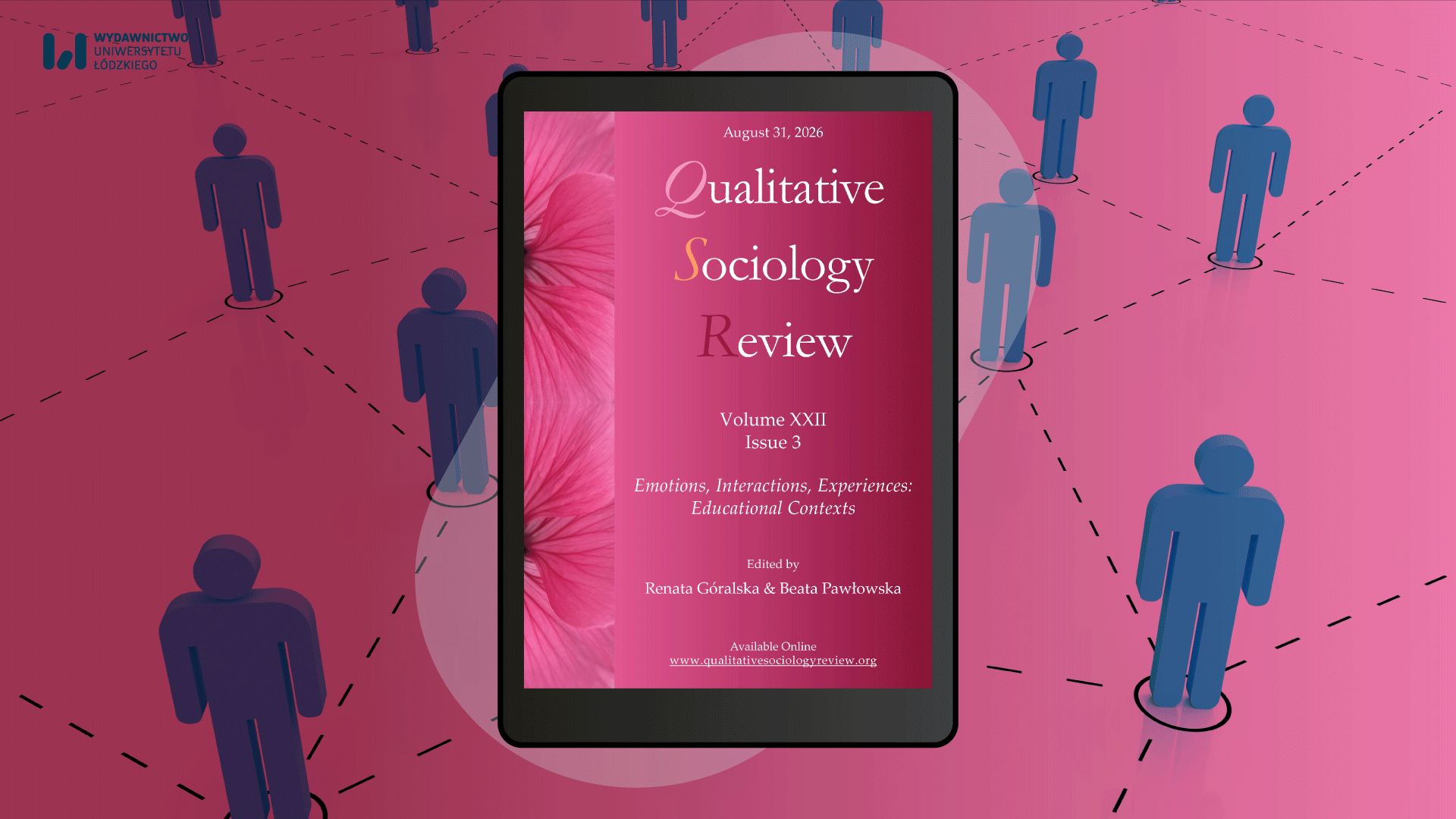
The issue is founded on the premise that emotions are not merely an individual's private experience. They also constitute an important element of institutional functioning, social relationships, and educational processes. The guest editors point out that contemporary higher education is increasingly shaped by pressures related to productivity, evaluation, competition, and bureaucratisation. Under such conditions, emotions become part of academic teachers’ professional work, leading not only to engagement and a sense of purpose, but also to fatigue, anxiety, and burnout.
The Emotional Labour of Academic Teachers
The issue opens with an article by Renata Góralska devoted to the emotional labour of academic teachers and the phenomenon of affective injustice. Drawing on qualitative interviews with academic teachers, the author analyses the relationship between emotions, professional identity, and power relations. She demonstrates that the contemporary university can be a space where emotional labour fosters both personal development and self-reflection, while at the same time limiting employees’ agency and wellbeing.
The next article, by Beata Pawłowska, focuses on the emotions accompanying the multidimensional evaluation of academic teachers’ work. The analysis illustrates how continuous assessment, criticism, and competition affect self-esteem and emotional coping strategies. The author argues that in conditions of increasing bureaucratisation and neoliberal management, evaluation processes originally intended to support professional development may instead lead to demotivation and exhaustion.
Between Agency and Subordination
Małgorzata Kosiorek addresses the issue of empowerment, understood as strengthening academic teachers’ sense of agency. Based on qualitative research, the author examines situations in which academic work may foster autonomy and influence over one’s own actions, but may also result in experiences of subordination and institutional “enslavement”. Particular attention is paid to the emotions accompanying everyday professional activities.
Alina Wróbel, in turn, investigates the phenomenon of manipulation within the academic environment. Analysis of academic teachers’ experiences makes it possible to distinguish three levels at which manipulation may occur: the macro level, related to educational policy and systemic decisions; the meso level, concerning hierarchical relationships within higher education institutions; and the micro level, encompassing direct interactions between employees. The author emphasises that autonomy and agency among members of the academic community are essential for its healthy development and for building teachers’ professional identity.
Emotions and Citizenship Education
A school-based and societal perspective is offered in Violetta Kopińska’s article on emotions and relationships in Polish citizenship education. The author analyses the national core curricula of 2018 and 2025, asking whether schools create space for citizenship to be developed as an emotional and relational experience connected with a sense of belonging to a community. The findings suggest that both documents contain potential for recognising the emotional dimension of citizenship, although the 2025 curriculum places greater emphasis on categories that support this understanding of citizenship.
Emotions as an Important Dimension of Education
Taken together, the contributions in this issue create an interdisciplinary picture of contemporary education, ranging from the everyday experiences of academic teachers, through power relations and institutional evaluation mechanisms, to curricula and the development of civic attitudes. What unites them is an understanding of emotions as a significant element of social processes rather than merely individual experiences.
The issue also encourages reflection on the future of the university. The authors demonstrate that questions concerning effectiveness, evaluation, and competitiveness cannot be separated from questions about wellbeing, agency, relationships, and a sense of belonging. The research presented in this volume therefore constitutes an important contribution to discussions on creating a more inclusive, democratic, and supportive educational environment.
The issue was developed, among other initiatives, in connection with an interdisciplinary research project being carried out at the University of Lodz on engagement and exhaustion as consequences of the emotional labour of academic teachers, financed under the “Inicjatywa Doskonałości – Uniwersytet Badawczy” [Excellence Initiative – Research University] (IDUB-UŁ) programme.
We encourage all readers to explore the articles available on the journal’s website.