Over the course of two days, the Biedermann’s Palace and the Faculty of Philology, University of Lodz, became a meeting place for researchers, artists, journalists and radio practitioners from Poland and abroad, who jointly sought to answer the question of what radio is today and what its future may look like.
What resonated most strongly throughout the conference was the remarkable diversity of perspectives. Radio was approached in a comprehensive manner – as a technology, a social space, a cultural practice, an artistic medium, an archive of memory and also as a site for building communities and relationships between people. Discussions encompassed local radio stations, the history of broadcasting and radio drama, as well as podcasts, streaming platforms, artificial intelligence and contemporary audio fiction ecosystems.
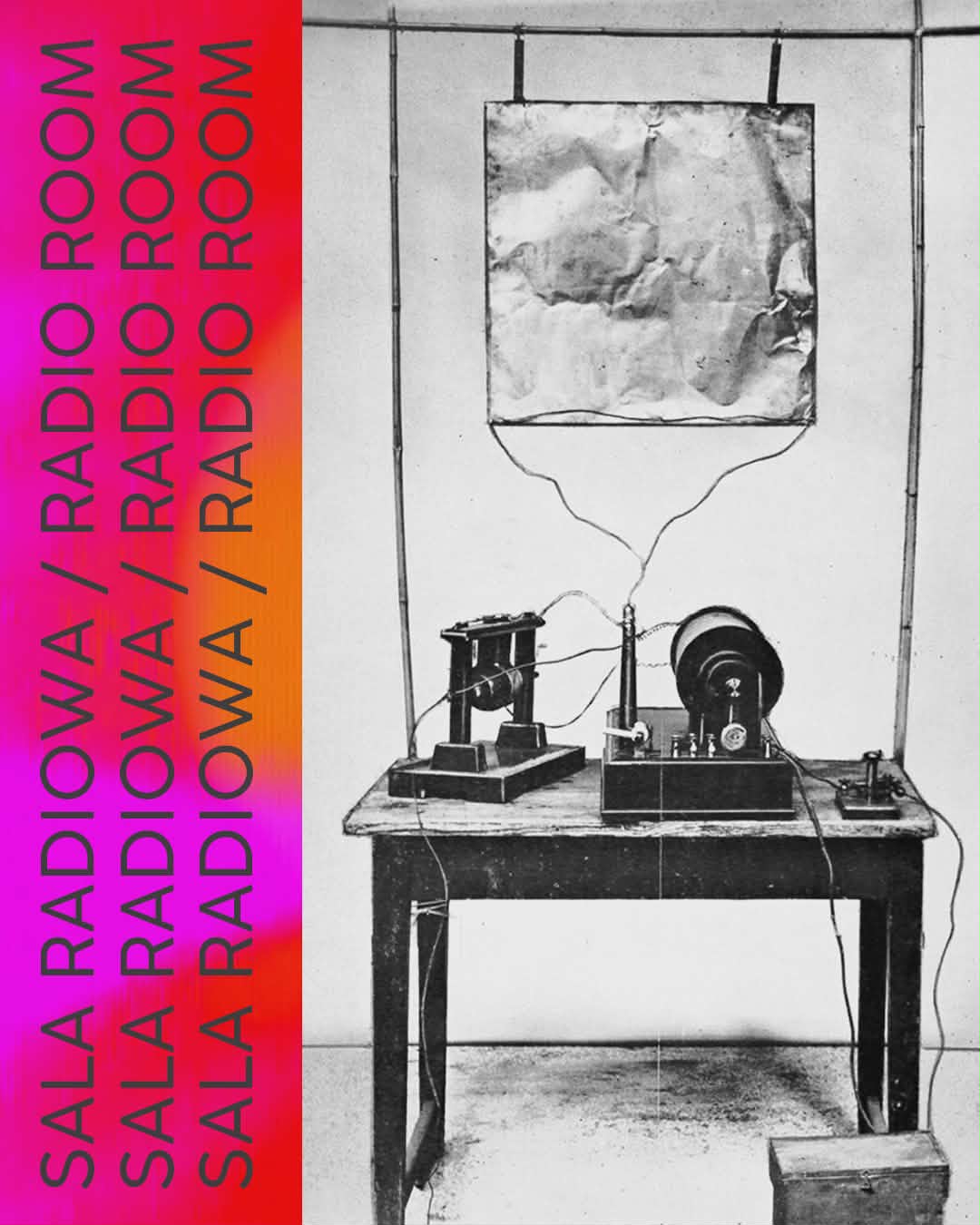
The accompanying premiere of “Sala radiowa” by Justyna Banaszczyk was an important symbol of the entire event. The installation, composed of fragments, remnants and spectral residues of sound, became a metaphor for radio itself: a medium that is ephemeral, constantly changing and perpetually in motion. The visual layer of the project was created by Darek Pietraszewski, working under the pseudonym Copy Corpo. The premiere of the installation during the proceedings underscored the fact that the organisers did not wish to discuss radio solely in terms of technology or media history, but also as an experience and an active, culture-forming process.
The first day of the conference was opened by Jacek Grudzień, Editor-in-Chief of Radio Łódź. The opening also featured the voice of radio practitioners. Mariusz Woźniczka, a journalist from Radio Łódź, spoke about the return of the programme “Radio Nocą” [Radio at Night] in a completely transformed media landscape, juxtaposing the contemporary experience of radio with Francis Fukuyama’s concept of the “end of history”. This was a reflection on how the medium operates today in a world characterised by information overload, digital platforms and changing audience habits.
The presentation by Dr Daniel Muzyczuk, Director of the Museum of Art in Łódź, devoted to the museum’s sound archives, was also a significant point in the programme. The talk addressed unique archival tapes, new performances and previously unknown compositions, including works inspired by Władysław Strzemiński’s theory of vision. It demonstrated that radio and sound remain an important part of the history of the Polish avant-garde and modern artistic culture.
During the subsequent plenary sessions, researchers and radio creators took the floor. Dr hab. Grażyna Stachyra spoke about the spatio-temporal dimension of radio practices; Prof. Urszula Doliwa and Dr Magdalena Szydłowska analysed podcasting as a contemporary form of audio communication; and editor Dr Katarzyna Michalak discussed transformations in audio reportage. These contributions clearly showed that radio is not a medium confined to the past, but one that dynamically responds to technological and cultural change.
The second day of the conference opened up an even broader perspective. Discussions focused on historical transformations in broadcasting, the development of audio archives, the popularisation of Polish music in the interwar period, and the role of Polish Radio in building the international presence of Polish culture, including through the works of Karol Szymanowski. Radio thus emerged as both a culture-forming tool and an institution of memory. Thanks to the presentation by Prof. dr hab. Violetta Wejs-Milewska, the theme of archives returned, highlighting how they increasingly function today as a distinct circuit of sound and media memory.
The theme of radio art was also particularly prominent. The presentation by Dr Janusz Łastowiecki, devoted to the radio plays of Darek Błaszczyk, was dedicated to Prof. Elżbieta Pleszkun-Olejniczakowa on the tenth anniversary of her death. The discussions explored inspirations shaping the artistic practice of radio creators, examined the collaboration between Waldemar Modestowicz and Marta Rebzda, and addressed the category of “new sincerity” in contemporary audio reportage. These contributions presented radio not only as a medium of information, but also as a space for artistic experimentation and aesthetic reflection.
The international nature of the conference was its major strength. English-language panels featured highly significant contributions from international researchers specialising in contemporary broadcasting and audio art. A particularly important highlight was the presentation by Christof Migone – the author of the 1990s manifesto “Naked Radio” – who reflected on the relevance of his ideas in the era of digital platforms and new listening practices.
The panel “Radio After Transitions” focused on transformations in broadcasting following political transitions in Central and Eastern Europe. Drawing on the research of Robert Horvitz, participants discussed the demonopolisation of broadcasting in post-communist societies, transformations in Polish radio after 1989, and new community practices related to the audio medium. Dr Marija Maglov analysed discourses of radio art in the activities of the Belgrade radio station, while Dr Ákos Windhager examined the work of Ádám Bősze at the Hungarian public radio station Bartók Rádió.
The third international panel was devoted to contemporary transformations of radio drama and audio fiction. Discussions addressed the impact of streaming platforms on the form of radio plays, methods of describing and cataloguing them in the digital environment, as well as the development of independent audio productions and new models of distribution and community-building around audio series. These contributions demonstrated that contemporary radio increasingly operates beyond traditional broadcasting, migrating to applications, platforms and multi-channel digital environments.
The presence of radio beyond its traditional broadcasting environment was also an important theme of the conference. Discussions covered the phenomenon of Radio Solidarność as a radical and endemic medium, recalled practices of using television sound channels to transmit illegal radio programmes, analysed how broadcasting is represented in opinion-forming press, and examined the impact of the digitalisation of the audio market and artificial intelligence on contemporary sound media.
In the panel “Radio między technologią a społecznością” [Radio between Technology and Community], the question of the communal dimension of broadcasting was particularly prominent. Dr hab. Krzysztof Kaszewski analysed ways of manifesting locality in the names of Polish radio stations and programmes, demonstrating how language constructs relationships between radio and its listeners. Dr hab. Patryk Gałuszka and Dr Piotr Chmielewski discussed the phenomenon of Radio 357 as a community-funded project, comparing it with the idea of community radio and analysing audience engagement in co-creating the station. Dr Barbara Leja, in turn, presented transformations of Polish diaspora radio in the United States, showing it as an important space for maintaining ethnic ties and building migrant communities.
The conference demonstrated that, after a century, radio remains an exceptionally vibrant medium – one that evolves alongside technology while retaining its social and cultural strength. The discussions led by distinguished Polish researchers and prominent international guests showed that radio continues to be an important tool for building communities, creating culture and narrating the world through sound. The centenary of Polish broadcasting thus became not only an opportunity for reflection, but also a starting point for discussion about the future of a medium which, despite successive technological revolutions, remains an important element of contemporary social and cultural experience.
Photo coverage from the first day of the conference on the University of Lodz Flickr
Source: Dr Natalia Kowalska-Elkader
Edit: Jolanta Sławińska-Ryszka, Centre for Organising Cultural Events and Conferences, University of Lodz