The scientist took part in a panel discussion entitled “Biochemia obcego życia oraz co z niej wynika” [The Biochemistry of Alien Life and Its Implications], organised by the Polish Astrobiological Society. The discussion also featured writer Istvan Vizvary and science communicator Mateusz Wielgosz.
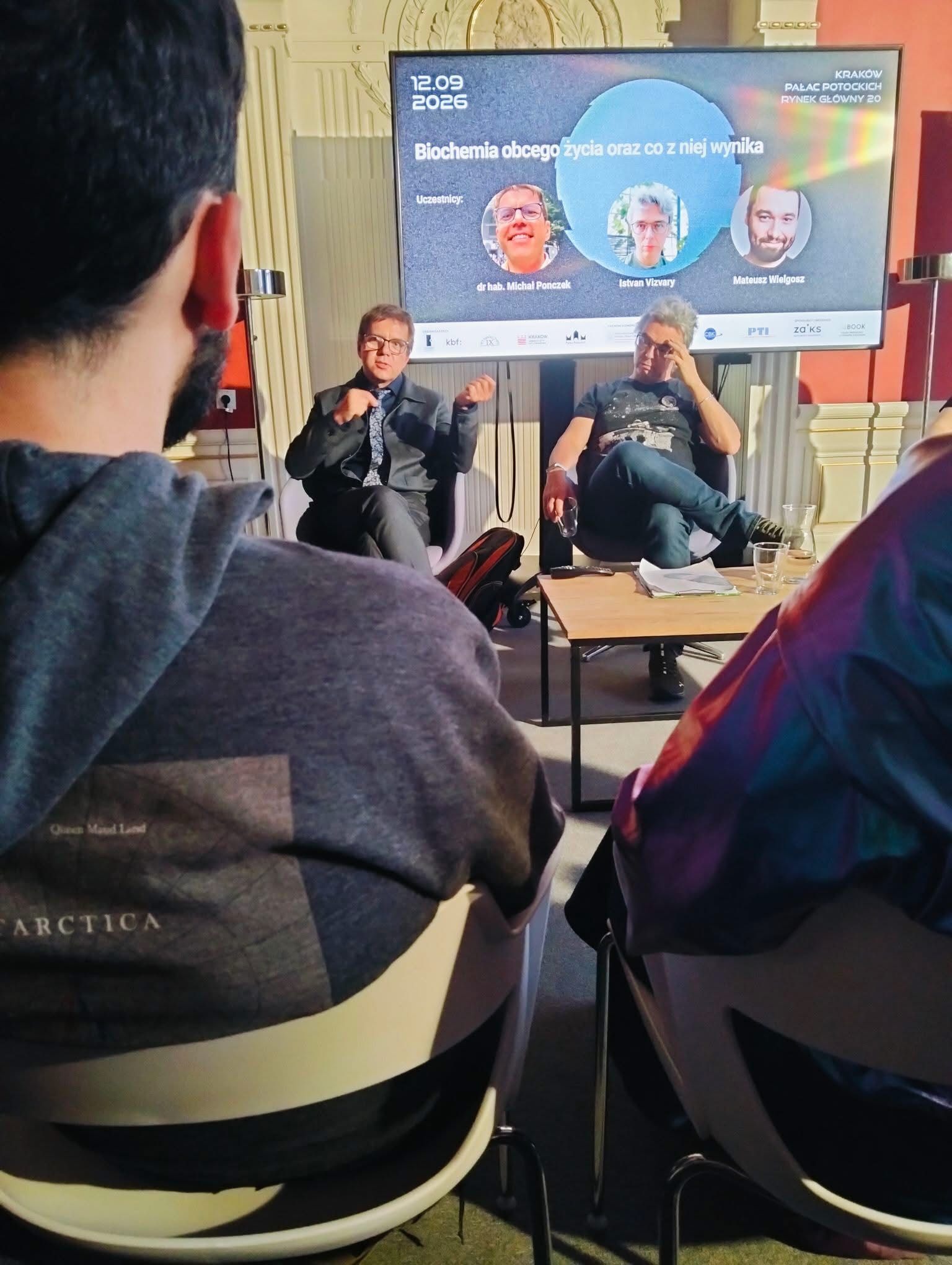
The panel addressed topics including alternative biochemistries, astrobiology, the possibility of organisms based on chemistry different from that found on Earth, as well as the scientific and philosophical implications of a potential discovery of extraterrestrial life.
The meeting sought to answer one of the most important questions in contemporary science: must life in the Universe resemble life on Earth?
As dr hab. Michał Ponczek explains:
During the discussion, we emphasised that our current biological knowledge is based on a single example of terrestrial life, relying on carbon chemistry and water as a solvent. Contemporary astrobiology, however, encourages consideration of a broader spectrum of possibilities, including different planetary environments and alternative biochemical solutions.
From a biochemist’s perspective, a particularly intriguing question is not so much which principal elements life could be built from, but rather what mechanisms enable matter to store information, undergo evolution and give rise to increasingly complex structures. The search for extraterrestrial life therefore requires openness to forms of biology that may differ significantly from those known on Earth.
Even if we never discover organisms based on alternative biochemistry, asking such questions helps us better understand the nature of life and humanity’s place in the Universe. Should extraterrestrial life, even in its simplest form, ever be confirmed, it would constitute one of the most important discoveries in the history of science, forcing us to reconsider both the definition of life and our presumed uniqueness on a cosmic scale.
About the Congress
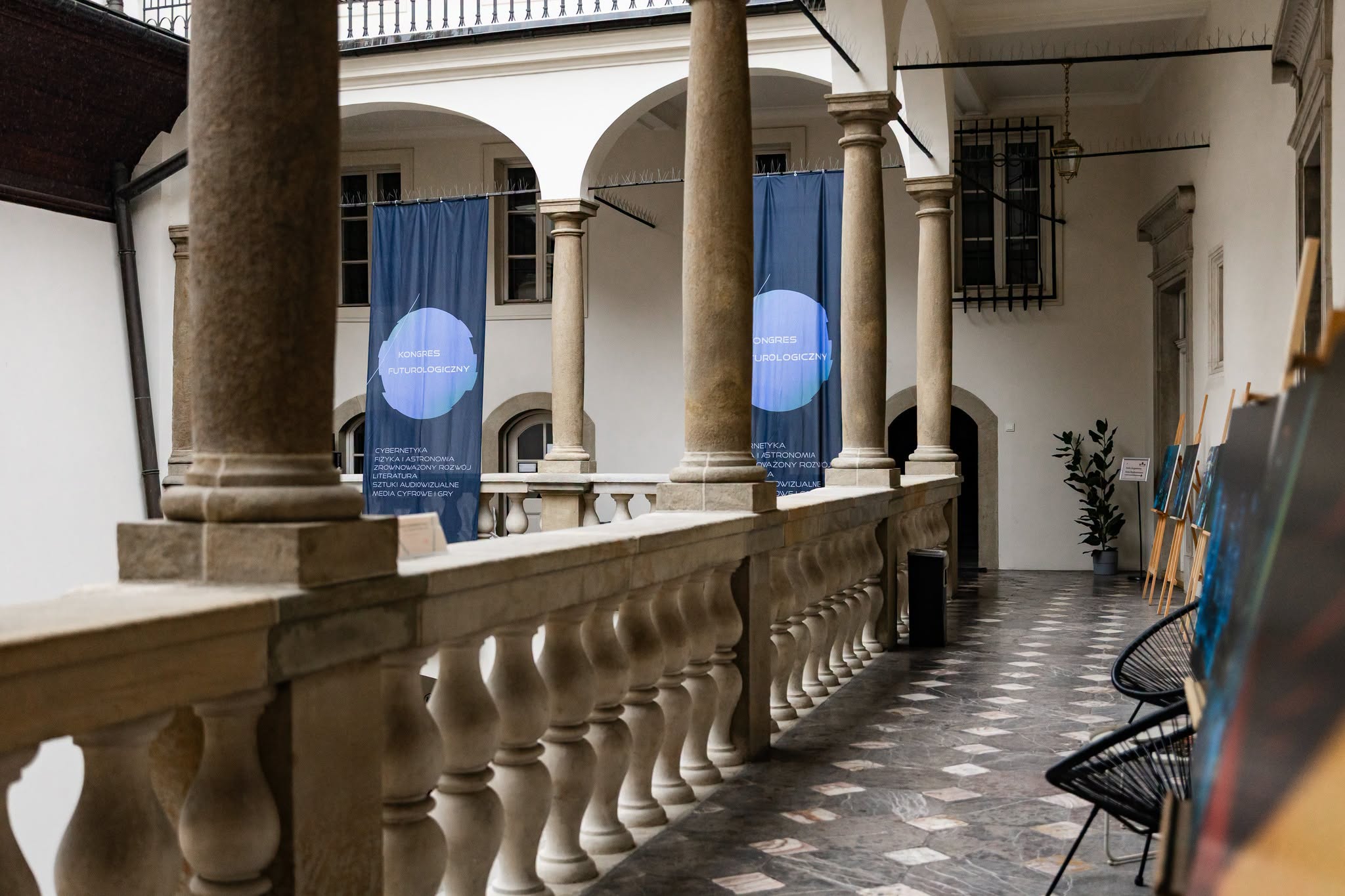
The Futurological Congress is an annual cultural and scientific conference organised by the Polish Science Fiction Foundation in cooperation with the Krakow Festival Office and IX Publishing House. Taking its name from the famous short story by Stanisław Lem, the event serves as an interdisciplinary forum for the exchange of ideas. Inspired by the works and philosophical thought of the renowned Kraków writer, it brings together cultural creators and representatives of the academic community. The scope of the discussions is defined by issues explored within futures studies and their representation in popular culture. By building a bridge between imagination and science, the conference fosters mutual inspiration and strengthens the foundations for the further development of Polish science fiction literature.
ORGANISER’S WEBSITE (in Polish)
Dr hab. Michał Ponczek is a biochemist, structural biologist and bioinformatician, and an Assistant Professor in the Department of General Biochemistry at the Faculty of Biology and Environmental Protection, University of Lodz. He studies the evolution, structure and function of blood coagulation proteins, treating them not as static objects but as dynamic systems in which function emerges from movement, relationships and context. He integrates bioinformatics, molecular modelling and cryo-electron microscopy (Cryo-EM), linking the molecular level with broader questions concerning the nature of life. A pivotal moment in his scientific career was his collaboration with Prof. R.F. Doolittle (UCSD, EMBO 2008), which directed his research towards protein evolution.
His interest in these questions dates back to his school years. Today, he views carbon chemistry not as a prejudice but as a consequence of cosmology: an element forged in stars which, in the presence of hydrogen, oxygen and liquid water, creates a space in which matter begins to “remember” and evolve. At that point, the question is no longer what life is, but when matter begins to tell its own story. Perhaps consciousness is merely the shadow cast by the movement of matter and memory.
Edit: Mateusz Kowalski (Promotion Centre, Faculty of Biology and Environmental Protection, University of Lodz)
Photo: dr hab. Michał Ponczek (Department of General Biochemistry, Faculty of Biology and Environmental Protection, University of Lodz)