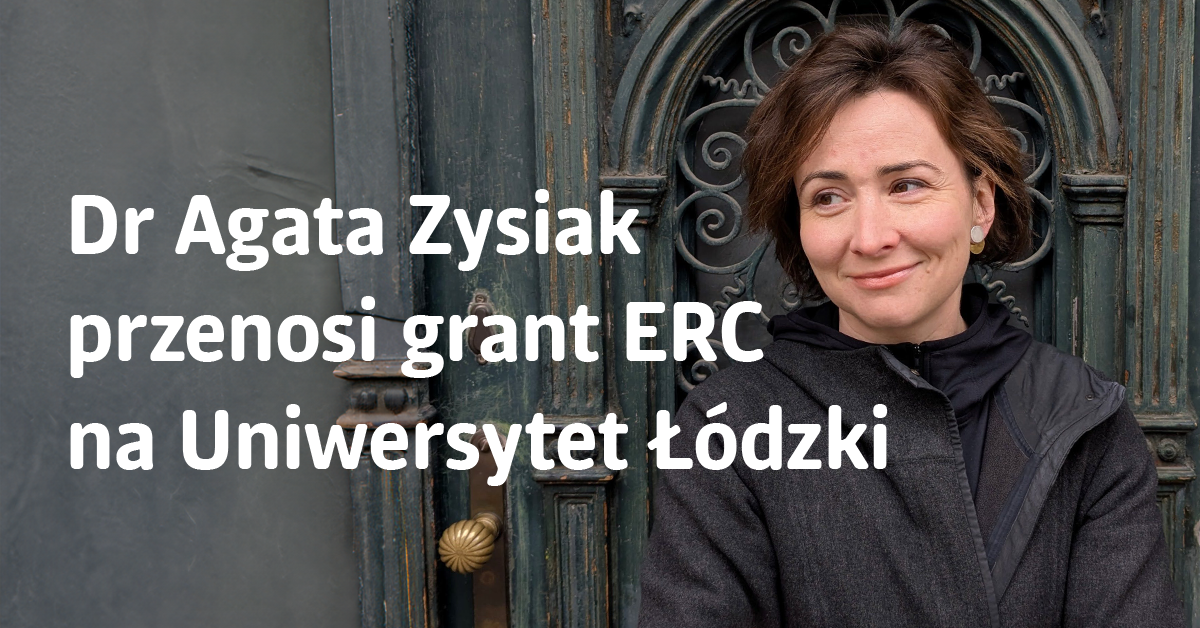
Dr Agata Zysiak is transferring her ERC Starting Grant to the University of Lodz. She was awarded funding of EUR 1.5 million in 2025 for the project CLASS-UP: Upward Social Mobility under Socialism in Eastern Europe 1945–1989. The ERC grant makes it possible to establish an international research team in Lodz and conduct large-scale research across the continent. To this end, Dr Zysiak has already recruited Dr Una Blagojević, a historian of ideas whose research interests focus on social and cultural history, as well as the history of women and gender in Central and Eastern Europe. Additional researchers will join the team in the coming months.
Who Had Better Chances for Social Advancement: People in the East or the West?
The CLASS-UP project addresses one of the most significant social processes of the 20th century: the social mobility of millions of Europeans after the Second World War, with particular attention to the specific context of Eastern Europe. The researcher aims to examine this phenomenon through the stories of specific individuals and even entire families, rather than primarily through statistical indicators such as education, occupation or income.
Following the Second World War, socialist states promised a radical transformation of society. The nationalisation of property, land reforms, industrialisation, migration from rural areas to cities and the expansion of education were intended to reshape the social structure, including opening opportunities for advancement to the “working classes”. Yet there is still no straightforward answer to the question of whether individuals from lower social classes found it easier to “move up” socially in Eastern Europe than in Western countries, nor what “social advancement” actually meant under state socialism. Was success defined by obtaining higher education? Moving from a village to a city? Entering a white-collar profession? Building a career within state institutions? Or perhaps by being able to provide one’s children with a better start in life? The project is intended to contribute to a better understanding of these questions. The international team will study Poland, Romania and Yugoslavia, three countries representing different variants of post-war socialism.
Social Mobility Seen Through Family Histories
The CLASS-UP project will combine analyses of official documents and political discourses, the press and historical sociological studies with biographical research encompassing successive generations within families.
This approach is also intended to reveal the less obvious side of social advancement. Changing one’s social position could mean gaining access to education, a new profession or greater opportunities, but it could also come at a cost: feelings of not fitting in, the loss of former social ties or experiences of classism.
At the same time, the resources and privileges gained by one generation could subsequently be passed on to children and grandchildren. For this reason, the project will focus not on individual biographies but on entire family histories.
The inspiration for the project came from Dr Agata Zysiak’s earlier research on the academic intelligentsia and higher education in the People’s Republic of Poland. She became increasingly interested in people who were the first in their families to obtain higher education, the barriers they encountered and the social costs associated with changing their social position.
The Second ERC Grant at the University of Lodz
Bringing Dr Agata Zysiak’s ERC grant to the University of Lodz is very important news for us. European Research Council grants are a symbol of scientific courage and research conducted at the highest international level. I am particularly pleased that Dr Agata Zysiak chose the University of Lodz as the place to carry out her project and build her research team, especially knowing that she considered many universities in Poland and abroad. We want the University of Lodz to be a place to which researchers come and return with ambitious ideas and the best European grants
– says the Rector of the University of Lodz, Prof. Rafał Matera.
Following the transfer of the CLASS-UP project to the University of Lodz, it will become only the second ERC grant ever carried out at our institution. The first was awarded in 2022 to Prof. Andrzej Indrzejczak from the Faculty of Philosophy and History, University of Lodz, recipient of an ERC Advanced Grant.
What Are ERC Grants?
The European Research Council (ERC) funds ambitious frontier research carried out by researchers across Europe. ERC grants are among the most prestigious and competitive sources of research funding and are therefore subject to an exceptionally rigorous evaluation process.
The competitions do not impose predefined research topics. Instead, they are based on the originality of the scientific idea and its potential to expand existing knowledge. ERC Starting Grants support researchers who are building research independence and enable them, among other things, to establish their own research teams. The grant may amount to up to EUR 1.5 million and is typically awarded for a period of five years.
Dr Agata Zysiak’s project was among the 478 projects selected by the ERC in the Starting Grants 2025 competition. The European Research Council chose these proposals from 3,928 projects submitted for evaluation from across Europe. The success rate therefore stood at 12.2%. Only six ERC grants were awarded to Polish universities in this call, including just two in the fields of social sciences and humanities.
Source: Dr Agata Zysiak