
PhD students of the University of Lodz Doctoral School of Social Sciences receive a scholarship of at least:
- 3570,50 PLN (approx. 840 EURO) gross per month (first and second year of study - before mid-term evaluation)
- 4641,65 PLN (approx. 1090 EURO) gross per month (first and second year of study - before mid-term evaluation) - for doctoral students with a certificate of disability
- 5500,50 PLN (approx. 1300 EURO) gross per month (third and fourth year of study - after mid-term evaluation)
- 6571,65 PLN (approx. 1550 EURO) gross per month (third and fourth year of study - after mid-term evaluation) - for doctoral students with a certificate of disability.
Admission procedure
New admission round starts with online registration from 17-25 June 2026.
NOTE: Details on the upcoming admission round (June 2026) will be gradually updated
When contacting a potential supervisor, candidates should have the following:
1. CV
2. preliminary concept of their doctoral dissertation, which should include: definition of the research area, indication of the research problem/research questions;
3. previous academic activity (e.g. publications, conferences, projects);
4. contact details of a person who can provide references (optional).
Under the guidance of your potential supervisor, prepare a concept for your doctoral dissertation, which is one of the required documents in the recruitment process.
If the candidate has obtained from the supervisor (an academic employee of the University of Lodz) a consent to take him/her under supervision, he/she submits a statement of the potential supervisor on his/her willingness to take on the supervision (sample available at step 4).
If the candidate has not obtained such a consent, he/she submits an application for appointing a selected person who has the right to act as a supervisor as a supervisor of his/her doctoral dissertation (template available at step 4).
Information about competitions for doctoral students within NCN grants (together with the research topics) is available at http://ncn.gov.pl
List of supervisors and topics of PhD seminars in the academic year 2026/2027 for each scientific discipline is provided below.
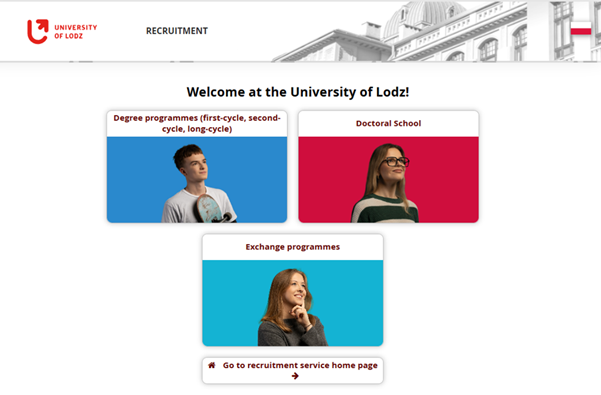
Enrollment/Registration - Electronic registration for studies is possible between 17 June - 25 June 2025
Remember to print out the application form from the Electronic Recruitment System!
Go to the Electronic Recruitment System
Prepare legible scans or photos of all the paper documentation you are to submit as part of the admission process, and attach them by uploading them to the IRK system within the time frame allowed in the Recruitment Schedule for submission of your documents. Each scan file should include the applicant's full name and an indication of the kind of the document that was scanned, according to the following scheme: Forename_Surname_Heading of scanned document
Persons admitted to SDNS should submit original documents upon arrival in Poland, not later than the day of signing the oath.
UL Doctoral School Centre
UL Doctoral School of Social Sciences
ul. Matejki 21/23, 90-237 Lodz, Poland
Room 114
Please remember to sign all your documents (incl. your application, dissertation concept, questionnaire)
Candidates for doctoral schools:
a) register online in the IRK system;
b) attach a complete set of application documents to the IRK system, including a printed out, signed and scanned application form for admission to SDNS:
1) a copy of the diploma of completion of the Bachelor’s and Master’s degree or the Uniform Master's degree or equivalent, together with a copy of the diploma supplement with grade average from the period of studies (subject to Section 8(2)(3)). Candidates who have completed their studies outside the Republic of Poland should provide the grading scale applicable in the country where they have completed their studies,
2) If a candidate has completed his/her studies abroad, the diploma must be legalised or apostilled, and confer the right to apply for the award of a doctoral degree in the country whose higher education system includes the institution which has awarded it. In the case of a diploma issued in a language other than Polish or English, a translation into one of these languages must also be submitted. The candidate shall submit a statement with a commitment to provide a sworn translation of the aforementioned diploma into Polish within the time limit specified in the statement (Annex 2 to the Recruitment Rules).
3) Candidates referred to in Section 2(2) of the Recruitment Rules shall submit a certificate of the grade weighted average obtained in the course of the Bachelor’s and Master’s studies or the Uniform Master's Studies or equivalent (where a weighted average cannot be shown, the arithmetic average may be accepted), as well as a commitment to provide a certificate of having passed the diploma examination and having been awarded the Master's degree within the time limit consistent with the recruitment schedule (a template of the commitment is set out in Annex 3 to the Recruitment Rules); the aforementioned persons shall provide a copy of the diploma confirming the obtaining of the degree referred to in Section 2(1) of the Recruitment Rules, before commencing the programme of SDNS,
4) an outline of the proposed doctoral dissertation with a statement confirming that the candidate has never previously prepared or defended a doctoral dissertation in the proposed topic (the obligation to submit the aforementioned statement does not apply to cases of transfer from another doctoral school and to persons who will be studying under a cotutelle agreement and are already studying at a foreign university at the time of recruitment). The outline (ca 5–8 pages) must include: a) an introduction with indication of the research problem, b) reasons for taking up the problem/research topic - its scientific significance, c) a review of the literature on the topic together with an indication of the gap in the science that the candidate intends to fill with his/her research, d) identification of the main research questions, the research objective, the main thesis and possible specific hypotheses, e) research method(s) to address the research problem, f) contribution to the development of science, and in the case of the industrial doctoral programme, the practical usefulness of the solutions, g) bibliography, In the case of candidates referred to in Section 11 clause 7 of the present Rules, the English language is acceptable for the outline.
5) a statement of an UL employee on his/her readiness to act as a supervisor (if the candidate has such a consent) - according to the template available in the IRK system. In the absence of such statement, the candidate submits an application for the appointment of a selected person, who is qualified to act as a supervisor, to the role of supervisor of the candidate’s doctoral dissertation (Annex 4 to the Recruitment Rules); the said person is chosen from the list of potential supervisors that SDNS shall make available on its website not later than one month before the start of the recruitment procedure. If the list contains no person specializing in the candidate’s topic, then the candidate may indicate another qualified UL staff. It is required that the topic of the doctoral dissertation, as specified in the candidate's outline, be consistent with the research interests and specialisation of the person selected from the list of potential supervisors. The list shall be drawn up by the Director of SDNS in consultation with the persons he/she intends to include in the list. A written consent of a person concerned shall be a condition for inclusion in the above list. The Director of SDNS may, before drawing up a list of potential supervisors, consult its shape with Coordinators for scientific disciplines appointed by the Rector,
6) a questionnaire for evaluation of the candidate's documentation (Annex 5 to the Recruitment Rules), which is the candidate's declaration of achievements to be evaluated,
7) a document confirming the candidate's knowledge of English of at least B2 level in accordance with the List of Documents Confirming the Knowledge of a Modern Foreign Language (Annex 6 to the Recruitment Rules), if the candidate does not have the aforementioned document, he/she shall take the English language examination under the principles laid down in Section 9 of the Recruitment Rules,
8) confirmation of previous research activities (during the recruitment procedure, an account shall be taken of the candidate's documented research and organisational activity corresponding to the disciplines in which SDNS is conducted, from the last 5 full calendar years preceding the recruitment – until the end of the online registration):
a) publications - the following should be attached: photocopies of the title page and the editorial page, the table of contents and the first and last page of own text (already published works); or a certificate from the editorial office / publisher that the work has been accepted for publication.
b) participation in scientific conferences - confirmation of participation must be provided in the form of: a conference programme with the title of the presentation and the candidate’s name, or confirmation by the conference organisers of the candidate’s active participation with the title of the presentation,
c) scientific and research projects - participation in projects confirmed by a document from the grantor / a letter from the project manager stating the source of financing,
d) a document confirming knowledge of languages other than English and one's mother tongue (in accordance with the List of Documents Confirming the Knowledge of a Modern Foreign Language (Annex 6 to the Recruitment Rules),
e) attestation of social, organisational and popularisation activities - each organisational activity and its duration should be confirmed,
9) a candidate with a certificate of disability / degree of disability issued based on the provisions of the Act of 27 August 1997 on Vocational and Social Rehabilitation and Employment of Persons with Disabilities (consolidated text Journal of Laws of 2025, item 913 as amended) shall submit a copy of the certificate with other recruitment documents if he/she intends to exercise additional rights under the law,
candidates from abroad (of foreign nationality/citizenship) shall also submit:
(a) a document confirming the legality of their residence in the territory of the Republic of Poland in the form of a copy of a current visa or residence card immediately after obtaining one of the aforementioned documents, at the latest by the end of the first semester of study at SDNS,
(b) for candidates who do not have their domicile or habitual residence or registered office in the Republic of Poland, another Member State of the European Union, the Swiss Confederation or a Member State of the European Free Trade Association (EFTA) - a party to the Agreement on the European Economic Area - a written designation of an address for service in the territory of the Republic of Poland or appointment of a representative ad litem (for the purposes of service of letters and administrative decisions). If the above obligation is not fulfilled, decisions and letters shall be left in the candidate's file with effect of having been served.
Candidates admitted to UL Doctoral School of Social Sciences are to submit original documents required in admission procedure not later than the day of signing the oath.
English language test date: 1 July 2026
Test format: online
Sample English language tests available below:
During the interview the following are assessed:
− knowledge of research methods applied in the scientific work in the given discipline,
− knowledge of previous achievements of Polish and foreign science on the subjects to be dealt with in the candidate’s research,
− knowledge of national and international scientific centres in the chosen discipline(s),
− innovative thinking and flexibility in the candidate’s concept of the doctoral thesis, also in the context of the possibility of being supervised by an employee(s) of the university indicated in the list of potential supervisors whose scientific profile(s) is/are closest to the subject indicated by the candidate,
− having basic knowledge of the possibilities for obtaining funds for conducting scientific research and of the application of the output resulting from the planned doctoral dissertation in the process of commercialisation of the results of scientific activity, insofar as it results from the research topic,
− career plans and motivation to scientific work and activity in academic environment,
− the linguistic level of the answers (fluency in specialist terminology, ability to compose a speech, communicativeness, interaction during discussion).
Total: 25 points
Each member of the recruitment committee will assess independently with 25 points. The final amount of points awarded to a candidate shall be the arithmetic mean of the points awarded by the members of the committee.
Interviews will be held from 13 to 21 July 2026.
The candidate will be informed of the interview date via electronic messaging (in the IRK system).
Information on acceptance to the studies is visible in the Electronic Registration System on the candidate's account, and the Recruitment Committee's decision on non-acceptance is sent by registered letter with acknowledgement of receipt.
Results of admission
Secretary
International office
ul. Matejki 21/23
90-237 Lodz
room 114
P. +48 42 635 62 42 / tel. +48 601 083 029
E. office.sdns@uni.lodz.pl
Other ul Doctoral Schools
BIO-MED-CHEM DOCTORAL SCHOOL OF UL AND LODZ INSTITUTES OF THE POLISH ACADEMY OF SCIENCES
biological sciences, medical sciences, and chemical sciences
UL DOCTORAL SCHOOL OF HUMANITIES
archeology, history, philosophy, linguistics, literary studies, and cultural, religious and art studies
UL DOCTORAL SCHOOL OF EXACT AND NATURAL SCIENCES
mathematics, biological sciences, chemical sciences, physical sciences, and Earth and environmental sciences.