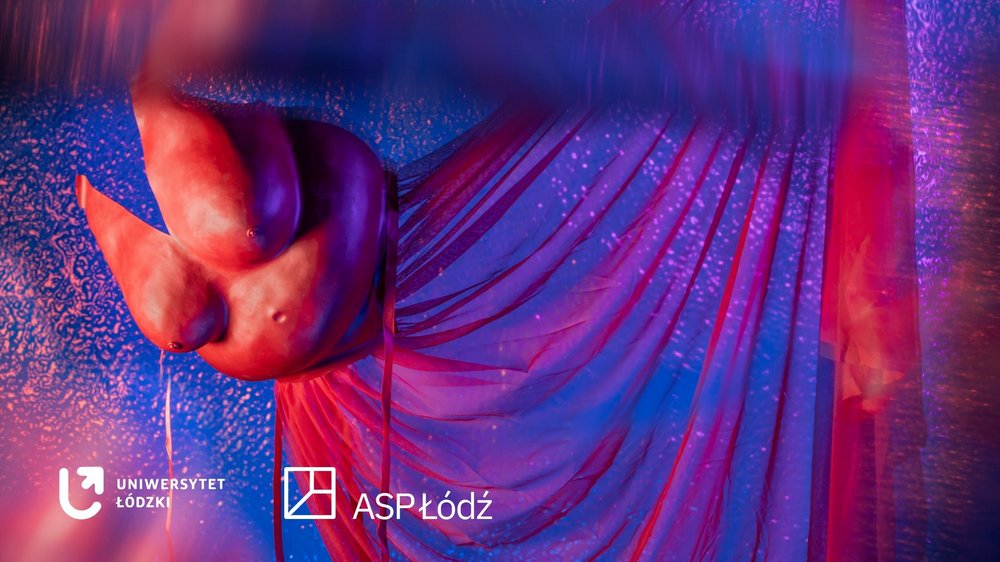
The “(Nie)dopasowane” exhibition reveals the uneasy relationship with the body. It seems that we should be in contact with our own body, something closest to us, most natural, most primal. However, are the body and we one? It's often difficult to determine what prevents us from identifying with it, what blocks full love and acceptance of it. Do we consider our body's needs? Is our potential hidden by insecurities, shame or fears? At what stage of the journey to self-understanding and acceptance of our physicality are we?
Corporeality – a symbol and barometer of cultural change
The female body has always been a recognisable symbol, an icon of the time it represents, like a barometer revealing transformations in the world. The model of female beauty has changed more frequently than the male model. Cultural expectations towards women have been greater. A given cultural circle has always distinguished certain ingrained stereotypes within which it has constructed its perception of women. The ideal female body reflected its position and socio-political situation. It was also closely linked to religion and philosophy. The topic of the body and corporeality is explored in many different ways today. In feminist and critical art, issues of corporeality in relation to women have appeared in the context of oppression, cultural limitations and objectification of the body. The (Nie)dopasowane exhibition is closer to a narrative related to the celebration of the body and its emancipation. It is a celebration that emphasises the essence, greatness, importance and uniqueness of the body, as well as emancipation understood as liberation and freeing the body, both literally and symbolically.
In my work, I often refer to the full contours of the female body. Archetypal images of femininity are important to me in terms of symbolic potential – most often identified with the Mother Goddess, a kind of Magna Mater, the giver of all life, personifying fertility and motherhood. Based on the proportions of the prehistoric Venus of Willendorf, I create new, enlarged forms or leave her natural size and use her as a quote from the past in a new context. I allow myself to decontextualise and deconstruct the meanings encoded in the figure of prehistoric Venus. Working with her is an ongoing, art-therapeutic project for me. Thanks to her, I consciously confront the stereotypes that shape my life. I examine the myths and notions surrounding traditionally understood femininity – adds Beata Marcinkowska.
About the artist
Beata Marcinkowska is an intermedia artist, art animator, a lecturer, and a native resident of Lodz. She holds a Habilitation in Art. She works at the Institute of Art Education at the Władysław Strzemiński Academy of Fine Arts Łódź. Her intermedia work explores diverse aspects of contemporary life, identity and its culturally assigned characteristics, as well as the symbolism of the body in contemporary times. She creates her own artistic projects – objects, installations, collages, land art and performances. She takes part in solo and group exhibitions, artistic campaigns, transmedia and site-specific activities in Poland and abroad. She designs and leads artistic and educational workshops. She implemented her own project, "Przytul sztukę – warsztaty dla mamy z dzieckiem" (2017-2020), at the Specialist Support Centre for People Experiencing Domestic Violence in Łódź. She is an author of numerous publications, including art textbooks and exercise books for children and young adults, published by Wydawnictwo Szkolne i Pedagogiczne and Wydawnictwo Szkolne PWN. She has co-founded the Frakcja group, an intergenerational group of female artists and art theorists. She is a member of the Polish Committee of the International Association for Education through Art (InSEA) and the Art and Documentation Association.
(Mis)matched – on Femininity Between Biology, Art and Social Norms
The “(Nie)dopasowane” project is not just an exhibition – it's a space for dialogue and a shared exploration of the meanings of the female body. We invite you to take part in discussions, workshops and creative activities that will allow you to examine corporeality from various perspectives: biological, sociological and artistic. We will explore how canons of beauty affect our bones, why the female body continues to function in a male world, and how art can become a tool for emancipation.
Three women will lead these events:
- dr hab. Beata Marcinkowska who is an artist and the creator of the exhibition (The Strzemiński Academy of Fine Arts Łódź),
- Dr Beata Borowska who is a biological anthropologist (Department of Anthropology, Faculty of Biology and Environmental Protection, University of Lodz),
- dr hab. Dominika Byczkowska-Owczarek who is a sociologist of the body (Department of the Sociology of Culture, Faculty of Economics and Sociology, University of Lodz).
The project is authored by Agata Dawidowicz who is a cultural studies scholar and a science populariser from the University of Lodz Centre for External Relations and Social Responsibility of the University.
We encourage you to participate in the events (admission is free):
(Nie)dopasowane: opening of the exhibition by dr hab. Beata Marcinkowska
28 November (Friday), 6:30 p.m., Wozownia 11 Gallery (Marii Skłodowskiej-Curie 11)
Ślady ideału: jak kanony piękna formują ciało i kości [Traces of the Ideal: How the Canons of Beauty Shape Body and Bones] (workshop)
4 December (Thursday), 6:00 p.m., Wozownia 11 Gallery (Marii Skłodowskiej-Curie Street 11)
Facilitators: Dr Beata Borowska and the Anthropołowcy Student Science Club and Beata Marcinkowska – art workshops
Dopasowywane i niedomyślne. Kobiece ciało w męskim świecie [Adjusted and Non-Adjusted: The Female Body in a Male World] (workshop)
13 December (Saturday), 5:00 p.m., Wozownia 11 Gallery (Marii Skłodowskiej-Curie Street 11)
Facilitators: dr hab. Dominika Byczkowska-Owczarek and art workshops led by Beata Marcinkowska
Ślady ideału: jak kanony piękna formują ciało i kości [Traces of the Ideal: How the Canons of Beauty Shape the Body and Bones] (workshop for organised groups)
15 January (Thursday), 10:00 a.m., Wozownia 11 Gallery (Marii Skłodowskiej-Curie 11)
Facilitators: Dr Beata Borowska and Antropołowcy Student Science Club
O kobiecości – między biologią, sztuką a społeczną normą [On Femininity – Between Biology, Art and Social Norms] (conversation and closing of the exhibition)
23 January (Friday), 6:00 p.m., Wozownia 11 Gallery (Marii Skłodowskiej-Curie Street 11)
The speakers will include dr hab. Beata Marcinkowska (The Strzemiński Academy of Fine Arts Łódź), Dr Beata Borowska (Department of Anthropology, University of Lodz), dr hab. Dominika Byczkowska-Owczarek (Department of the Sociology of Culture, University of Lodz).