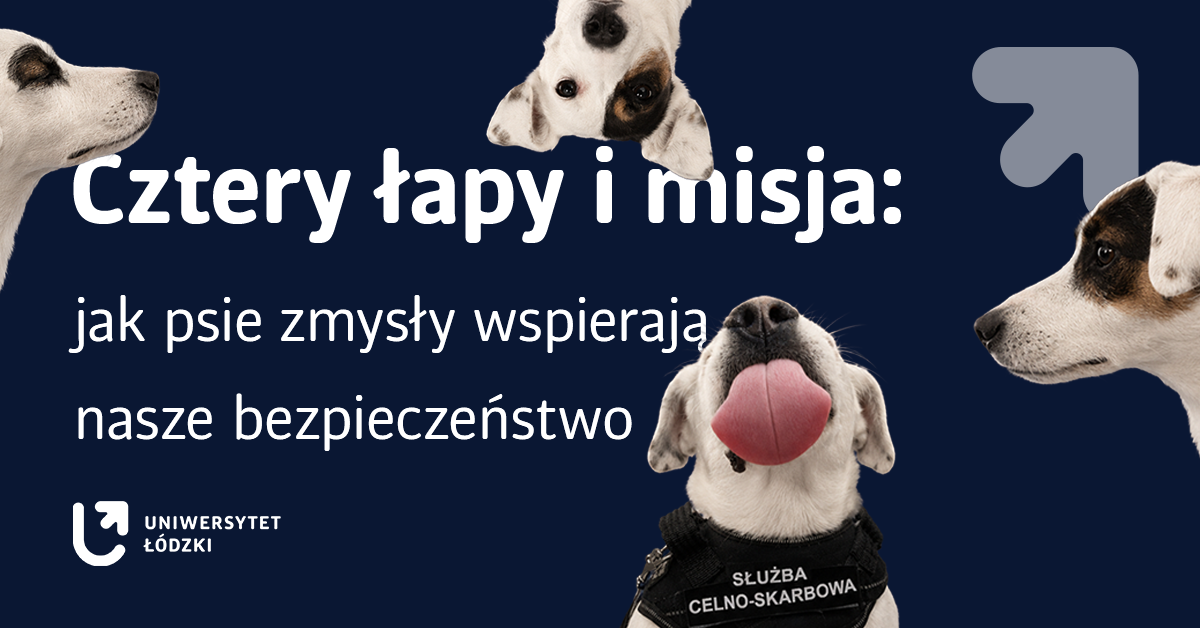
As thousands of travellers set off on their holidays, they patrol airports, border crossings and freight terminals, supporting the system that protects the state's financial interests and border security. The situation of these four-legged officers has been examined by experts from the Faculty of Law and Administration: Dr Ireneusz Nowak from the University of Lodz and Dr Marta Sagan-Martko from the University of Rzeszów. Together, they prepared the article "Psy służbowe w Służbie Celno-Skarbowej” [Service Dogs in the Customs and Tax Service].
While legal scholars analyse the place of dogs within state structures, biologists seek to answer the question of where their extraordinary effectiveness comes from. Dr Katarzyna Majecka, Head of the Natural History Museum University of Lodz at the Faculty of Biology and Environmental Protection, and Dr Dariusz Pietraszewski from the Faculty of Biology and Environmental Protection, University of Lodz, point out that the key to understanding the phenomenon of dogs lies in their senses, which in many respects surpass human capabilities.
An Officer and a Dog: A Team Built on Trust
In public debate, service dogs are often portrayed as assistants to officers. The legal scholars who authored the aforementioned publication draw a bold conclusion:
Service dogs and their handlers from the Customs and Tax Service may well be regarded as the best officers.
As full members of the Customs and Tax Service, they form, together with their handlers, a team built on trust. Dr Marta Sagan-Martko highlights this unique nature of cooperation:
For thousands of years, dogs have accompanied humans, supporting them in a wide range of tasks, from hunting and herding to, in contemporary times, mountain and water rescue, dog-assisted therapy, assisting persons with disabilities, and service in formations responsible for public safety. Their exceptional predispositions, particularly their excellent sense of smell, intelligence and ability to cooperate with humans, make them irreplaceable partners in the activities of the Customs and Tax Service as well.
However, this is not merely a matter of good relations between human and animal. Canine teams are a permanent element of Customs and Tax Service operations, particularly during inspections of travellers, means of transport and goods.
A Dog’s Nose in Service of the State
Dogs' exceptional aptitude for carrying out this responsible work results from the remarkable sensitivity of their senses. As Dr Katarzyna Majecka and Dr Dariusz Pietraszewski explain, dogs possess a set of sensory abilities that make them extraordinary partners for humans. Their best-known asset is, of course, their sense of smell:
The surface area of the olfactory epithelium in dogs is approximately 150-170 cm², whereas in humans it is around 5 cm². Dogs also possess a significantly greater number of olfactory receptors, estimated at between 125 and 300 million, while in humans this number is many times lower, ranging from several to several dozen million.
Moreover, a dog's nose is exceptionally efficient at capturing scent particles:
The structure of a dog’s nose allows the formation of micro-vortices of air, which increase the effectiveness of capturing scent particles. During exhalation, dogs direct air through the lateral slits of the rhinarium, creating local turbulence and directing scent particles from the environment towards the nostrils. During inhalation, the air together with these particles is then drawn into the nose.
Dogs can scent independently with each nostril, enabling them to determine the direction from which an interesting smell originates. For an officer, this means the ability to pinpoint the source of an odour concealed in luggage, a vehicle or a parcel.
They Hear More Than We Can
Airports, terminals and border crossings are exceptionally noisy places. Paradoxically, this does not hinder dogs in performing their duties effectively. Biologists from the University of Lodz explain the phenomenon:
Dogs can hear sounds at much higher frequencies than humans. Depending on age and breed, they may perceive sounds with frequencies reaching approximately 45-65 kHz. As a result, they can detect ultrasounds emitted by certain rodents and signals from ultrasonic whistles. By comparison, the upper limit of human hearing is around 20 kHz.
Their ears are equipped with an extraordinarily precise sound localisation system. As many as 18 muscles control the movements of the external ear, allowing it to be positioned in the direction from which a sound is coming.
Additionally, dogs’ ears can move independently of one another, further helping them to "tune in" precisely to a sound source. Dogs are also better than humans at concentrating on a specific sound in a noisy environment. This is known as the “cocktail party” effect. In practice, it means the ability to select the most important signals even in an environment filled with distracting stimuli.
They See the World Differently
Although sight is not a dog's most important working tool, nature has equipped it with remarkable abilities in this area as well. As the biologists explain:
Dogs do not see details as clearly as humans, especially in daylight, because their retinas contain proportionally fewer cones, which are responsible for sharp and colour vision. However, they are better adapted to functioning in low-light conditions thanks to a predominance of rods in the retina, a greater ability of the eye to capture light and the presence of the tapetum lucidum, a light-reflecting layer that increases visual sensitivity after dusk.
Another advantage is their exceptional sensitivity to movement:
Dogs’ vision is particularly sensitive to motion. Dogs detect moving objects from greater distances than stationary ones, an adaptation for observing prey and potential threats.
Visual information is also processed more quickly by dogs than by humans.
Taste and Smell: An Exceptionally Efficient Duo
A less obvious advantage of canine biology is taste. Researchers from the University of Lodz point to an interesting difference between humans and dogs:
Unlike humans, dogs possess taste receptors that are sensitive to water, allowing them to perceive this stimulus directly while drinking.
At the same time, they emphasise that taste and smell form an exceptionally efficient partnership in dogs:
Dogs’ sense of taste is closely linked to their sense of smell. It is precisely this cooperation that enables a dog to assess effectively whether a given food is safe and suitable for consumption.
This is yet another piece of evidence showing that a dog's effectiveness does not result from a single extraordinary sense, but from the interaction of an entire perceptual system.
Needed More Than Ever
The legal experts, authors of "Psy służbowe w Służbie Celno-Skarbowej” [Service Dogs in the Customs and Revenue Service], stress that the importance of canine teams is so great that systematically increasing their numbers remains justified. As they note, between 2018 and 2024, the number of dogs in the service decreased from 154 to 135. In their view, this may affect the effectiveness of detections and discoveries made by the formation. They also point to the need to invest in appropriately adapted means of transport for handlers and dogs, maintain reliable statistics concerning the work of canine teams and systematically promote their achievements.
Dr Ireneusz Nowak highlights the successes of canine teams, but also the necessity of appropriately documenting and promoting their activities, as they are among the most recognisable and most positively perceived elements of the National Tax Administration.
A Retirement That Must Be Earned
One of the most interesting issues described by Dr Ireneusz Nowak concerns the status of dogs after the end of their service:
The Customs and Tax Service, operating within the structures of the National Tax Administration as a unified and uniformed formation, was the first uniformed service in Poland whose service dogs obtained a statutory right to a so-called retirement pension (in 2018).
Importantly, this solution is not only formal in nature but also ethical:
From the beginning of their service, service dogs remain under the care of their handlers and, after the end of their service, with those same individuals acting as carers, they continue to live with them and receive professional care for the rest of their lives.
Such an approach combines legal and ethical-humane aspects, reflecting contemporary standards of animal welfare. Responsibility for a service dog does not end with its final working day.
Effectiveness and Welfare
The ethical dimension of service is also emphasised by the co-author of the publication, Dr Marta Sagan-Martko:
A dog is a living, sentient being to whom humans are obliged to provide the best possible living conditions, proper care, attention to health and welfare both during service and after its completion.
The researcher stresses that the responsible use of animals requires appropriate organisation of service and the preparation of handlers based on current scientific knowledge:
Such an approach reflects contemporary standards of responsible use of animals and reminds us that service effectiveness and canine welfare are not competing values but rather mutually reinforcing ones.
The Best Officers?
Therefore, we should look at service dogs with even greater appreciation. Their effectiveness is not simply the result of training. It is a combination of exceptional biological predispositions, many months of work by their handlers and a relationship built on trust. During your next holiday inspection, it may be worth seeing such a four-legged officer differently: as one of the most remarkable specialists working for state security, using abilities that humans have still not managed to replace with even the most advanced technology. And if effectiveness, professionalism and trust are among the most important attributes of a good officer, is it really an exaggeration to say that dogs and their handlers may aspire to the title of the best officers in the Customs and Tax Service?
Source: Dr Ireneusz Nowak (Faculty of Law and Administration, University of Lodz), Dr Marta Sagan-Martko (Faculty of Law and Administration, University of Rzeszów), Dr Katarzyna Majecka (Head of the Natural History Museum University of Lodz, Faculty of Biology and Environmental Protection, University of Lodz), Dr Dariusz Pietraszewski (Faculty of Biology and Environmental Protection, University of Lodz)
Edit: Agata Dawidowicz (Centre for External Relations and Social Responsibility of the University, University of Lodz)