• Polski
  • English
  • AA Font size
  • PJM translator
  • UniLodz accessibility
 
University
  • About Us
  • Management at the University
  • Structure
  • Councils
  • Find an Employee of the University of Lodz
  • Rector's Lectures Series
  • University of Lodz Decorations
  • Professor Tadeusz Kotarbiński Award
  • HR Excellence in Research
Science and Research
  • Science and Research at the UniLodz
  • ScienceON
  • Welcome Point for International Researchers
  • Science Popularisation
  • Scientific centres
  • Support for Science
Admission
  • Study with Us
  • How to Apply
  • Programme Offer and Fees
  • Prepare For Arrival
  • Accommodation
  • Scholarships And Career
  • Contact Us - Admission
Cooperation
  • Cooperation at UL
  • Partnerships, Networks and Projects
  • Business
  • For the Media
  • Technology transfer
  • Rental and sales
  • Career at the UniLodz
  • Whistleblowers
The University Social Responsibility
  • What Is Social Responsibility of the University?
  • UniLodz UNIFIED
  • Gender Equality Plan
  • Social Campaigns
  • Equality Council
  • Climate and Environmental Policy Council
  • Work-Life Balance Team
Study at UniLodz
  • Hello!
  • Academic Calendar
  • Timetable
  • IT Systems
  • News
  • Events
  • Candidate Zone
  • Student Zone
  • Doctoral Student Zone
  • Employee Zone
  • Graduate Zone
  • UniLodz mail
  • USOSweb
  • Employee Portal
  • Moodle e-learning platform
  • Accessibility
  • Map
  • Privacy policy
  • University of Lodz Library
  • Lodz University Press
  • UniLodz Store
  • University
    • About Us
    • Management at the University
    • Structure
    • Councils
    • Find an Employee of the University of Lodz
    • Rector's Lectures Series
    • University of Lodz Decorations
    • Professor Tadeusz Kotarbiński Award
    • HR Excellence in Research
  • Science and Research
    • Science and Research at the UniLodz
    • ScienceON
    • Welcome Point for International Researchers
    • Science Popularisation
    • Scientific centres
    • Support for Science
  • Admission
    • Study with Us
    • How to Apply
    • Prepare For Arrival
    • Accommodation
    • Scholarships And Career
    • Contact Us - Admission
  • Cooperation
    • Cooperation at UL
    • Partnerships, Networks and Projects
    • Business
    • For the Media
    • Technology transfer
    • Rental and sales
    • Career at the UniLodz
    • Whistleblowers
  • The University Social Responsibility
    • What Is Social Responsibility of the University?
    • UniLodz UNIFIED
    • Gender Equality Plan
    • Social Campaigns
    • Equality Council
    • Climate and Environmental Policy Council
    • Work-Life Balance Team
  • Study at UniLodz
    • Hello!
    • Academic Calendar
    • Timetable
    • IT Systems
  • News
  • Events
  • Candidate Zone
  • Student Zone
  • Doctoral Student Zone
  • Employee Zone
  • Graduate Zone
  • UniLodz mail
  • USOSweb
  • Employee Portal
  • Moodle e-learning platform
  • Accessibility
  • Map
  • Privacy policy
  • University of Lodz Library
  • Lodz University Press
  • UniLodz Store

Most searched phrases:
  • gender equality plan
  • admission
  • IDUB #UniLodz
  • e-mail
  • doctoral schools
  • academic calendar
Centrum Badań Narracji Osobistych
Centre for Self-Narratives
  • About Us
  • Publications

Book: Privacy in Early Modern Egodocuments: Personal Lives in Historical Perspective
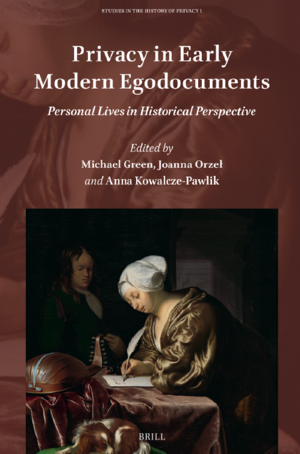
 

Series: 

  • Studies in the History of Privacy, Volume: 1

Volume Editors: Michael Green, Joanna Orzeł, and Anna Kowalcze-Pawlik

In early modern Europe, literacy was on the rise, and it became possible to reflect on one’s own life and secrets in private notes, letters to family and friends, as well as diaries, memoirs, and travelogues. Privacy in Early Modern Egodocuments: Personal Lives in Historical Perspective combines historical research with an analysis of personal narratives from Eastern, Central, and Western Europe (also in the global context) to discuss what privacy meant at a time of political and social turmoil. The contributions explore personal writings by elite figures, as well as non-elite groups and marginalised voices, in a detective-like fashion, bringing into focus narratives that have long been overlooked in traditional historical studies. The authors offer insights into the evolution of the concept of privacy as well as the use of egodocuments as a vital resource for understanding individual and collective memory, particularly as shaped by the region's dynamic history. 

Contributors are: András Bándi, Jakub Basista, Michael Green, Nere Jone Intxaustegi Jauregi, Anna Kowalcze-Pawlik, Katarzyna Kuras, Bernadetta Manyś, Joanna Orzeł, François-Joseph Ruggiu, Robert T. Tomczak, Nataliia Voloshkova, and Aleksandra Ziober.

2026 

E-Book (PDF), ISBN: 978-90-04-74984-9, Publication: 09 Feb 2026

Hardback, ISBN: 978-90-04-69310-4, Publication: 12 Mar 2026


Chapters:

Privacy, Private Lives, and Egodocumental Research, Michael Green, Joanna Orzeł, and Anna Kowalcze-Pawlik, 1–17 
Chapter 1 Looking for Early Modern Egodocuments as Sources for Privacy Research in the Archives: Some Observations, Michael Green, 18–39 
Chapter 2 Intimacy as Mutual Knowledge: an Exploration of Privacy through French Personal Writings during the Early Modern Period, François-Joseph Ruggiu, 40–68 
Chapter 3 The Making of a Hero: Virginia Narratives of John Smith (bap. 1580, d. 1631) and the Subtle Use of Privacy as a Tool to Promote Himself, Jakub Basista,

69–91 
Chapter 4 (De)Constructing Privacy, Describing Diplomatic Ties: Representations of Elizabeth I in Central European Egodocuments, Anna Kowalcze-Pawlik, 92–116 
Chapter 5 Lawsuits and Egodocuments on Sexual Intimacy in Early Modern Bilbao, Nere Jone Intxaustegi Jauregi, 117–133. Download PDF here.
Chapter 6 “Emotions” of a Parent during the Struggles of War: Lew Sapieha’s Private Relationship with His Son Jan Stanisław in Letters from 1626, Aleksandra Ziober, 134–152 
Chapter 7 The Privacy of Princesses and Princes: Relations between Members of the Saxon House of Wettin in the Mid-Eighteenth Century, Katarzyna Kuras, 153–175 
Chapter 8 Privacy and Publicity in Early Modern Alba Amicorum from Central Europe, Robert T. Tomczak, 176–196 
Chapter 9 Privacy in the Last Will Acts of Vilnius Bourgeois Women from the First Half of the Eighteenth Century: Study of Selected Cases, Bernadetta Manyś, 197–218 
Chapter 10 The Emergence of Privacy: Motivations and Self-Expression in Polish Noblewomen’s Diaries and Memoirs in the Late Eighteenth and Early Nineteenth Centuries, Joanna Orzeł, 219–240 
Chapter 11 Bluestockings and Their Spaces of Privacy in Conversation and in Writing: the Case of Mary Hamilton (1756–1816), Nataliia Voloshkova, 241–258 
Chapter 12 Public Duty and Private Life in Michael Conrad von Heydendorff (1730–1821)’s Autobiography and Georg Michael Gottlieb von Herrmann (1737–1807)’s Curriculum Vitae, András Bándi, 259–286 
  • https://brill.com/display/title/69877
Godło
bip
hr
hr
Sm

FacebookInstagramLinkedInYouTubeFlickrSoundCloud
Faculties and Units
  • Faculty of Biology and Environmental Protection
  • Faculty of Chemistry
  • Faculty of Economics and Sociology
  • Faculty of Educational Sciences
  • Faculty of Geographical Sciences
  • Faculty of International and Political Studies
  • Faculty of Law and Administration
  • Faculty of Management
  • Faculty of Mathematics and Computer Science
  • Faculty of Philology
  • Faculty of Philosophy and History
  • Faculty of Physics and Applied Informatics
  • University of Lodz Branch in Tomaszów Mazowiecki
  • Scientific Centres and Research Teams
  • University of Lodz Library
  • Lodz University Press
Shortcuts
  • UniLodz mail
  • USOSWeb
  • Employee Portal
  • Moodle e-learning platform
  • UniLodz Experts
  • Privacy policy
  • Accessibilty
  • About the website
  • UniLodz store
  • Faculties and Units
  • Site maps

UNIVERSITY OF LODZ


Narutowicza 68, 90-136 LODZ

fax: 00 48 42/665 57 71, 00 48 42/635 40 43

NIP: 724 000 32 43

Funduszepleu
Projekt Multiportalu UŁ współfinansowany z funduszy Unii Europejskiej w ramach konkursu NCBR
Questions? Virtual assistant

Essential cookies enable basic functions and are necessary for the website to function properly

Statistics cookies collect information anonymously. This information helps us to understand how our visitors use our website.

Our website uses cookie files (so-called cookies) for statistical, advertising and functional purposes. Thanks to them, we can customize the site to Your needs. Anyone can accept cookies or have the option to disable them in the browser, so that no information will be collected
Navigate to Privacy Policy