The goal of study curriculum is to broaden and deepen knowledge of doctoral students in the field of selected scientific discipline in an interdisciplinary environment allowing for the placement of competence associated with a given scientific discipline in a wider context. Knowledge and skills acquired during the studies will prepare you as a doctoral student to plan, design and conduct research independently within the Individual Research Plan (Indywidualny plan badawczy – IPB).
After graduating from the Doctoral School, you will be prepared to critically evaluate scientific research results that constitute a basis for scientific publications as well as to present the obtained results in the international scientific community. The acquired knowledge and ability to share it will enable you to carry out didactic work at the level of higher education.
Thanks to the education process you will gain competence enabling you to engage in individual as well as team scientific research, especially interdisciplinary ones, conducted by national and international research teams. The obtained knowledge and research results will constitute your contribution to the development of innovative economy and work for the public good.
The studies last 8 semesters and they are full-time studies (the classes are held during working days). They are free of charge.
List of academic staff that perform supervison over doctoral dissertations
dr hab. Aneta Balcerczyk, prof. UL — supervision of doctoral dissertation entitled: "The impact of peptidylarginine deiminase inhibition and PAD4 gene silecing on selected endothelial cell functions epigenome parameters".
dr hab. Anna Brzostek, prof. IMB PAS — supervision of doctoral dissertation entitled: "Functional analysis of potential DNA repair proteins - Msmeg_1891 and Rv3226c - in Mycobacterium genus".
prof. dr hab. Jarosław Dziadek — supervision of doctoral dissertation entitled: "The importance of genetic and phenotypic variance of Mycobacterium tuberculosis in tuberculosis transmission".
dr hab. Agnieszka Grzelak — supervision of doctoral dissertation entitled: "Evaluation of the antioxidant properties of ergothioneine and its potential role against neurodegeneration".
dr hab. Agnieszka Krupa, prof. UL — supervision of doctoral dissertation entitled: : Angiogenic and pro-regenerative properties of cholesterol and osteogenic effects of cholesterol-modified biocomposite".
prof. dr hab. Zbigniew Leśnikowski — supervision of doctoral dissertation entitled: "Oligofunctionalization of boron clusters as building blocks for new materials and bioactive molecules".
prof. dr hab. Magdalena Mikołajczyk-Chmiela — supervision of doctoral dissertation entitled: "Pro-regenarative, antimicrobial and immunomodulatory properties of Pseudomonas aeruginosa pyomelanin".
prof. dr hab. Grzegorz Mlostoń — supervision of doctoral dissertation entitled: "New applications of D-A cyclopropanes in the synthese of sulfur heterocycles and other organic compounds of sulfur".
dr hab. Michał Rachwalski, prof. UL — supervision of doctoral dissertation entitled: "Use of chiral aziridine ligands in the synthesis of compounds with luminescent properties".
dr hab. Artur Różański, prof. CMMS PAS — supervision of doctoral dissertation entitled: "Micromechanisms of deformation of semicrystalline polymers at small strains".
prof. dr hab. Piotr Bałczewski — supervision of doctoral dissertation entitled: "Synteza i badanie właściwości fosforo-podstawionych acenów".
dr hab. Melania Bednarek, prof. CMMS PAS — supervision of doctoral dissertation entitled: "Modification of polylactide by introducing into the polymer structure a moiety containing a covalent bond susceptible to thermal dissotiation".
dr hab. Justyna Gatkowska, prof. UL — supervision of doctoral dissertation entitled: "Toxoplasma gondii recombinant proteins in immunoprophylaxis and diagnostics of toxoplasmosis".
prof. dr hab. Maksim Ionov — supervision of doctoral dissertation entitled: "Biophysical characterization and evaluation of biological proerties of polyphenolic dendrimers modified with caffeic acid".
prof. dr hab. Magdalena Klink — supervision of doctoral dissertation entitled: "Functional analysis of RAB27 in melanoma cell lines: small extracellular vesicle secretion, migration, invasion and cell signaling".
dr hab. Agnieszka Krupa, prof. UL — supervision of doctoral dissertation entitled: "Angiogenic and pro-regenarative properties of cholesterol and osteogenic effects of cholesterol-modified biocomposite".
prof. dr hab. n. med. Edyta Paradowska — supervision of doctoral dissertation entitled: "Wpływ białek regulatorowych E5, E6 i E7 HPV na proces karcynogenezy jajnika".
dr hab. Agnieszka Robaszkiewicz, prof. UL— supervision of doctoral dissertation entitled: "Overcoming multidrug resistance in cancer at the genome level: developing a method to counteract overexpression of ABC transporters in cancer cells based on inhibitors of chromatin remodeling enzymes".
prof. dr hab. Piotr Bałczewski — supervision of doctoral dissertation entitled: "Synthesis and study of the properties of phosphine substituted acenes".
dr hab. Anna Brzostek, prof. UL — supervision of doctoral dissertation entitled: "Utilization of evolutionary patterns for the optimization of Mycobacterium tuberculosis gyrase inhibitors".
dr hab. inż. Małgorzata Baśko, prof. CMMS PAS — supervision of doctoral dissertation entitled: “Poly(2-isopropenyl-2-oxazoline) networks as multifunctional materials with tailored properties”.
dr hab. Magdalena Druszczyńska, prof. UL — supervision of doctoral dissertation entitled: "BCG vaccine as an immunomodulator of children's innate immune response to the antigens of viral respiratory pathogens".
dr hab. Anna Krześlak, prof. UL— supervision of doctoral dissertation entitled: "The relationship between O-GlcNAcylation dysregulations and the activity of hypoxia-inducible factors in breast cancer".
prof. dr hab. Katarzyna Lisowska — supervision of doctoral dissertation entitled:" Biological activity and toxicity of silver nanoparticles synthesized by microbiological method using the filamentous fungus Gloeophyllum striatum".
prof. dr hab. Magdalena Mikołajczyk-Chmiela — supervision of doctoral dissertations entitled:
1. "Identification of low-molecular-weight compounds inhibiting the activity of nucleotidyltransferases involved in tRNA metabolism in Helicobacter pylori".
2. “Investigation of RNA degradation as a starting point for the discovery of novel compounds with antimycobacterial activity.”
dr hab. Katarzyna Miłowska, prof. UL — supervision of doctoral dissertation entitled:"Dendrimers as Potential Carriersof Medicinal Substances”.
dr hab. Łukasz Pułaski, prof. UL — supervision of doctoral dissertation entitled: "Epigenetic and transcriptional outcomes of flame retardant action in immune cells".
dr hab. Agnieszka Robaszkiewicz, prof. UL — supervision of doctoral dissertation entitled: "The role of SWI/SNF-EP300 complex in the development of cancer cell resistance to chemotherapy".
dr hab. Bogna Rudolf, prof. CMMS PAS — supervision of doctoral dissertation entitled: "New methods of imaging proteins with fluorescent and metallocarbonyl markers".
dr hab. inż. Małgorzata Baśko — supervision of doctoral dissertation entitled: "Cyclic acetals in the synthesis of copolymers with increased degradation".
dr hab. Michał Bijak, prof. UL — supervision of doctoral dissertation entitled: "Analysis of molecular changes induced in the cell by Ochratoxin A as an attempt to explain its cytotoxic and carcinogenic effect".
dr hab. Marta Dudek, prof. CMMS PAS — supervision of doctoral dissertation entitled: "Application of non-classical crystallization methods for better control of the formation process of difficult-to-obtain polymorphic forms of molecular crystals".
dr hab. Katarzyna Dzitko, prof. UL / prof. Leszek Lisowski —- supervision of doctoral dissertation entitled: "Application of non-classical crystallization methods
dr hab. Agnieszka Grzelak — supervision of doctoral dissertation entitled: "Nanoplastic and silver nanoparticles as a factor modulating estrogen-dependent signalling activity in mammary gland epithelial cells".
dr hab. Agnieszka Robaszkiewicz, prof. UL — supervision of doctoral dissertation entitled: "Nucleolar role of PARP1 in predisposition of chemotherapy-resistant cancer cells to polyaneuploidy and senescence".
dr hab. Paweł Stączek, prof. UL / dr hab. Jacek Kubiak — supervision of doctoral dissertation entitled: "The role of Translationally Controlled Tumor Protein (TCTP) in apoptosis and proliferation of cancerous and non-transformed cells".
prof. dr hab. Tomasz Śliwiński — supervision of doctoral dissertation entitled: "The role of synaptic plasticity in the pathogenesis of depressive disorders".
dr hab. Aneta Balcerczyk, prof. UL — supervision of doctoral dissertation entitled: "Analysis of the epigenetic potential of the ketogenic diet and ketone bodies in the aspects of metabolic syndrome disorders".
prof. dr hab. Jarosław Dziadek — supervision of doctoral dissertation entitled: "Quinolone derivatives as potential anti-mycobacterial drugs and mechanisms of resistance acquisition in mycobacteria".
prof. dr hab. Andrzej Gałęski — supervision of doctoral dissertation entitled: "Foaming of polymer nanocomposites".
dr hab. Alejandro Ibanez Ricoma — supervision of doctoral dissertation entitled: "The role of the microbiome in chemical communication in reptiles".
dr hab. Paweł Stączek, prof. UL — supervision of doctoral dissertation entitled: „The potential role of microbiota in the immunopathogenesis of selected female reproductive tract cancers and modulation of the chemotherapy course”
prof. dr hab. Maksim Ionov — supervision of doctoral dissertation entitled: "Biodegradable carbosilane dendrimers in controlled drug and siRNA delivery to cancer cells".
dr hab. Katarzyna Izydorczyk, prof. ERCE PAN — supervision of doctoral dissertation entitled: “Dynamic analysis of the relationship of flow rate with nutrient concentration and river metabolism in the catchment-river-reservoir system”.
prof. dr hab. Joanna Mankiewicz-Boczek — supervision of doctoral dissertation entitled: "Phycosphere-prokaryotic communities and cyanobacterial blooms under complex surface water threats in different landscapes and climate zones".
prof. dr hab. Marcin Palusiak — supervision of doctoral dissertation entitled: "Research towards synthesis of multicomponent crystals consisting of biologically active components ".
dr hab. Sylwia Smarzewska, prof. UL — supervision of doctoral dissertation entitled: "Electrochemical investigations of biologically active compounds with particular regard to food components".
dr hab. Iurii Vozniak, prof. CMMS PAS — supervision of doctoral dissertation entitled: “Development of Multiple-Shape Memory Polymers via Blending of Immiscible Polymers Induced by Severe Plastic Deformation".
prof. dr hab. Piotr Bałczewski — supervision of doctoral dissertation entitled: "Friedel-Crafts-Bradsher reaction as a tool for the synthesis of alkynyl-substituted acenes".
prof. dr hab. Joanna Boncela — supervision of doctoral dissertation entitled: "Platelets as carriers of therapeutic agents in the colorectal cancer treatment.”
dr hab. Mariola Brycht, prof. UL / prof. Ing. Ľubomír Švorc, DrSc. — supervision of doctoral dissertation entitled: "Development of innovative electrochemical sensors based on non-traditional carbon based electrode materials and their application in electroanalysis".
dr hab. Marek Brzeziński, prof. CMMS PAS / dr hab. Weronika Gonciarz — supervision of doctoral dissertation entitled: "Click chemistry in microfluidic channels for the construction of nanomaterials against drug-resistant microbes".
dr hab. Marta Dudek, prof. CMMS PAS — supervision of doctoral dissertation entitled: "Do monomorphic molecules exist? - Theoretical and experimental evaluation of potentislly monomorphic systems".
dr hab. Monika Gosecka, prof. CMMS PAS — supervision of doctoral dissertation entitled: " Polymeric biphasic cross-linked materials as dressings for the therapy of chronic deep diabetic ulcer wounds".
dr hab. Weronika Gonciarz / dr hab. Marek Brzeziński, prof. CMMS PAS — supervision of doctoral dissertation entitled: "The role of encapsulated histamine and anticancer drugs in limiting gastric cancer cells expansion and its neovascularization induced in vitro by Helicobacter pylori components".
dr hab. Marcin Kiedrzyński, prof. UL — supervision of doctoral dissertation entitled: "Identification of future microrefugia for pine forest plants through global and regional biogeographical niche modelling and in situ environmental stress analysis".
prof. dr hab. Barbara Klajnert-Maculewicz — supervision of doctoral dissertation entitled: "Charakterystyka i zastosowania biomedyczne liposomów funkcjonalizowanych nanocząstkami złota".
dr hab. Philippe J. R. Kok, prof. UL — supervision of doctoral dissertation entitled: "Cognitive and genomic consequences of social evolution in anurans".
dr hab. Marta Kolanowska, prof. UL — supervision of doctoral dissertation entitled: ,"Taxonomy and ecology of Ophrys speculum complex (Orchidaceae)".
dr hab. Wiesław Lorkiewicz, prof. UL — supervision of doctoral dissertation entitled: "Degenerative changes of the spine and their functional determinants in the Neolithic, medieval and early modern populations from".
prof. dr hab. Piotr Minias — supervision of doctoral dissertation entitled: "Microevolutionary Basis of Synurbization Processes – From Microbiomes to Landscape Genomics"."
dr hab. Izabela Papiewska-Pająk, prof. IMB PAS — supervision of doctoral dissertation entitled: "Inhibition of extracellular vesicles incorporation as a tool for suppression of colorectal cancer progression".
dr hab. Przemysław Płociński, prof. UL — supervision of doctoral dissertation entitled: "Investigation of RNA Degradosome-Mediated Drug Resistance Mechanisms in Mycobacterium tuberculosis".
dr hab. Łukasz Półtorak, prof. UL — supervision of doctoral dissertation entitled: "Electrochemical sensors development for determination of psychoactive substances".
dr hab. Sylwia Różalska, prof. UL — supervision of doctoral dissertations entitled:
1. "Study of interactions between microgreens and plant growth-promoting bacteria".
2. "Study of the environmental functions of entomopathogenic fungi of the genera Akanthomyces, Hirsutella, Penicillium and Samsoniella under the influence of climate change".
dr hab. Artur Różański, prof. CMMS PAS — supervision of doctoral dissertation entitled: "Faza amorficzna sztywna-mikrostruktura oraz rola we właściwościach barierowych polimerów częściowo krystalicznych”.
prof. dr hab. Tomasz Śliwiński — supervision of doctoral dissertation entitled: "The role of chemokines and their receptors in the pathogenesis of depression".
dr hab. Anna Wrona-Piotrowicz, prof. UL — supervision of doctoral dissertation entitled: "Synteza i właściwości fotofizyczne nowych fluoroforów opartych na szkielecie piren-adamantan".
prof. dr hab. Elżbieta Żądzińska — supervision of doctoral dissertation entitled: "Rekonstrukcja twarzy człowieka z zastosowaniem nowoczesnych technik komputerowych i sztucznej inteligencji".
dr hab. Iurii Vozniak, prof. CBMM PAS — supervision of doctoral dissertation entitled: "Structural and phase transformations in polymers induced by ultrahight plastic deformation".
prof. dr hab. Piotr Bałczewski – supervision of doctoral dissertation entitled: "Synteza preparatów farmaceutycznych zawierających leki o niskiej rozpuszczalności i ko-formery pochodzenia naturalnego"
prof. dr hab. Karolina Bącela-Spychalska – supervision of doctoral dissertation entitled: "Harnessing Environmental DNA and RNA to Monitor Biodiversity and Ecosystem Function in Temporary Ponds"
dr hab. Michał Bijak, prof. UŁ – supervision of doctoral dissertation entitled: "Opracowanie nowych inhibitorów acetylocholinoesterazy opartych na naturalnych farmakoforach w kontekście terapii wspomagającej funkcje poznawcze"
prof. dr hab. Magdalena Błażewicz – supervision of doctoral dissertation entitled: "Environmental Drivers of Peracarida Biodiversity in the Clarion-Clipperton Zone (CCZ): Assessing the Impact of Deep-Sea Mining"
prof. dr hab. Joanna Boncela – supervision of doctoral dissertation entitled: "Pęcherzyki zewnątrzkomórkowe uwalniane z komórek śródbłonka w stanach zapalnych - badania proteomiczne"
dr hab. Marek Brzeziński, prof. CBMiM PAN – supervision of doctoral dissertation entitled: "Supramolekularne nanocząstki zdolne do blokowania kanałów wapniowych w komórkach nowotworowych"
dr hab. Marta Dudek, prof. CBMiM PAN – supervision of doctoral dissertation entitled: "Connecting experimental crystallization of drug polymorphs with computational predictions"
prof. dr hab. Jarosław Dziadek – supervision of doctoral dissertation entitled: "Identyfikacja oraz charakterystyka nowych związków przeciwprątkowych, w tym inhibitorów wybranych enzymów metabolizmu RNA”
dr hab. Monika Gosecka, prof. CBMiM PAN – supervision of doctoral dissertation entitled: "Biżele o kontrolowanym uwalnianiu hydrofilowych i hydrofobowch związków terapeutycznych, jako potencjalnych opatrunków w leczeniu owrzodzeń stopy cukrzycowej"
dr hab. Katarzyna Izydorczyk, prof. ERCE PAN – supervision of doctoral dissertation entitled: "Wpływ ekohydrologicznych rozwiązań bliskich naturze na reżim hydrologiczny rzeki Luboczanki oraz retencję wód w dolinie rzeki dla zwiększenia odporności na stres"
dr hab. Edyta Kiedrzyńska, prof. ERCE PAN – supervision of doctoral dissertation entitled: "Analiza śladowych stężeń wybranych β-blokerów i niesteroidowych leków przeciwzapalnych w wodach powierzchniowych i ściekach z wykorzystaniem techniki LC-MS/MS – identyfikacja źródeł, zasięgu występowania oraz potencjalnego ryzyka środowiskowego"
dr hab. Anna Kowalewska, prof. CBMiM PAN – supervision of doctoral dissertation entitled: "New biomimetic silsesquioxane coatings with built-in antimicrobial and antibiofilm properties"
dr hab. Tomasz Mamos, prof. UŁ – supervision of doctoral dissertation entitled: "Genomics and transcriptomics of microcrustacean hatching in Temporary Ponds"
Dr. Urszula McClurg – supervision of doctoral dissertations entitled:
-
"Why do cancer cells re-express meiotic proteins SYCP1, SYCP2 and SYCP3? "
-
"Determining the role of meiotic protein SYCE3 in cancer cells"
prof. dr. hab. Piotr Minias – supervision of doctoral dissertation entitled: "Adaptacje i ograniczenia kształtujące odporność ptaków siewkowych w trakcie migracji"
prof. dr hab. Marcin Palusiak – supervision of doctoral dissertation entitled: "Synteza i badania strukturalne kryształów związków biologicznie aktywnych"
dr hab. Łukasz Półtorak, prof. UŁ – supervision of doctoral dissertations entitled:
-
"Bezpośredni druk tuszem do zastosowań bioelektrochemicznych"
-
"3D printed electrodes for energy storage and conversion applications"
dr hab. Sylwia Różalska, prof. UŁ – supervision of doctoral dissertations entitled:
-
"Badania nad potencjałem biotechnologicznym grzybów entomopatogennych z rodzaju Samsoniella – zastosowanie w biologicznej ochronie roślin i detoksykacji środowiska”
-
"Entomopatogeniczne grzyby z rodzaju Akanthomyces jako bioinsektycydy i promotory wzrostu roślin"
dr hab. Konrad Rudnicki – supervision of doctoral dissertation entitled: "Samoorganizujące się monowarstwy na granicach fazowych typu ciecz-ciecz do wykrywania metabolitów grzybów"
dr hab. Sylwia Smarzewska, prof. UŁ – supervision of doctoral dissertation entitled: "Bioelektroanaliza z wykorzystaniem zaawansowanych technik elektrochemicznych”
dr hab. Carl Smith, prof. UŁ – supervision of doctoral dissertation entitled: "Eko-ewolucyjna dynamika radiacji adaptacyjnej"
prof. dr hab. Tomasz Śliwiński – supervision of doctoral dissertations entitled:
-
"Zastosowanie metody DNA seq w celu zidentyfikowania alternatywnego mechanizmu genetycznego związanego z somatyczną utratą heterozygotyczności, klasą ukrytych mutacji występujących w nowotworach litych"
-
"Wpływ włókien mineralnych o różnej toksyczności na wytwarzanie izolacji termicznych stosowanych w wysokich temperaturach"
prof. dr hab. n. med. Anna S. Świerzko – supervision of doctoral dissertation entitled: “Impact of Yersinia enterocolitica O:3 surface structures on the activity of outer membrane vesicles (OMVs) as a complex virulence factor: interconnection of inflammation, complement and coagulation systemsprof. dr hab. Piotr Bałczewski - promotorstwo nad rozprawą doktorską pt.: “Synteza preparatów farmaceutycznych zawierających leki o niskiej rozpuszczalności i ko-formery pochodzenia naturalnego”
Teachers
Prof. John A. Blaho, USA, The City College of New York
Język angielski nauk biologicznych, chemicznych, medycznych
Prof. Laura Bowater 0000-0003-3232-8062
Język angielski nauk biologicznych, chemicznych, medycznych
Prof. Richard Bowater 0000-0002-2745-7807
Język angielski nauk biologicznych, chemicznych, medycznych
Dr hab. Dominika Drzewiecka 0000-0002-2753-7700
Język angielski nauk biologicznych, chemicznych, medycznych
Dr hab. Marta Dudek, prof. CBMM PAN 0000-0003-3412-0177
NMR Spectroscopy
Dr Katarzyna Hnatuszko-Konka 0000-0001-8174-3268
Badania kliniczne produktów leczniczych
Dr hab. Andrzej Jóźwiak, prof. UŁ 0000-0001-7314-904X
Metodologia w badaniach naukowych z elementami etyki
Prof. dr hab. Elżbieta Kuźniak-Gębarowska 0000-0002-8750-6201
Podstawy komunikacji naukowej
Dr Paweł Krzyczmonik 0000-0002-1743-4310
Technologie informatyczne
Prof. Camille Locht 0000-0001-7295-7336
Research in vaccinology
Dr hab. Magdalena Łabieniec-Watała, prof. UŁ 0000-0002-1408-5557
Metody analizy statystycznej (kurs podstawowy)
Prof. Erin Maloney 0000-0001-5557-0842
Język angielski nauk biologicznych, chemicznych, medycznych
Dr Rafał Mielczarek 0000-0002-4467-4731
Wprowadzenie do efektywnego publikowania
Mgr Lidia Mikołajuk
Wprowadzenie do efektywnego publikowania
Dr hab. Łukasz Pułaski, prof. UŁ 0000-0001-8063-801X
Seminarium w języku angielskim
Mgr Jędrzej Szynkowski
Warsztaty z kreatywności i innowacyjności
Dr hab. Marek Wieczorek, prof. UŁ 0000-0002-0862-8076
Metodologia w badaniach naukowych z elementami etyki
Dr Anna Wypych-Stasiewicz, prof. UŁ www.scopus.com
Dydaktyka szkoły wyższej w języku polskim i angielskim
Dr hab. Robert Zakrzewski, prof. UŁ 0000-0002-0781-1442
Dydaktyka szkoły wyższej w języku polskim i angielskim
Dr hab. Anna Zawisza, prof. UŁ 0000-0001-8801-8210
Stereochemia
Współczesny świat i jego poznanie – rezultaty badań łódzkich naukowców nt. „Ekologiczne, społeczne i ekonomiczne aspekty (nie)zrównoważonego rozwoju”:
Prof. dr hab. Piotr Gałecki 0000-0003-2447-5636
Dziedziczenie traumy w aspekcie biologicznym i społecznym w świetle teorii neurorozwojowej depresji
Prof. dr hab. Dariusz Heim 0000-0002-1036-5818
Wybrane koncepcje rozwoju budownictwa zrównoważonego i dostępne metody oceny
Dr hab. Tomasz Jurczak, prof. UŁ 0000-0002-1576-6741
Zastosowanie ekohydrologii do zarządzania ekosystemami wodnymi dla poprawy jakości zasobów wodnych oraz adaptacji do antropogenicznych zmian klimatycznych
Dr Stanisław Krysiak 0000-0002-8131-6386
Krajobraz Polski Środkowej - przeszłość, teraźniejszość, kierunki przemian
Prof. dr hab. Paweł Mierczyński 0000-0001-8359-2029
Proekologiczne źródła zielonej energii jako alternatywa dla paliw kopalnych
Prof. dr hab. Zbigniew Rdzany 0000-0002-9059-9904
Krajobraz Polski Środkowej - przeszłość, teraźniejszość, kierunki przemian
Prof. dr hab. Maciej Sibiński 0000-0002-9752-3400
Zrównoważona produkcja i konsumpcja energii
Prof. dr hab. Izabela Warwas 0000-0001-8066-746X
Krajobraz komunikacji naukowej w Polsce
Prof. dr hab. Joanna Wibig 0000-0002-8560-0325
Zmiany klimatu, stan obecny, przyczyny i prognozy
Prof. dr hab. Lech Witkowski 0000-0002-9940-5096
Humanistyczne wyzwania (nie)zrównoważenia
Prof. dr hab. Maciej Zalewski 0000-0002-4483-6200
Zastosowanie Ekohydrologii w Strategiach Zrównoważonego Rozwoju i Green Deal w świetle najnowszych dokumentów ONZ i Komisji Europejskiej
Dr hab. Aneta Balcerczyk, prof. UŁ 0000-0001-8544-5778
Seminarium w języku angielskim
Prof. John A. Blaho, USA, The City College of New York
Język angielski nauk biologicznych, chemicznych, medycznych
Prof. Laura Bowater 0000-0003-3232-8062
Język angielski nauk biologicznych, chemicznych, medycznych
Prof. Richard Bowater 0000-0002-2745-7807
Język angielski nauk biologicznych, chemicznych, medycznych
Dr hab. Marta Dudek , prof. CBMM PAN 0000-0003-3412-0177
NMR Spectroscopy
Dr hab. Dominika Drzewiecka 0000-0002-2753-7700
Język angielski nauk biologicznych, chemicznych, medycznych
Dr Katarzyna Hnatuszko-Konka 0000-0001-8174-3268
Badania kliniczne produktów leczniczych
Dr hab. Andrzej Jóźwiak, prof. UŁ 0000-0001-7314-904X
Metodologia w badaniach naukowych z elementami etyki
Prof. dr hab. Elżbieta Kuźniak-Gębarowska 0000-0002-8750-6201
Podstawy komunikacji naukowej
Prof. Camille Locht 0000-0001-7295-7336
Research in vaccinology
Prof. Erin Maloney 0000-0001-5557-0842
Język angielski nauk biologicznych, chemicznych, medycznych
Dr Rafał Mielczarek 0000-0002-4467-4731
Wprowadzenie do efektywnego publikowania
Mgr Lidia Mikołajuk
Wprowadzenie do efektywnego publikowania
Dr hab. Łukasz Pułaski, prof. UŁ 0000-0001-8063-801X
Seminarium w języku angielskim
Dr Karolina Rudnicka, prof. UŁ 0000-0002-3412-9000
Techniki wystąpień publicznych / Public speaking techniques
Mgr Jędrzej Szynkowski
Warsztaty z kreatywności i innowacyjności
Dr hab. Marek Wieczorek, prof. UŁ 0000-0002-0862-8076
Metodologia w badaniach naukowych z elementami etyki
Dr Anna Wypych-Stasiewicz, prof. UŁ www.scopus.com
Dydaktyka szkoły wyższej w języku polskim i angielskim
Dr hab. Robert Zakrzewski, prof. UŁ 0000-0002-0781-1442
Dydaktyka szkoły wyższej w języku polskim i angielskim
Dr hab. Anna Zawisza, prof. UŁ 0000-0001-8801-8210
Stereochemia
Dr Małgorzata Czerniak-Reczulska
Techniki e-learning i blended learning
Dr hab. Marta Dudek , prof. CBMM PAN 0000-0003-3412-0177
NMR Spectroscopy
Dr hab. Katarzyna Dzitko, prof. UŁ 0000-0002-3265-0409
Interdyscyplinarne seminarium postępów IPB / IPB interdisciplinary progress seminar
Dr hab. Marek Fol, prof UŁ 0000-0002-8041-1920
Microbes and their hosts
Joanna Frączek-Broda
Carrier coaching Intercultural competences
Dr hab. Justyna Gatkowska, prof. UŁ 0000-0002-0559-1706
Microbes and their hosts
Dr hab. Marek Gensler, prof. UŁ 0000-0001-8074-6854
Ethical and legal aspects of scientific research
Dr hab. Andrzej Kaniowski, prof. UŁ 0000-0003-1452-2670
Etyczne i prawne aspekty badań naukowych
Dr hab. Andrzej Komisarski, prof. UŁ 0000-0002-0954-3699
Język R w analizie danych
Hanna Król
Carrier coaching
Dr Magdalena Kowalewicz-Kulbat 0000-0003-4447-0859
Metody analizy statystycznej (kurs podstawowy) w naukach BioMedChem / Statistical methods in biology, part I / Microbes and their hosts
Prof. dr hab. Andrzej Kruk 0000-0003-1452-7906
Fundamentals of science communication
Prof. Camille Locht 0000-0001-7295-7336
Research in vaccinology
Dr hab. Magdalena Łabieniec-Watała, prof. UŁ 0000-0002-1408-5557
Finansowanie nauki i transfer wiedzy / Science funding and knowledge transfer
Dr Anna Maciejewska
Emisja głosu
Dr Rafał Mielczarek 0000-0002-4467-4731
Wprowadzenie do efektywnego publikowania
Prof. dr hab. Magdalena Mikołajczyk-Chmiela 0000-0002-5447-2922
Microbes and their hosts
Mgr Lidia Mikołajuk
Wprowadzenie do efektywnego publikowania
Dr Kamila Pytka 0000-0002-9100-305X
Warsztaty z narzędzi IT i grywalizacji
Dr hab. Aneta Rogalska-Marasińska, prof. UŁ 0000-0002-4170-1693
Higher education didactics
Dr Karolina Rudnicka, prof. UŁ 0000-0002-3412-9000
Techniki wystąpień publicznych / Microbes and their hosts
Dr hab. Beata Sadowska, prof UŁ 0000-0001-6383-3972
Microbes and their hosts
Dr Sebastian Sakowski 0000-0002-6127-3403
Język R w analizie danych
Mgr Jędrzej Szynkowski
Warsztaty z kreatywności i innowacyjności
Dr Wojciech Świtalski 0000-0002-6968-8347
Warsztaty z narzędzi IT i grywalizacji / Techniki e-learning i blended learning
Dr hab. Marek Wieczorek, prof. UŁ 0000-0002-0862-8076
Etyczne i prawne aspekty badań naukowych / Ethical and legal aspects of scientific research
Prof. dr hab. Sylwia Wojtczak 00000001-6054-0963
Etyczne i prawne aspekty badań naukowych / Ethical and legal aspects of scientific research
Dr Anna Wypych-Stasiewicz, prof. UŁ www.scopus.com
Dydaktyka szkoły wyższej / Higher education didactics
Dr hab. Robert Zakrzewski, prof. UŁ 0000-0002-0781-1442
Dydaktyka szkoły wyższej / Higher education didactics
Dr hab. Aneta Balcerczyk, prof. UŁ 0000-0001-8544-5778
Nazwa wykładanego przedmiotu: Higher education didactics
Mgr Magdalena Boroń
E-learning and blended learning techniques
Prof. Joanna Boncela 0000-0001-8419-7012
Molecular methods in biomedical research
Dr Małgorzata Czerniak-Reczulska
Techniki e-learning i blended learning
Dr hab. Marta Dudek , prof. CBMM PAN 0000-0003-3412-0177
NMR Spectroscopy
Prof. dr hab. Jarosław Dziadek 0000-0003-1427-884X
Molecular methods in biomedical research
Dr hab. Katarzyna Dzitko, prof. UŁ 0000-0002-3265-0409
Interdyscyplinarne seminarium postępów IPB / IPB interdisciplinary progress seminar
Dr hab. Andrzej Kaniowski, prof. UŁ 0000-0003-1452-2670
Etyczne i prawne aspekty badań naukowych
Prof. dr hab. n. med. Magdalena Klink 0000-0002-9870-7391
Molecular methods in biomedical research
Dr Magdalena Kowalewicz-Kulbat 0000-0003-4447-0859
Statistical methods in biology, part I / Metody analizy statystycznej (kurs podstawowy) w naukach BioMedChem / Metody zaawansowanej analizy statystycznej w naukach BioMedChem
Prof. dr hab. Andrzej Kruk 0000-0003-1452-7906
Fundamentals of science communication
Prof. dr hab. Zbigniew Leśnikowski 0000-0003-3158-5796
Molecular methods in biomedical research
Dr hab. Magdalena Łabieniec-Watała, prof. UŁ 0000-0002-1408-5557
Finansowanie nauki i transfer wiedzy / Science funding and knowledge transfer
Dr Anna Maciejewska
Emisja głosu
Dr Rafał Mielczarek 0000-0002-4467-4731
Wprowadzenie do efektywnego publikowania
Mgr Lidia Mikołajuk profil
Wprowadzenie do efektywnego publikowania
Prof. dr hab. Bartłomiej Pałecz 0000-0003-3608-0367
Fizykochemiczne właściwości naturalnych i syntetycznych makromolekuł
Prof. dr hab. n. med. Edyta Paradowska 0000-0001-9446-0136
Molecular methods in biomedical research
Dr hab. Łukasz Pułaski, prof. UŁ 0000-0001-8063-801X
Higher education didactics
Dr Kamila Pytka 0000-0002-9100-305X
Warsztaty z narzędzi IT i grywalizacji
Dr hab. Marcin Ratajewski, prof. IBM PAN 0000-0001-5391-5843
Molecular methods in biomedical research
Dr Karolina Rudnicka, prof. UŁ 0000-0002-3412-9000
Techniki wystąpień publicznych / Microbes and their hosts
Mgr Jędrzej Szynkowski
Warsztaty z kreatywności i innowacyjności
Dr hab. Marek Wieczorek, prof. UŁ 0000-0002-0862-8076
Etyczne i prawne aspekty badań naukowych / Ethical and legal aspects of scientific research
Dr Anna Wypych-Stasiewicz, prof. UŁ www.scopus.com
Dydaktyka szkoły wyższej / Higher education didactics
Dr hab. Robert Zakrzewski, prof. UŁ 0000-0002-0781-1442
Dydaktyka szkoły wyższej / Higher education didactics
Dr hab. Anna Zawisza, prof. UŁ 0000-0001-8801-8210
Nazwa wykładanego przedmiotu: Stereochemia
Współczesny świat i jego poznanie – rezultaty badań łódzkich naukowców nt nt. „Transformacje w nauce: nowe technologie, sztuczna inteligencja”:
Prof. dr hab. Elżbieta Aleksandrowicz profil
Sztuka równowagi. Nowoczesne środki audiowizualne jako element strukturalny dzieła choreograficznego
Prof. dr hab. Anna Fabijańska 0000-0002-0249-7247
Wizja komputerowa i sztuczna inteligencja, czyli jak komputery widzą Świat
Prof. dr hab. n. med. Wojciech Fendler 0000-0002-5083-9168
Potencjalne zastosowania sztucznej inteligencji w medycynie
Prof. Francois Jullien 0000-0003-4308-6361
Ponownie odsłonić możliwości: de-koincydencja i kolejne życie
Dr hab. Dominik Mierzejewski, prof. UŁ 0000-0002-5943-2874
Sztuczna inteligencja w Chinach: zastosowania, zagrożenia
Dr hab. Katarzyna Pękała-Speer, prof. UŁ profil
O społecznym tworzeniu wiedzy przez nie-ekspertów i jej upowszechnianiu, na przykładzie Wikipedii
Dr Mirosław Sopek 0000-0003-0378-5125
Nasz nowy świat sztucznej inteligencji
Prof. dr hab. inż. Krzysztof Ślot profil
Krótki spacer po ogrodach świata sztucznej inteligencji
Prof. dr hab. Sylwia Wojtczak 0000-0001-6054-0963
Prawo prywatne a sztuczna inteligencja: pragmatyczne podejście do korzyści i zagrożeń przypisywanych sztucznej inteligencji
Wykłady interdyscyplinarne:
Dr Tomasz Kantyka 0000-0003-3023-2382
Never look a gift horse in the mouth - the world according to Porphyromonas gingivalis
Dr Hassan Kassassir 0000-0002-2713-9497
Micro-worlds of Therapy: Vesicular Drug Delivery Systems at the Intersection of Chemistry and Biology
Prof. Camille Locht 0000-0001-7295-7336
Vaccine development from concept to clinical / Preclinical and clinical development of vaccines
Prof. dr hab. Jan Potempa 0000-0002-3600-7461
Corruption of host immune responses by bacterial proteases
Prof. Dr Filip Du Prez 0000-0001-7727-4155
Self-healing polymers: Materials of the Future (part 1) / Self-healing polymers: Materials of the Future (part 2)
Prof. Michele Salmain 0000-0003-3039-5659
Elements of bioinorganic and bioorganometallic chemistry : Metalloproteins and metalloenzymes Metal-based drugs: classification according to their mechanism of action Metal-catalyzed chemistry in cells
Prof. Agnieszka Świątecka-Urban 0000-0002-6575-0334
Decoding CFTR Mutations: How Genetic Changes Drive Cystic Fibrosis
Prof. dr hab. Jolanta Zakrzewska-Czerwińska 0000-0002-2042-974X
Binary or Nonbinary Fission? Reproductive Mode of a Predatory Bacterium Depends on Prey Size
Dr hab. Anna Zawilak-Pawlik, prof. IITD PAN 0000-0003-1824-1550
Profiling of the Helicobacter pylori redox switch HP1021 regulon using a multi-omics approach.
Prof. Karina Gin Yew-Hoong 0000-0002-1266-9276
Micro-worlds of Therapy: Vesicular Drug Delivery Systems at the Intersection of Chemistry and Biology
Współczesny świat i jego poznanie – rezultaty badań łódzkich naukowców nt. "Człowiek-zdrowie-środowisko":
Dr hab. Mariola Antczak, prof. UŁ 0000-0002-4378-7101
Kultura czytelnicza Polaków a cybersuicydologia
Prof. dr hab. Eleonora Bielawska-Batorowicz 0000-0002-3177-6026
Psychologia środowiskowa: relacje między człowiekiem a jego otoczeniem
Dr hab. Weronika Gonciarz, prof. UŁ 0000-0002-5231-5341
Dwa oblicza prątków gruźlicy
Dr Agnieszka Kołodziejczak profil
Czy można "opowiedzieć ciszę"? Głusi odbiorcy sztuk wizualnych w XXI wieku. Wyzwania i szanse
Dr hab. Andrzej Komisarski, prof. UŁ 0000-0002-0954-3699
Język R w analizie danych
Dr Karolina Kossakowska 0000-0003-3618-1918
Psychologia środowiskowa: relacje między człowiekiem a jego otoczeniem
Dr hab. Anna Liszewska, prof. AM profil
Sztuka interpretacji dzieła muzycznego; czy sztuczna inteligencja może zastąpić indywidualnego wykonawcę?
Dr hab. Alicja Łaska-Formejster, prof. UŁ 0000-0002-8341-6268
Wyzwania polskiego systemu ochrony zdrowia
Prof. dr hab. Magdalena Mikołajczyk-Chmiela 0000-0002-5447-2922
Dwa oblicza prątków gruźlicy
Dr Sebastian Sakowski 0000-0002-6127-3403
Język R w analizie danych
Prof. dr hab. Sławomir Wiak 0000-0001-9622-9341
Współczesne technologie transmisji danych - wyzwania cywilizacyjne
Prof. dr hab. Joanna Wibig 0000-000208560-0325
Zdrowie człowieka i jakość środowiska – zagrożenia w obliczu zmian klimatycznych
Dr Marcin Włodarczyk 0000-0002-3323-7093
Dwa oblicza prątków gruźlicy
Prof. dr hab. n. med. Jerzy Krzysztof Wranicz 0000-0002-6335-0273
Jak przewidzieć nieprzewidywalne czyli stratyfikacja i profilaktyka nagłego zgonu sercowego
Dr Katarzyna Zaborska profil
Psychologia środowiskowa: relacje między człowiekiem a jego otoczeniem
Prof. dr hab. n. farm. Jolanta Zawilska
Fenomen „dopalaczy”– skutki zdrowotne i społeczne
Prof. dr hab. inż. Wojciech Wolf 0000-0002-9162-9933
Demokracja i konkurencja w nauce
Dr hab. Aneta Pawłowska, prof. UŁ 0000-0003-2847-4403
Czy można "opowiedzieć ciszę"? Głusi odbiorcy sztuk wizualnych w XXI wieku. Wyzwania i szanse
Dr hab. Aneta Balcerczyk, prof. UŁ 0000-0001-8544-5778
Finansowanie nauki i transfer wiedzy / Science funding and knowledge transfer
Mgr Magdalena Boroń
E-learning and blended learning techniques
Dr Małgorzata Czerniak-Reczulska
Techniki e-learning i blended learning
Dr hab. Marta Dudek , prof. CBMM PAN 0000-0003-3412-0177
NMR Spectroscopy
Dr hab. Katarzyna Dzitko, prof. UŁ 0000-0002-3265-0409
Interdyscyplinarne seminarium postępów IPB / IPB interdisciplinary progress seminar
Dr hab. Marek Gensler, prof. UŁ 0000-0001-8074-6854
Ethical and legal aspects of scientific research
Dr hab. Wioletta Kazimierska-Jerzyk 0000-0003-1871-7897
Etyczne i prawne aspekty badań naukowych
Dr Magdalena Kowalewicz-Kulbat 0000-0003-4447-0859
Methods of Statistical Analysis (core course) in the BioMedChem sciences / Methods for advanced statistical analysis in the BioMedChem sciences / Metody analizy statystycznej (kurs podstawowy) w naukach BioMedChem / Metody zaawansowanej analizy statystycznej w naukach BioMedChem
Prof. dr hab. Andrzej Kruk 0000-0003-1452-7906
Podstawy komunikacji naukowej / Fundamentals of science communication
Prof. dr hab. Grzegorz Leszczyński 0000-0003-4189-5165
Etyczne i prawne aspekty badań naukowych
Dr Anna Maciejewska
Emisja głosu
Dr Rafał Mielczarek 0000-0002-4467-4731
Wprowadzenie do efektywnego publikowania / Zarządzanie bazami bibliograficznymi / Specjalistyczne bazy danych
Dr Joanna Miksa 0000-0002-3517-7856
Etyczne i prawne aspekty badań naukowych / Ethical and legal aspects of scientific research
Dr Kamila Pytka 0000-0002-9100-305X
Warsztaty z narzędzi IT i grywalizacji / Workshops on IT tools and gamification
Dr hab. Aneta Rogalska-Marasińska, prof. UŁ 0000-0002-4170-1693
Nazwa wykładanego przedmiotu: Higher education didactics
Dr Karolina Rudnicka, prof. UŁ 0000-0002-3412-9000
Techniki wystąpień publicznych / Public speaking techniques
Dr hab. Jakub Szczerbowski, prof. UŁ 0000-0002-2168-0741
Ethical and legal aspects of scientific researc
Mgr Jędrzej Szynkowski
Warsztaty z kreatywności i innowacyjności
Dr Anna Wendorff 0000-0003-0829-6603
Finansowanie nauki i transfer wiedzy / Science funding and knowledge transfer
Dr Anna Wypych-Stasiewicz, prof. UŁ www.scopus.com
Nazwa wykładanego przedmiotu: Dydaktyka szkoły wyższej / Higher education didactics
Wykłady interdyscyplinarne:
Prof. Dr Filip Du Prez 0000-0001-7727-4155
Self-healing polymers: Materials of the Future (part 1) / Self-healing polymers: Materials of the Future (part 2)
Dr Tomasz Kantyka 0000-0003-3023-2382
Never look a gift horse in the mouth - the world according to Porphyromonas gingivalis
Dr Hassan Kassassir 0000-0002-2713-9497
Micro-worlds of Therapy: Vesicular Drug Delivery Systems at the Intersection of Chemistry and Biology
Prof. Camille Locht 0000-0001-7295-7336
Vaccine development from concept to clinical / Preclinical and clinical development of vaccines
Prof. dr hab. Jan Potempa 0000-0002-3600-7461
Corruption of host immune responses by bacterial proteases
Prof. Michele Salmain 0000-0003-3039-5659
Elements of bioinorganic and bioorganometallic chemistry : Metalloproteins and metalloenzymes Metal-based drugs: classification according to their mechanism of action Metal-catalyzed chemistry in cells
Prof. Agnieszka Świątecka-Urban 0000-0002-6575-0334
Decoding CFTR Mutations: How Genetic Changes Drive Cystic Fibrosis
Prof. dr hab. Jolanta Zakrzewska-Czerwińska 0000-0002-2042-974X
Binary or Nonbinary Fission? Reproductive Mode of a Predatory Bacterium Depends on Prey Size
Dr hab. Robert Zakrzewski, prof. UŁ 0000-0002-0781-1442
Nazwa wykładanego przedmiotu: Dydaktyka szkoły wyższej / Higher education didactics
Dr hab. Anna Zawilak-Pawlik, prof. IITD PAN 0000-0003-1824-1550
Profiling of the Helicobacter pylori redox switch HP1021 regulon using a multi-omics approach.
Prof. Karina Gin Yew-Hoong 0000-0002-1266-9276
Micro-worlds of Therapy: Vesicular Drug Delivery Systems at the Intersection of Chemistry and Biology
Współczesny świat i jego poznanie – rezultaty badań łódzkich naukowców nt. "Człowiek-zdrowie-środowisko":
Dr hab. Mariola Antczak, prof. UŁ 0000-0002-4378-7101
Kultura czytelnicza Polaków a cybersuicydologia
Prof. dr hab. Eleonora Bielawska-Batorowicz 0000-0002-3177-6026
Psychologia środowiskowa: relacje między człowiekiem a jego otoczeniem
Dr hab. Weronika Gonciarz, prof. UŁ 0000-0002-5231-5341
Dwa oblicza prątków gruźlicy
Dr Agnieszka Kołodziejczak profil
Czy można "opowiedzieć ciszę"? Głusi odbiorcy sztuk wizualnych w XXI wieku. Wyzwania i szanse
Dr hab. Andrzej Komisarski, prof. UŁ 0000-0002-0954-3699
Język R w analizie danych
Dr Karolina Kossakowska 0000-0003-3618-1918
Psychologia środowiskowa: relacje między człowiekiem a jego otoczeniem
Dr hab. Alicja Łaska-Formejster, prof. UŁ 0000-0002-8341-6268
Wyzwania polskiego systemu ochrony zdrowia
Prof. dr hab. Magdalena Mikołajczyk-Chmiela 0000-0002-5447-2922
Dwa oblicza prątków gruźlicy
Dr hab. Aneta Pawłowska, prof. UŁ 0000-0003-2847-4403
Czy można "opowiedzieć ciszę"? Głusi odbiorcy sztuk wizualnych w XXI wieku. Wyzwania i szanse
Dr Sebastian Sakowski 0000-0002-6127-3403
Język R w analizie danych
Prof. dr hab. inż. Wojciech Wolf 0000-0002-9162-9933
Demokracja i konkurencja w nauce
Prof. dr hab. Sławomir Wiak 0000-0001-9622-9341
Współczesne technologie transmisji danych - wyzwania cywilizacyjne
Prof. dr hab. Joanna Wibig 0000-000208560-0325
Zdrowie człowieka i jakość środowiska – zagrożenia w obliczu zmian klimatycznych
Dr Marcin Włodarczyk 0000-0002-3323-7093
Dwa oblicza prątków gruźlicy
Prof. dr hab. n. med. Jerzy Krzysztof Wranicz 0000-0002-6335-0273
Jak przewidzieć nieprzewidywalne czyli stratyfikacja i profilaktyka nagłego zgonu sercowego
Dr Katarzyna Zaborska profil
Psychologia środowiskowa: relacje między człowiekiem a jego otoczeniem
Prof. dr hab. n. farm. Jolanta Zawilska
Fenomen „dopalaczy”– skutki zdrowotne i społeczne
Dr hab. Aneta Balcerczyk, prof. UŁ 0000-0001-8544-5778
Finansowanie nauki i transfer wiedzy / Science funding and knowledge transfer
Dr inż. Paulina Bartos 0000-0003-0514-951X
Innovations Within Reach: Network, Learn, Discover
Dr hab. Marta Dudek, prof. CBMM PAN 0000-0003-3412-0177
NMR Spectroscopy
Dr hab. Marek Gensler, prof. UŁ 0000-0001-8074-6854
Ethical and legal aspects of scientific research
Dr hab. Wioletta Kazimierska-Jerzyk 0000-0003-1871-7897
Etyczne i prawne aspekty badań naukowych
Dr hab. Andrzej Komisarski, prof. UŁ 0000-0002-0954-3699
R language in data analysis
Prof. dr hab. Grzegorz Leszczyński 0000-0003-4189-5165
Etyczne i prawne aspekty badań naukowych
Dr Joanna Miksa 0000-0002-3517-7856
Etyczne i prawne aspekty badań naukowych / Ethical and legal aspects of scientific research
Dr hab. Łukasz Póltorak, prof. UŁ 0000-0002-8799-8461
Innovations Within Reach: Network, Learn, Discover
Dr hab. Aneta Rogalska-Marasińska, prof. UŁ 0000-0002-4170-1693
Higher education didactics
Dr Sebastian Sakowski 0000-0002-6127-3403
Język R w analizie danych / R language in data analysis
Dr hab. Jakub Szczerbowski, prof. UŁ 0000-0002-2168-0741
Ethical and legal aspects of scientific research
Dr Anna Wendorff 0000-0003-0829-6603
Finansowanie nauki i transfer wiedzy / Science funding and knowledge transfer
Dr Anna Wypych-Stasiewicz, prof. UŁ www.scopus.com
Nazwa wykładanego przedmiotu: Dydaktyka szkoły wyższej / Higher education didactics
Wykłady interdyscyplinarne:
Prof. Dr Filip Du Prez 0000-0001-7727-4155
Self-healing polymers: Materials of the Future (part 1) / Self-healing polymers: Materials of the Future (part 2)
Dr Tomasz Kantyka 0000-0003-3023-2382
Never look a gift horse in the mouth - the world according to Porphyromonas gingivalis
Dr Hassan Kassassir 0000-0002-2713-9497
Micro-worlds of Therapy: Vesicular Drug Delivery Systems at the Intersection of Chemistry and Biology
Prof. Camille Locht 0000-0001-7295-7336
Vaccine development from concept to clinical / Preclinical and clinical development of vaccines
Prof. dr hab. Jan Potempa 0000-0002-3600-7461
Corruption of host immune responses by bacterial proteases
Prof. Michele Salmain 0000-0003-3039-5659
Elements of bioinorganic and bioorganometallic chemistry : Metalloproteins and metalloenzymes Metal-based drugs: classification according to their mechanism of action Metal-catalyzed chemistry in cells
Prof. Agnieszka Świątecka-Urban 0000-0002-6575-0334
Decoding CFTR Mutations: How Genetic Changes Drive Cystic Fibrosis
Prof. dr hab. Jolanta Zakrzewska-Czerwińska 0000-0002-2042-974X
Binary or Nonbinary Fission? Reproductive Mode of a Predatory Bacterium Depends on Prey Size
Dr hab. Robert Zakrzewski, prof. UŁ 0000-0002-0781-1442
Nazwa wykładanego przedmiotu: Dydaktyka szkoły wyższej / Higher education didactics
Dr hab. Anna Zawilak-Pawlik, prof. IITD PAN 0000-0003-1824-1550
Profiling of the Helicobacter pylori redox switch HP1021 regulon using a multi-omics approach
Prof. Karina Gin Yew-Hoong 0000-0002-1266-9276
Micro-worlds of Therapy: Vesicular Drug Delivery Systems at the Intersection of Chemistry and Biology
1a. Study curriculum
The goal of study curriculum is to broaden and deepen knowledge of doctoral students in the field of selected scientific discipline in an interdisciplinary environment allowing for the placement of competence associated with a given scientific discipline in a wider context. Knowledge and skills acquired during the studies will prepare you as a doctoral student to plan, design and conduct research independently within the Individual Research Plan (Indywidualny plan badawczy – IPB).
After graduating from the Doctoral School, you will be prepared to critically evaluate scientific research results that constitute a basis for scientific publications as well as to present the obtained results in the international scientific community. The acquired knowledge and ability to share it will enable you to carry out didactic work at the level of higher education.
Thanks to the education process you will gain competence enabling you to engage in individual as well as team scientific research, especially interdisciplinary ones, conducted by national and international research teams. The obtained knowledge and research results will constitute your contribution to the development of innovative economy and work for the public good.
The studies last 8 semesters and they are full-time studies (the classes are held during working days). They are free of charge.
Curriculum outline, with descrition of learning outcomes, number of hours required and PQF (PRK) codes
1c. Syllabus / learning outcomes
A syllabus is the official description of a course offered within a doctoral school and designed in accordance with a learning-outcomes-based approach. It clearly specifies:
Course information
- a concise description of the course,
- intended learning outcomes (in terms of knowledge, skills, and social competences),
- general course content,
- entry requirements.
Course delivery and assessment
- required and recommended reading,
- teaching and learning methods,
- methods and criteria of assessment,
- procedures for verifying and assessing the extent to which the intended learning outcomes have been achieved,
- detailed course content.
The syllabus is a binding document for both doctoral candidates and course instructors. It serves as the basis for the organisation, delivery, and evaluation of the teaching and learning process and ensures transparent and fair assessment. The intended learning outcomes are aligned with the Polish Qualifications Framework (PQF) at level 8.
- Go to:
https://usosweb.uni.lodz.pl - Switch the interface language to EN.
- Select DIRECTORY from the main menu.
- Search for the course by its code or title.
- Log in to view and print the syllabus.
Please follow step-by-step instructions with screenshots provided in the attachment.
Guidelines given in Rector's Regulation on Syllabus / Course Description and Tasks of Course Coordinator
(RR no. 96 - 13 June 2024)
Guidelines given in Annex to Rector's Regulation on System of verification of Learning Outcomes
(RR no. 97 - 13 June 2024)
2. Mid-term evaluation
TIME FRAME
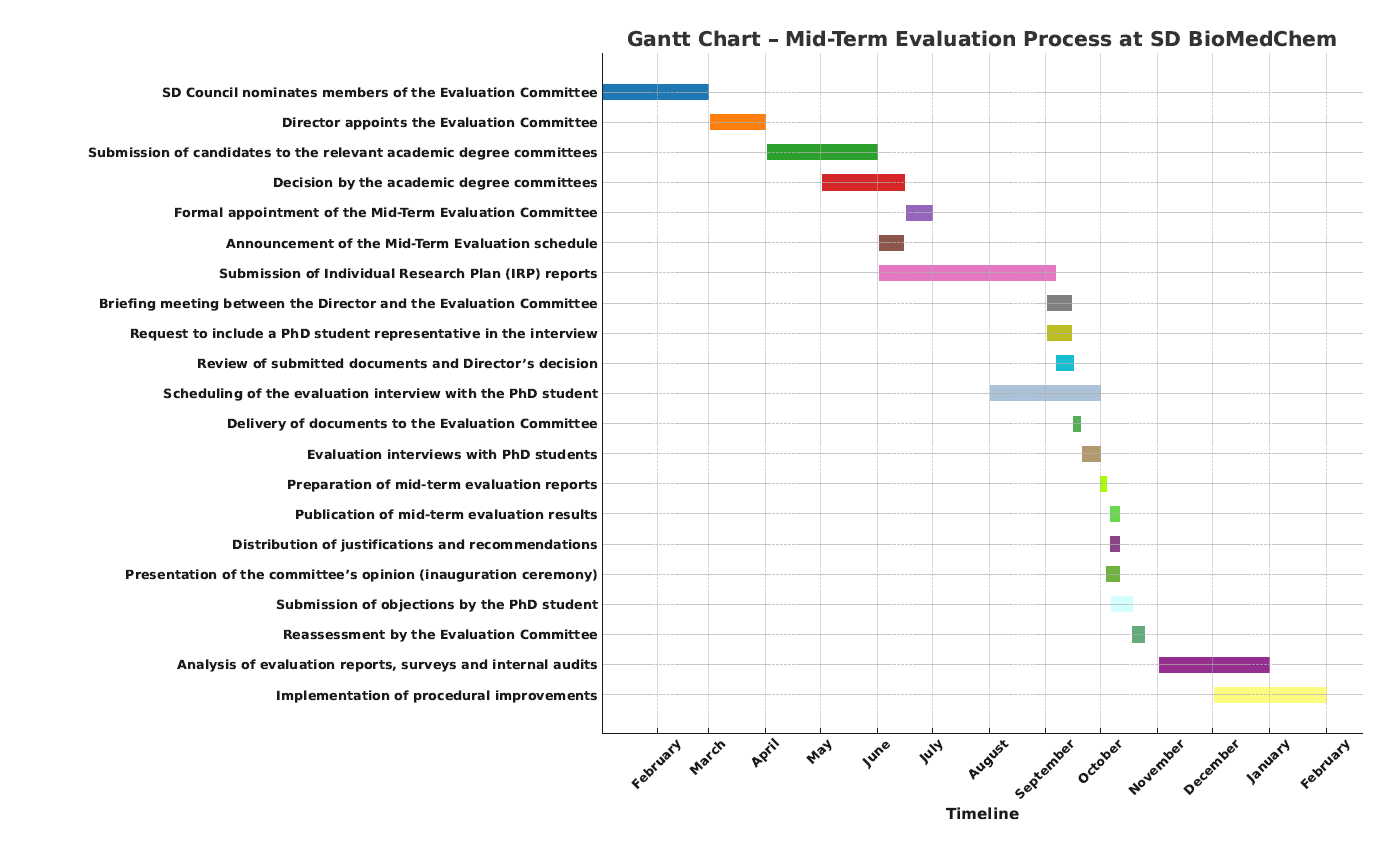
The mid-term evaluation shall take place no later than the last day of the period representing half of the period of study specified in the study programme. In the year in which the doctoral student enters the mid-term evaluation, the deadline for the doctoral student to obtain all credits and grades and to submit documentation is 5 September. In this case, the Director of the Doctoral School shall complete credits and grades pertaining to the study year by 15 September.
In the case of those who have commenced their studies at a date which prevents the doctoral student from completing the study programme in accordance with the academic calendar, as defined in separate regulations, and the doctoral student commences the study programme from the summer semester, the deadline for the doctoral student to obtain all credits and marks and to submit documentation in the year in which the doctoral student enters the mid-term evaluation shall be 21 days before the commencement of the summer semester (after two years from the commencement of the study programme).
EVALUATION COMMITTEE
The mid-term evaluation shall be carried out by an evaluation committee consisting of 3 persons, including at least 1 person holding a postdoctoral degree or a professorial title in the discipline in which the doctoral thesis is being prepared, who is employed outside any entity conducting the doctoral school. The doctoral supervisor and assistant doctoral supervisor cannot be appointed as members of the committee.
Evaluation committees shall be appointed by the Director of the Doctoral School, for each doctoral student individually, from among candidates proposed by the School Council, after the relevant doctoral degree committee in the discipline corresponding to the discipline of the doctoral thesis has given its opinion, at the latest three months before the date of the doctoral student's mid-term evaluation.
At the request of a doctoral student submitted no later than seven days before the date of the mid-term evaluation, a representative of doctoral students may participate in the committee's sessions as an observer. The representative of doctoral students shall be appointed in accordance with the rules laid down in the regulations governing the activities of the doctoral student self-government.
MID-TERM EVALUATION PROCEDURE
Evaluation committees shall conduct a mid-term evaluation of a doctoral student and an evaluation of the doctoral student's academic supervision.
The evaluation committee evaluates the doctoral student based on:
1) the effects of the implementation of the Individual Research Plan (IPB) - this is summarised on the basis of the doctoral student's annual reports, with the opinion of the supervisor(s), from the 2 years of study preceding the mid-term evaluation;
2) an examination interview with the doctoral student concerning the implementation of IPB.
The evaluation committee shall have the opportunity to review the doctoral student's evaluation sheets, together with documentation, from the 2 years of study preceding the mid-term evaluation.
In exceptional situations, it is possible to conduct an examination interview with a doctoral student using technical devices enabling it to be conducted remotely with simultaneous transmission of video and sound. The rules for conducting the interview in the aforementioned mode are defined by separate regulations in force at the University of Lodz. In exceptional situations, a member of the evaluation committee may participate in the work of the committee using technical devices enabling it to be conducted remotely with simultaneous transmission of image and sound.
The work of the committee includes:
(a) reading the doctoral student's documentation,
b) conducting an examination interview with the doctoral student,
c) preparing an evaluation of the doctoral student together with a justification (minutes/notes)
d) evaluation of the doctoral student's academic supervision,
e) preparing the result of the assessment of the scientific supervision provided to the doctoral student (minutes/notes).
The assessment of a doctoral student shall be conducted in accordance with the framework assessment criteria defined by the Director of the Doctoral School, in cooperation with the School Council, adopted pursuant to separate regulations. The evaluation of the scientific care shall take place taking into account the framework evaluation criteria, defined by the Director of the Doctoral School, in cooperation with the School Council, adopted on the basis of separate regulations.
OUTCOME OF THE MID-TERM EVALUATION
The mid-term evaluation of a doctoral student shall end with either a positive or a negative result. The evaluation committee shall prepare a written justification of the mid-term evaluation for each doctoral student. The result of the evaluation and the reasons for it shall be made public. In the event of a negative result of the mid-term evaluation, the doctoral student shall be removed from the list of doctoral students in the doctoral school.
The committee's assessment of the academic supervision shall be presented in writing to the Director of the doctoral school and to the supervisor(s) and/or assistant supervisor.
3. Curriculum completion
CURRICULUM COMPLETION AT DOCTORAL SCHOOL
The doctoral curriculum lasts 8 semesters and it ends with submission of doctoral dissertation.
The preparation schedule of doctoral dissertation and its submission deadline are specified in the doctoral student’s individual research plan (IPB).
The doctoral student who submitted their dissertation before the curriculum completion deadline specified in their IPB shall receive doctoral scholarship up till that deadline but for no more than 6 months.
SUBMITTING DISSERTATION AT DOCTORAL SCHOOL
A doctoral student shall submit their dissertation twice:
(1) First time: with curriculum completion at the Doctoral School, on conditions stipulated in the Regulations of that school..
The doctoral student shows a complete doctoral dissertation to their doctoral supervisor(s).
The supervisor is obliged to verify the dissertation with the Uniform Anti-plagiarism System. The report from the anti-plagiarism system is attached to the supervisor’s evaluation.
The condition for submitting the doctoral dissertation to the doctoral supervisor(s) is to obtain the credits and grades resulting from the curriculum and submitting the documentation of the course of study.
After verifying the dissertation, the supervisor(s) shall draft up an evaluation of the submitted dissertation.
The submission of the doctoral dissertation to the School’s Director using the dissertation submission form (Annex No. 2) together with positive evaluation from the doctoral supervisor(s). The doctoral school shall issue a certificate of curriculum completion to the doctoral student (the graduand).
The dissertation shall remain in the doctoral student’s file at the Doctoral School.
Hereby, the term “graduand” applies to a person who has completed a doctoral school curriculum – but this does not nesessarily mean this person has a doctoral degree/title. A graduand who is only after finishing their doctoral school curriculum should sign up for award proceeding in order to receive their PhD equivalent (Polish: doktor).
(2) Another and final time: at the initiation of proceeding for the award of the doctoral degree (doktor), subject to the Rules of detailed mode of proceedings for the award of the degree of doctor and habilitated doctor at the University of Lodz
CURRICULUM COMPLETION AT DOCTORAL SCHOOL – EXTENSION OF TIME LIMIT
The time limit for submitting the doctoral dissertation may be extended with no more than 2 years on conditions stipulated in the regulations of the doctoral school. During this extension period, the doctoral student retains the doctoral student status with a reservation that they collect scholarship for no more than 4 years at doctoral schools.
At the doctoral student’s request, the Director may extend the time limit for submitting the doctoral dissertation in the case of:
1) temporary incapacity to pursue studies due to illness;
2) the need to take personal care of a sick member of the family;
3) the need to take personal care of a child under 4 years of age or a child with a disability certificate;
4) participation in a grant related to the doctoral dissertation;
5) other specific situations of chance.
An application for the extension of the time limit for submitting the doctoral dissertation (Annex No. 1) should be submitted to the Director of the doctoral school. An evaluation from doctoral supervisor(s) the should be attached to the application.
The doctoral student may appeal against a refusal to extend the time limit for submitting the doctoral dissertation to the UL Rector within 14 days of receiving the decision. The UL Rector’s decision shall be final.
CONFERMENT OF DOCTORAL DEGREES
Detailed information on conferment of doctoral degrees will be provided by Committees responsible for particular scientific disciplines.
BIOLOGICAL SCIENCES
UL Committee for Academic Degrees in Biological Sciences
- Head of Committee - prof. dr hab. Agnieszka Marczak
agnieszka.marczak@biol.uni.lodz.pl lub stopnie.naukowe@biol.uni.lodz.pl - Committee Office
at UL Faculty of Biology and Environmental Protection (ul. Pilarskiego 14/16, 90-231 Łódź)
– doctoral proceedings coordinator:
dr hab. Adrianna Wojtal-Frankiewicz, prof. UŁ stopnie.naukowe@biol.uni.lodz.pl - guidance for doctoral students, formal verification of documents
- administration officer:
Sonia Suchińska tel. 42 635 45 07 and Jarosław Mrówczyński tel. 42 635 48 01, stopnie.naukowe@biol.uni.lodz.pl
All queries thematically related to aforementioned proceedings pertaining to doctoral degree in Biological Sciences should be directed to the Commitee's e-mail address: stopnie.naukowe@biol.uni.lodz.pl
CHEMICAL SCIENCES
UL Committee for Academic Degrees in Chemical Sciences
- Head of Committee - prof. dr hab. Rafał Głowacki
rafal.glowacki@chemia.uni.lodz.pl
- Committee Office
at UL Faculty of Chemistry (ul. Tamka 12, 91-403 Łódź)
Magdalena Pietruszka, tel. 42 635-57-44, magdalena.pietruszka@chemia.uni.lodz.pl
Agnieszka Łaska-Jesionowska, tel. 42 635-57-45, agnieszka.laska@chemia.uni.lodz.pl
Barbara Muskała-Plak, tel. 42 635-57-45, barbara.muskala.plak@chemia.uni.lodz.pl
Doctoral Committee at Centre of Molecular and Macromolecular Studies of Polish Academy of Sciences (CBMiM PAN) Undertaking Procedures of Conferment of Doctoral Degrees in Chemical Sciences at CBMiM PAN
- Head of Committee - dr hab. Marek Brzeziński, prof. CBMiM PAN
- Committee Office
Magdalena Michalak, tel. 42 680-32-56, magdalena.michalak@cbmm.lodz.pan
MEDICAL SCIENCES
Committee for Procedures of Conferment of Doctoral Degrees (Medical Sciences)
Head of Committee: dr hab. Joanna Boncela, prof. IBM PAN
Vice-Head of Committee: dr hab. Agnieszka B. Olejniczak, prof. IBM PAN
Committee Office: dr Izabela Papiewska-Pająk, ipapiewska-pajak@cbm.pan.pl
The career monitoring programme covers individuals who have completed doctoral studies. At the end of their education, they can consent to participate in the study via an e-form in the USOS system. The study involves participation in an anonymous survey one year after completing their education. The survey results will be used for aggregate statistical analysis.
5. Code of good practice
The community of Doctoral Schools at the University of Lodz is encouraged to read the contents of two important documents aimed at fostering transparent cooperation between doctoral students and supervisors based on mutual respect and responsibility, as well as indicating clear procedures for resolving disputes at doctoral schools of the University of Lodz
6. Stipends / Funding doctoral student's research activity
On 14 April 2026, a new Regulation amending the regulation on the minimum monthly basic remuneration for a professor employed in a public higher education institution has been signed (Dz.U. – Journal of Laws 2026, item 525). It states ca. 3% increase of remuneration applicable as from 1 January 2026 which means that the basic salary of a professor has risen from PLN 9370 to PLN 9650. The provisions of the regulation has entered into force on 17 February 2024 as applicable from 1 January 2026. The regulation has been published under in Dziennik Ustaw (abbreviated „Dz. U.”) or the Polish Journal of Laws, year 2026, item no. 525, link: https://eli.gov.pl/eli/DU/2026/525/ogl#
Why is this important for doctoral students? It affects the amount of scholarship (stipend) grant that you receive each month – since its amount is steadily proportional (pegged) to the value of professor’s salary, it has now increased accordingly, and you may even expect an extra balance payment once, due to the increase being applicable from January.
Pursuant to Article 209 clause 4 of the Act of 20 July 2018 – Law on Higher Education and Science (Journal of Laws 2023, item 742, amended) the amount of monthly doctoral scholarship should be at least:
1) 37% of a professor’s salary – gross amount of PLN 3570,50 – up to the month in which the mid-term evaluation was conducted;
2) 57% of a professor’s salary – gross amount of PLN 5500,50 – after the month in which the mid-term evaluation was conducted.
By virtue of the amendments made to the aforementioned Act by the Act of 28 July 2023 amending the Act - Teachers' Charter and certain other acts (Journal of Laws 2023, item 1672), as of 1.10.2023, the prohibition on employing doctoral students of a doctoral school as academic teachers or research staff does not apply any longer (because Article 209(10) has been repealed and the related Article 203(1)(5) has been amended). The Act does not prohibit doctoral students from taking up employment in any other capacity.
In addition, the provision making the stipend payout conditional on the amount of remuneration received has been changed. It used to refer to project participants specifically, but now it only refers to a certain form of employment.
A doctoral scholarship will not be awarded to a doctoral student whose:
- curriculum at a doctoral school involves a mandatory employment contract in an entity running that doctoral school,
- employment contract provides a remuneration exceeding the amount of the minimum monthly professor’s salary (currently PLN 9 650.00 gross).
The doctoral scholarship is not subject to income tax. However, doctoral students studying at doctoral schools and receiving a doctoral scholarship are covered by compulsory pension and accident insurance. Sickness insurance is voluntary.
A doctoral student may apply for a student loan. The provisions on student loans shall apply accordingly, except that:
• the loan may be obtained by a doctoral student under the age of 35;
• the loan shall be granted for the duration of training at the doctoral school only once and for no longer than 4 years.
Dear Candidate, please note that you are required to inform the Secretary of the Doctoral School:
- if you have previously been a doctoral student at another doctoral school (even for a short period of time) and received a doctoral scholarship there. You are entitled to receive a doctoral scholarship for a total of 48 months of education across all doctoral schools. After 48 months of curriculum, even if you continue your studies at our school, you will no longer be eligible for a doctoral scholarship;
- if you obtain(ed) a doctoral degree (PhD) at another university. In such a case, you lose the right to receive a doctoral scholarship at the University of Lodz, as a person who already holds a doctoral degree is not eligible to receive a doctoral scholarship.
During the process of delivering goods or providing services, please send to the following email address: orders_csd@uni.lodz.pl a document confirming that the order has been placed or that an agreement has been concluded with the supplier.
This obligation results from the provisions of law imposing on the University of Lodz the need to register contracts in the Central Register of Contracts. The notification must be made within 7 days of its conclusion.
In practice, this applies, among others:
- participation in scientific conferences,
- training and courses,
- accommodation bookings,
- purchase of airline tickets,
- all services
- publication of scientific articles,
- other purchases related to the implementation of scientific activities.
To the e-mail address: orders_csd@uni.lodz.pl you should send a computer-filled form (attached) along with documents confirming the order.
The regulations cover agreements concluded in written or electronic form:
- via e-mail,
- online (online stores, shopping platforms, application forms),
- in writing.
EXCEPTIONS are orders executed under the applicable successive agreements concluded by the University of Lodz, as well as contracts concluded orally (e.g. purchase in a stationary store) and by telephone. Such orders are not subject to notification to the Central Register of Contracts, but require filling in a form and sending information to the following e-mail address: orders_csd@uni.lodz.pl.
Failure to submit an order before its implementation will result in the inability to finance or settle a given expense from the funds of the University of Lodz.
If you have any questions or doubts, please contact Julita Szulc or Sylwester Jasiński phone number: 42 635-42-53 before placing your order. This will help avoid situations in which your order cannot be properly registered and reimbursed.
A call for applications for the Rector’s Awards for doctoral students of the University of Lodz for outstanding activities and achievements starts on 1 July 2026 and remains open until 15 September 2026.
The call pertains to activities undertaken and achievements obtained during the period from 31 May 2025 to 30 June 2026.
The objective of the Awards is to:
1) promote active participation in University life;
2) stimulate the creative and organisational potential of doctoral students; in doctoral programmes at the University of Lodz;
3) recognise doctoral students for their contributions to the development and promotion of the University’s academic community;
4) recognise doctoral students for other outstanding activities or achievements;
This competition does not apply to scientific or research achievements because they are subject to a different contest known (see Research Award of UL Rector below), whose rules are set by a separate regulation.
Below you can learn more about the rules of the present contest and the list of activities applicable:
A financial prize will be awarded in this competition to a number of best performing final-year students of UL Doctoral Schools for their outstanding achievements, especially as far as publication activity, internationalization and research contribution to UL community are concerned.
Any active four-year student of each UL Doctoral School may apply for the Research Award of the Rector (NNRUŁ), in accord with specifications and to the deadline stipulated in Rector's Announcement relating to the competition.
Doctoral Research Grants are an internal competition at the University of Lodz intended for researchers working at our university and implementing innovative research projects. The competition is addressed to doctoral students of the University of Lodz Doctoral Schools and the financing of winning projects is based on government subsidy. IDUB provides an opportunity to conduct research abroad, purchase research equipment and publish scientific papers in best international journals.
2024 – Result of the Call
A total of 19 winning projects, financed from the subsidy, have been selected, including those by Bio-Med-Chem doctoral students (marked bold):
Exact and Natural sciences
- Kinga Kołacz, Charakterystyka transkryptomu komórek poliploidalnych w poszukiwaniu genów odpowiedzialnych za repopulację komórek nowotworowych oraz nieskuteczność chemioterapii [Characterisation of the transcriptome of polyploid cells in search of genes responsible for cancer cell repopulation and chemotherapy ineffectiveness]
- Karolina Kozal, Zależna od O-GlcNAc transferazy regulacja czynnika indukowanego hipoksją w raku piersi [O-GlcNAc transferase-dependent regulation of hypoxia-inducible factor in breast cancer]
- Rafał Grulke, Zmienność warunków hydrochemicznych wód rzecznych na drodze przepływu hyporeicznego na odcinku meandrowym rzeki Miazgi [Variability of hydrochemical conditions of river waters along the hyporheic flow path in the meander section of the Miazga River]
- Marta Gaweł, Stworzenie chromatograficznych narzędzi do oceny zawartości niektórych związków bioaktywnych w owocach jagodowych w kontekście ich walorów prozdrowotnych [Creation of chromatographic tools for assessing the content of some bioactive compounds in berries in the context of their health-promoting properties]
- Aleksandra Nadolska, Defect engineering of two-dimensional transition metal oxides for hydrogen production.
- Margarita Zalinian, Naturalne i antropogeniczne czynniki odpowiedzialne za formowanie osadów stokowych, gleb kopalnych oraz archeologicznych warstw kulturowych w pradziejach i średniowieczu w kompleksie archeologicznym Ostrowite (Pojezierze Północno krajeńskie) [Natural and anthropogenic factors responsible for the formation of slope sediments, fossil soils and archaeological cultural layers in the prehistoric and medieval times in the Ostrowite archaeological complex (North Krajna Lakeland)]
- Urszula Sudomir, Zastosowanie ekstrakcji na nanocząstkach magnetycznych do oznaczania związków biologicznie ważnych w niekonwencjonalnych płynach biologicznych techniką elektroforezy kapilarnej [Application of magnetic nanoparticle extraction for determination of biologically important compounds in unconventional biological fluids by capillary electrophoresis technique]
- Adrian Olszewski, Opracowanie metod oznaczania mykotoksyn w żywności i paszach z wykorzystaniem chromatografii cieczowej sprzężonej z detektorem mas [Development of methods for determining mycotoxins in food and feed using liquid chromatography coupled with a mass detector]
Humanities
- Katarzyna Ciszewska, Hiszpański tryb łączący (‘subjuntivo’) w interjęzyku osób włosko- i polskojęzycznych uczących się języka hiszpańskiego jako obcego: empiryczne badanie porównawcze [Spanish ‘subjuntivo’ in the interlanguage of Italian- and Polish-speaking learners of Spanish as a foreign language: An empirical comparative study]
- Abdul Awalm, Impact of English language imperialism in Bangladeshi learner’s perception and attitude.
- Irena Podolska-Rutkowska, Identyfikacja warsztatów rzemieślniczych na podstawie wybranych przykładów biżuterii w strefie C osadnictwa kultury wielbarskiej [Identification of craft workshops based on selected examples of jewellery in Zone C of the Wielbark Culture settlement]
- Patrycja Chuszcz, Sposoby postrzegania reprezentacji zwierząt tzw. gospodarskich w filmie dokumentalnym [Ways of perceiving the representation of the so-called farm animals in a documentary film]
Social sciences
- Agata Dąbrowska, Komunikacja nieprofesjonalistów o prawie w mediach społecznościowych [Laypeople communicating about law on social media]
- Aleksandra Olbryk, Prawne granice ingerencji w autonomię decyzyjną konsumentów w środowisku internetowym [Legal limits of interference with consumer decision-making autonomy in the online environment]
- Małgorzata Juraś-Darowny, Style przywiązania w dorosłości, biologiczne wskaźniki przywiązania oraz retrospektywnie oceniane postawy rodzicielskie jako kontekst kształtowania się rysu osobowości borderline [Attachment styles in adulthood, biological indicators of attachment and retrospectively assessed parental attitudes as the context of the development of the borderline personality trait]
- Michał Byczyński, Znaczenie wskaźników praw człowieka dla prawnomiędzynarodowej ochrony praw człowieka. Analiza praktyki Światowej Organizacji Zdrowia w dobie pandemii COVID-19 [The importance of human rights indicators for international human rights protection. Analysis of the practice of the World Health Organization during the COVID-19 pandemic]
- Jan Okoński, Eric Voegelin: Staatslehre wobec pozytywizmu. Recepcja voegelinowskiego projektu teorii państwa na tle czystej teorii prawa [Eric Voegelin: Staatslehre and Positivism. Reception of Voegelin's Project of State Theory Against the Background of Pure Legal Theory]
- Andrzej Frączysty, Podział pracy terapeutycznej a hipoteza kulturalizacji różnic klasowych: socjologiczne badanie terapeutycznej ekspertyzy w Polsce [The division of therapeutic labour and the culturalisation of class differences hypothesis: Sociological study of therapeutic expertise in Poland]
- Kamil Jański, Sitios de Memoria Uruguay i Museo de la Memoria jako przykłady realizacji polityki pamięci o autorytaryzmie i dyktaturze w Urugwaju (1967–1985) [Sitios de Memoria Uruguay and Museo de la Memoria as examples of the implementation of the policy of memory of authoritarianism and dictatorship in Uruguay (1967–1985)]