- Tadeusz Kotarbiński: philosopher, teacher, the first rector of the University of Lodz
- In defence of University values
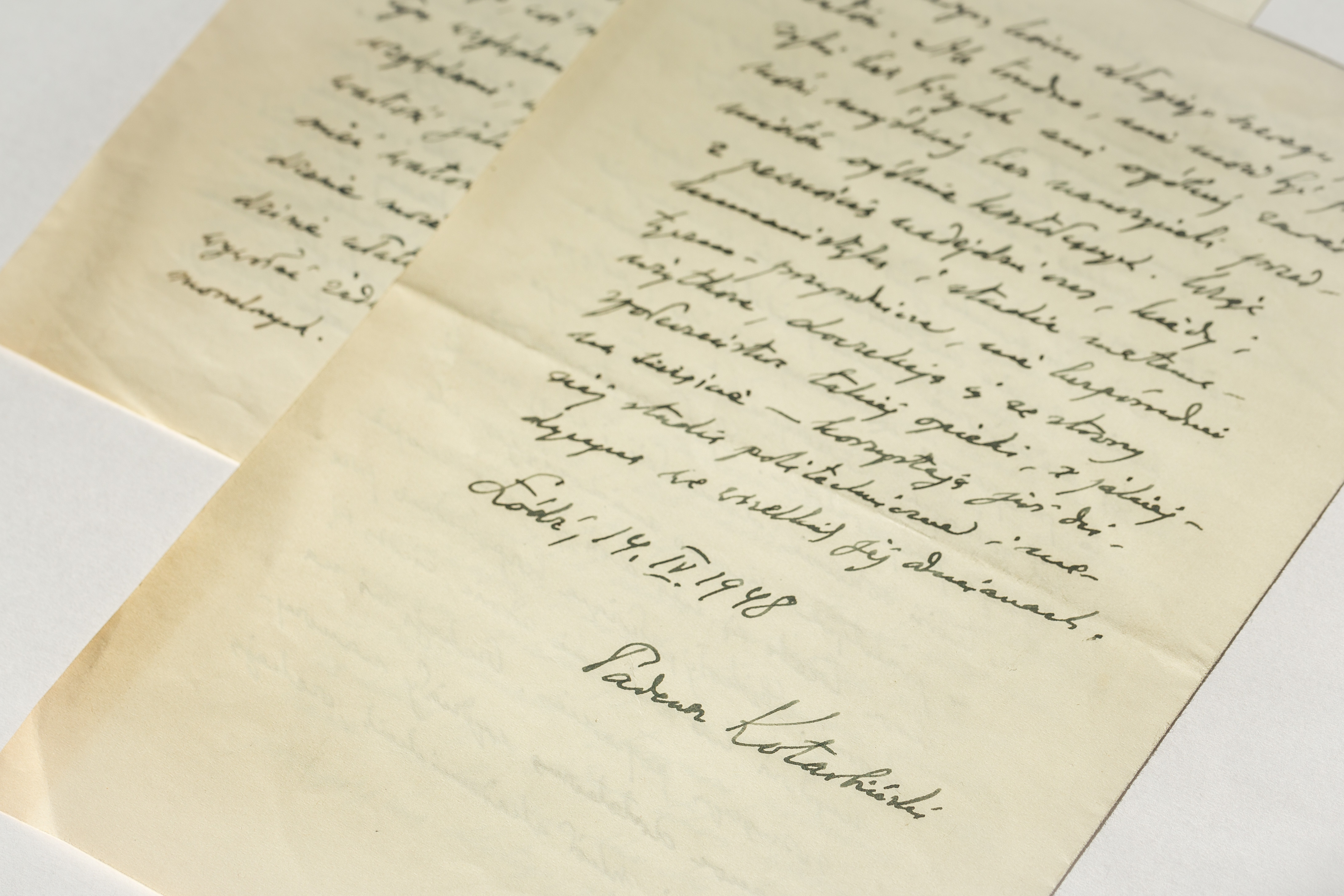
- Manuscript of the article "a note on the value of science"
- Manuscript of a statement by rector Tadeusz Kotarbiński published in the "Three years of work" issue of bratnia pomoc, Lodz, april 1948, p. 3-4
- The memorial prize of the first rector of the University of Lodz professor Tadeusz Kotarbiński for an outstanding piece of work in the field of humanities
- A Note on the Value of Science

A Note on the Value of Science
An essay by Prof. Tadeusz Kotarbiński, written in 1948 on the occasion of the founding of the University of Lodz’s banner and the creation of its motto.
Tadeusz Kotarbiński: philosopher, teacher, the first rector of the University of Lodz
Tadeusz Kotarbiński was a philosopher, an alumnus of the University of Lviv, a pupil of the eminent scholar and brilliant teacher Kazimierz Twardowski. His career as an academic lecturer was associated with the University of Warsaw, where he was active before and during the war in secret university lectures.
Professor Kotarbiński's scientific interests were focused on various philosophical issues, especially the problems of logic, praxeology and ethics. As a university lecturer, he was an outstanding teacher who knew how to get his students familiar the secrets of logical and philosophical knowledge.

After the Second World War, Professor Tadeusz Kotarbiński (born in 1886) was appointed the First Rector of the University of Lodz. Thanks to his efforts the new university achieved a significant position after the war. The new university brought together a large number of important scholars and became a place of study for the multitude of young people who, after the years of occupation, were provided with the opportunities for higher education.
In defence of University values
The 1940s were the years of rebuilding Poland after the devastation of the war, but also a time of serious internal conflicts, as a significant part of the society did not accept the new system, which was a system increasingly alien to the democratic one.
At the universities, too, there was a struggle to maintain autonomy and independence from Marxist ideology. At the newly established University of Lodz, the Rector – Professor Tadeusz Kotarbiński, who was supported by a significant number of professors and opposition-minded students, was at the forefront of this resistance. They fought for the preservation of traditional academic freedoms, as well as for not succumbing to the pressures of ideology. Professor Kotarbiński was a declared freethinker. He wanted not only to resist the dogmatic Marxism introduced at that time, but also to resist the pressure of the Catholic Church.
Veritas et libertas (truth and freedom)
As a Rector, Prof. Tadeusz Kotarbiński defended not only the autonomy of the university, but also the young people, who in many cases were the subject of political repression. It was therefore natural for him to work closely with the students and student organisations as a mentor and an educator.
At the University of Lodz, Student Science Club of Lawyers and Economists was the centre of student resistance. Members of the club initiated a fundraiser for a university banner in 1946. They suggested the slogan 'Truth and Freedom' should be written on it. These words were taken from a speech by Professor Tadeusz Kotarbiński, during which he said:
"Truth and Freedom – these are the university's flagship slogans".
The gift, donated by the students, was presented to the Rector by a delegation from the self-help organisation Bratnia Pomoc. The ceremony took place on 14 March 1948. On its occasion, Bratnia Pomoc published an issue,"Three Years of Work", which included Professor Kotarbiński’s article on the value, relevance and significance of science.
The significance of science lies not so much in satisfying curiosity
and fine-tuning intellects; nor does it lie in its affinity with art
in shaping refinement to the effect that both are frequently
mentioned in the same breath, though not directly comparable
in repute. The significance of science lies in being the essential
and indispensable grooming of the resourceful household and the
technology at its disposal, providing the protection against illness
and premature demise, and the defense against social threats,
in particular against the failure to lead an honourable existence
In the article, Prof. Kotarbiński talks about science, its value and importance both in practical terms (engineering, medicine) and the cognitive importance of educating human minds. While valuing the role of science in influencing economic and social well-being, Professor Kotarbiński also points to the importance of sciences such as the humanities and natural sciences. These disciplines have a significant impact on intellectual preparation and introduction to culture. He recognises that seeing science only from the perspective of instrumental benefits seems to put these disciplines somewhat in the background as having less immediate effects.
Manuscript of the article "a note on the value of science"
University of Lodz received the original manuscript of the aforementioned article in 2020. It was written on the occasion of the founding the University of Lodz banner in 1948 and the creation of the university's motto. The contributor to the document is the well-known economist Prof. Antoni Rajkiewicz from Warsaw, who was a student at the University of Lodz when Prof. Kotarbiński's article was written. After almost 75 years, Prof Rajkiewicz did not forget his home university and handed over this extremely valuable text to Prof Elżbieta Żądzińska, Rector of the University of Lodz.

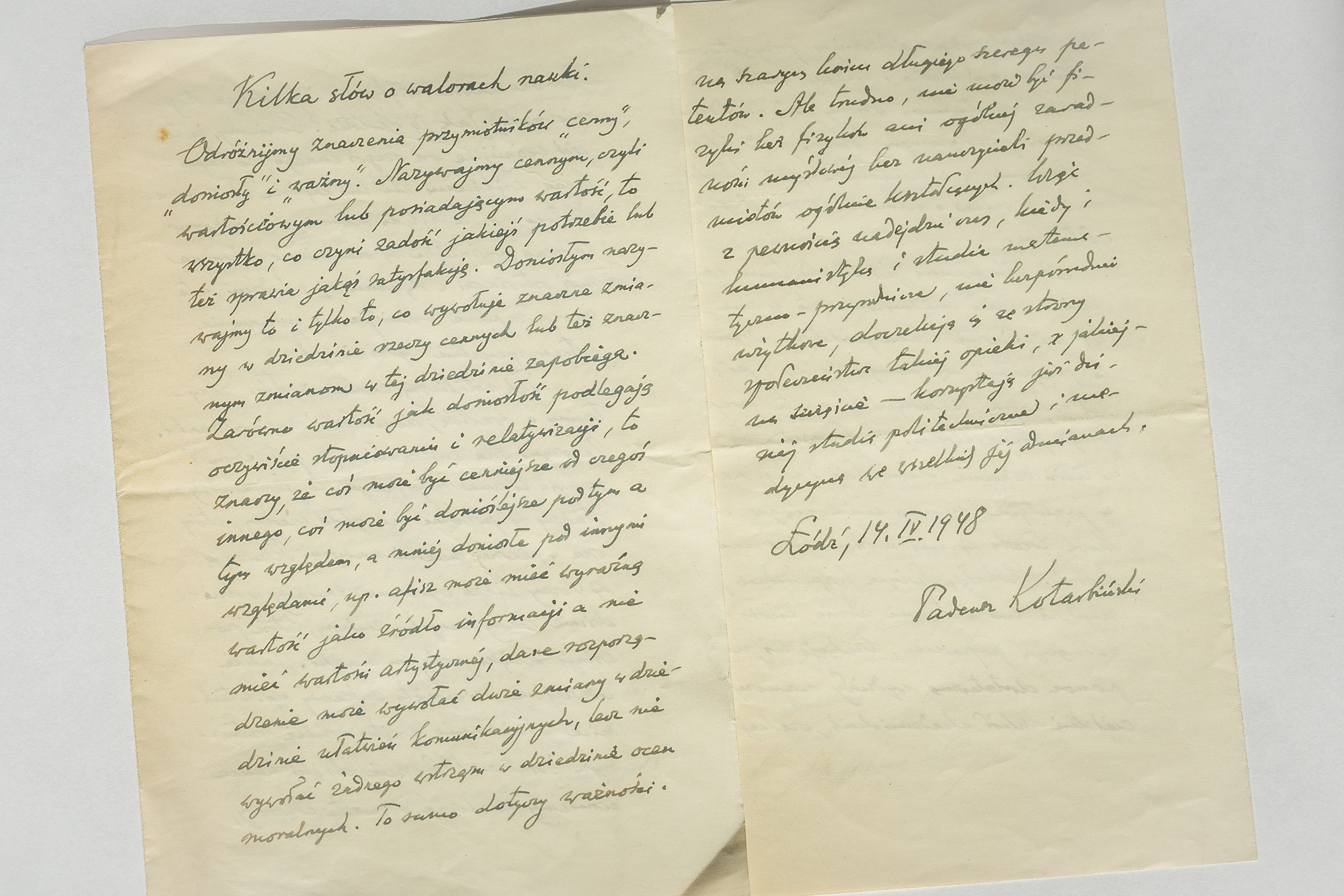
Manuscript of a statement by rector Tadeusz Kotarbiński published in the "Three years of work" issue of bratnia pomoc, Lodz, april 1948, p. 3-4
Let us make a clear distinction between the adjectives “valuable,” “momentous” and “significant.” Valuable is of value, precious; anything that feeds a need or brings satisfaction. Momentous is that - and only that - which brings about notable changes to valuable things or pre- vents such changes for that matter. Naturally, value and momentousness are gradable and relative. A thing may be more valuable than another; something may be more momentous in certain aspects and less momentous in others; for instance, a poster may carry significant informative value, but precious little artistic one; similarly, a regulation may instigate substantial alterations in transportation facilities, but hold no effect whatsoever when it comes to moral judgement. The same applies to significance. It is always relative and gradable. How so? We can say that a thing is more significant than another if it prevents or eradicates a greater evil. To take an example, public health protection schemes put greater significance on vaccinations than maintaining distance between people, while the latter is in turn more significant than consuming specially designated meals.
Having thus determined the meaning of these key words, let us ponder over the value, momentousness and significance of science. It is beyond question that science can be put to use, pay heed to various needs and bring tremendous satisfaction. Suffice it to say that science can satisfy the hunger for knowledge. Advances in scientific research result in substantial changes to things of value. What striking headway has been made, for instance, in the field of artificial lighting, both in our homes and in the streets! Science has also made it possible to combat diseases previously unrecognisable, inexplicable and incurable. Were it not a fact, then – though it certainly is – that science successfully aids in confronting a variety of threats (to name for instance, the application of probability theory to serve all sorts of insurance systems and companies), it would suffice to invoke the aforementioned advances in medicine in order to hail science as a very significant factor indeed.
That being said, there are still numerous voices that diminish the value of science as such, on account of the fact that it demonstrates great negative momentousness. Science has destroyed the edifice of delusions that pervade certain world views, and has shaken the balance of naive souls that was based on these delusional views. It has driven humanity further and further away from our natural state and therefore weakened our direct immunity to the forces of nature inherited from our animal ancestors. It has continually provided mankind with more and more devastating means of waging wars, handing in such weapons to men of dubious moral stance and resentful of each other. The result is impending disaster of unpredictable proportions...
All of the above is the sad truth, but numerous beneficial effects of science could be listed in retort, as the corollary of the previous statements. Moreover, positive changes in the psychical constitution of people of science could be rightly lauded. Their minds become more fertile, their thoughts wiser, tastes more refined, the conversations they hold turn out more invigorating, insistent and uplifting. It is the very nature of intellectual work that causes these changes; much more so if it is labour of love, working in a team of devoted enthusiasts of science, open minds eager to embrace research. It is like a mental orchestra, no less spiritual, but infinitely more intelligent. Still, none of these laudations, however justified, can silence the critics that verbalise the uses of scientific advances for destructive and devious purposes.
It appears that this dramatic dispute can be resolved with the help of two arguments, each perfectly sufficient on its own. Firstly, nothing can hold back science in its drive forward. Once unleashed, it is unstoppable. Science has become the passion and infatuation of the high-foreheaded human. There is no turning back to naivety. Childhood is gone forever, only maturity and dotage are left. There is no static balance anymore, only stagnation and apathy. Secondly, a society which would fall behind in terms of mental development, one which would renounce scientificity or merely dwindle in competitive re- search, would sooner or later (presumably sooner) end up in servitude, of ancillary nature to other societies, those better developed scientifically and therefore more operational.
Such, therefore, is the role of science and the institutions that foster it. The significance of science lies not so much in satisfying curiosity and fine-tuning intellects; nor does it lie in its affinity with art in shaping refinement to the effect that both are frequently mentioned in the same breath, though not directly comparable in repute. The significance of science lies in being the essential and indispensable grooming of the resourceful household and the technology at its disposal, providing the protection against illness and premature demise, and the defence against social threats, in particular against the failure to lead an honourable existence.
Seeing as science is thus of prime significance, teaching it is equally significant. While science produces tools to counter evil forces, teaching is in essence the pro- duction of producers. In theory, our society appreciates the momentousness and significance of science, but in practice it falls short of providing it with the support it needs. Schools, which directly serve the industry or health protection, enjoy constant sustenance. However, the teaching faculties in academia are behind everyone else in the queue for adequate backing. Well, just as there is no physics without physicists, there is no general mental resourcefulness without general education providers. I am certain that the time will come for the humanities, mathematical and natural sciences to enjoy the kind of well-earned societal support that is now the preserve of technical sciences and medicine.
Lodz, 14 April 1948
The memorial prize of the first rector of the University of Lodz professor Tadeusz Kotarbiński for an outstanding piece of work in the field of humanities
Prof. Tadeusz Kotarbiński played a huge role not only in the first years of the existence of the University of Lodz. He set the direction for the development of the university, shaped a model of scientific work that for the next decades will be a point of reference for the entire academic community of our University.
Continuing Professor Kotarbiński's humanistic reflection, in 2015, on the occasion of 70th anniversary of the university, the Memorial Prize of the First Rector of the University of Lodz Professor Tadeusz Kotarbiński for outstanding piece of work in the field of humanities was established uni.lodz.pl/en/tadeusz-kotarbinski-memorial-prize
The award is a nationwide distinction that has gained a great reputation among Polish scientists. The competition makes it possible to show the value and diversity of works in the field of humanities created in Poland to a wider audience.
Source: Prof. Ryszard Kleszcz, Member of the Competition Jury, Faculty of Philosophy and History of the University of Lodz; Paweł Spodenkiewicz, University of Lodz Library
Edit: Communications and PR Centre, University of Lodz
UNIVERSITY OF LODZ
Narutowicza 68, 90-136 LODZ
fax: 00 48 42/665 57 71, 00 48 42/635 40 43
NIP: 724 000 32 43



Projekt Multiportalu UŁ współfinansowany z funduszy Unii Europejskiej w ramach konkursu NCBR